
What is Ola
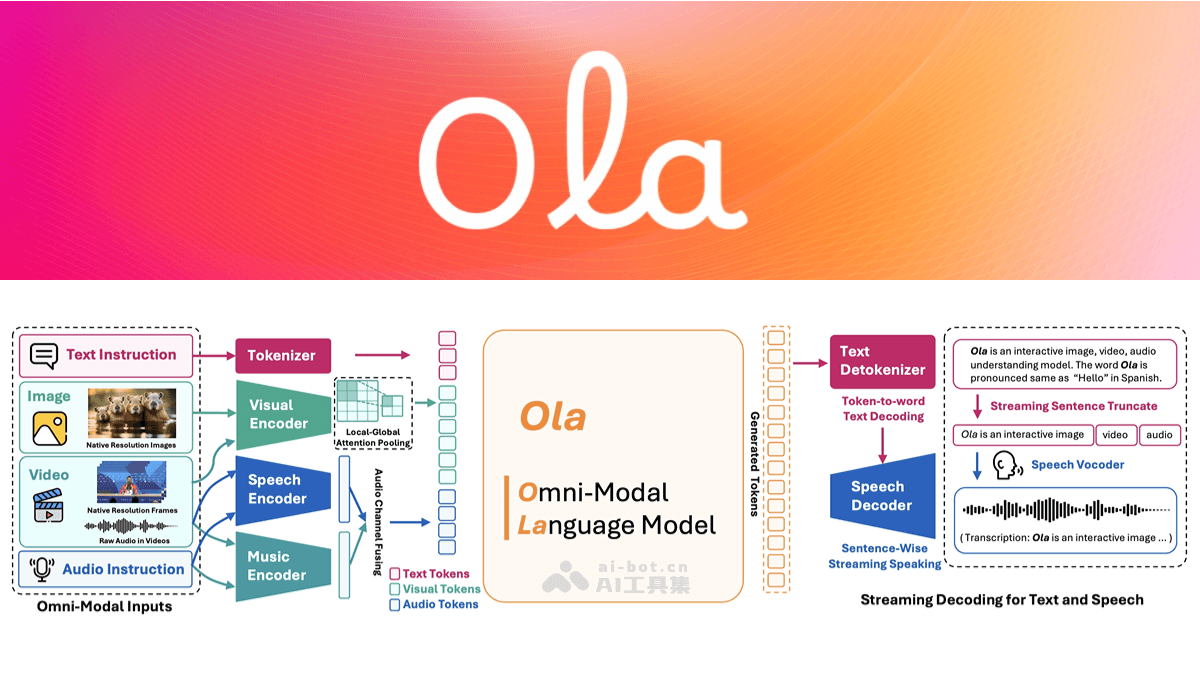
Ola is a full-modal language model jointly developed by Tsinghua University, the Tencent Hunyuan research team, and the S-Lab at the National University of Singapore. Through a progressive modality alignment strategy, it gradually expands the modalities supported by the language model, starting with images and text, then introducing speech and video data, to achieve understanding of multiple modalities. Ola's architecture supports full-modal input, including text, images, video, and audio, and can process these inputs simultaneously. Ola has designed a sentence-by-sentence decoding scheme for streaming speech generation, improving the interactive experience.
Ola's main features
- Multimodal understanding: Supports input in four modalities: text, images, video, and audio, can process these inputs simultaneously, and performs excellently in understanding tasks.
- Real-time streaming decoding: Supports user-friendly real-time streaming decoding, can be used for text and speech generation, and provides a smooth interactive experience.
- Progressive modality alignment: By gradually expanding the modalities supported by the language model, starting with images and text, then introducing speech and video data, it achieves understanding of multiple modalities.
- High-performance performance: Has outstanding performance in multimodal benchmarks, surpassing existing open-source full-modal LLMs, and is comparable to specialized single-modal models on some tasks.
Ola's technical principles
- Progressive modality alignment strategy: Ola's training process starts from the most basic modalities (images and text), then gradually introduces speech data (connecting language and audio knowledge) as well as video data (connecting all modalities). This progressive learning method enables the model to gradually expand its modality understanding capability, keeps the scale of cross-modal alignment data relatively small, and reduces the difficulty and cost of developing a full-modal model from an existing vision-language model.
- Multimodal input and real-time streaming decoding: Ola supports full-modal input, including text, images, video, and audio, and can process these inputs simultaneously. Ola has designed a sentence-by-sentence decoding scheme for streaming speech generation, supporting a user-friendly real-time interactive experience.
- Efficient use of cross-modal data: To better capture the relationships between modalities, Ola's training data includes traditional visual and audio data, and also designs cross-modal video-audio data. The data builds bridges through the visual and audio information in videos, helping the model learn the intrinsic connections between modalities.
- High-performance architecture design: Ola's architecture supports efficient multimodal processing, including a visual encoder, an audio encoder, a text decoder, and a speech decoder. Through techniques such as Local-Global Attention Pooling, the model can better fuse features from different modalities.
Ola's project address
- Project official website:https://ola-omni.github.io/
- Github repository:https://github.com/Ola-Omni/Ola
- arXiv technical paper:https://arxiv.org/pdf/2502.04328
Ola's application scenarios
- Intelligent voice interaction: Ola can serve as an intelligent voice assistant, supporting speech recognition and generation in multiple languages. Users can interact with Ola through voice commands to obtain information, solve problems, or complete tasks.
- Education and learning: Ola can serve as an English practice tool, helping users practice speaking and correct pronunciation and grammar errors. It can provide encyclopedia knowledge Q&A, covering multiple learning scenarios from K12 to the workplace.
- Travel and navigation: Ola can serve as a travel guide, providing users with introductions to the history and cultural background of scenic areas, and recommending travel guides and dining establishments.
- Emotional Companionship: Ola can provide emotional chat services, helping users relieve stress and offering psychological support.
- Life Services: Ola can recommend nearby dining merchants, provide schedule arrangements, travel navigation, and other services.