
What is OAgents
OAgents is an open-source foundational Agent framework launched by OPPO PersonalAI Lab. The framework is based on standardized evaluation protocols and modular design, advancing research on Agent frameworks. Based on systematic empirical research, OAgents analyzes the impact of different design choices of key Agent components (such as planning, tool use, memory, etc.) on performance, and introduces a more robust evaluation protocol. The framework achieved the highest average score of 73.93% on the GAIA benchmark, performing excellently across different task levels, demonstrating the effectiveness and robustness of the design. OAgents supports the integration of multiple Agent components, providing a solid foundation for future research.
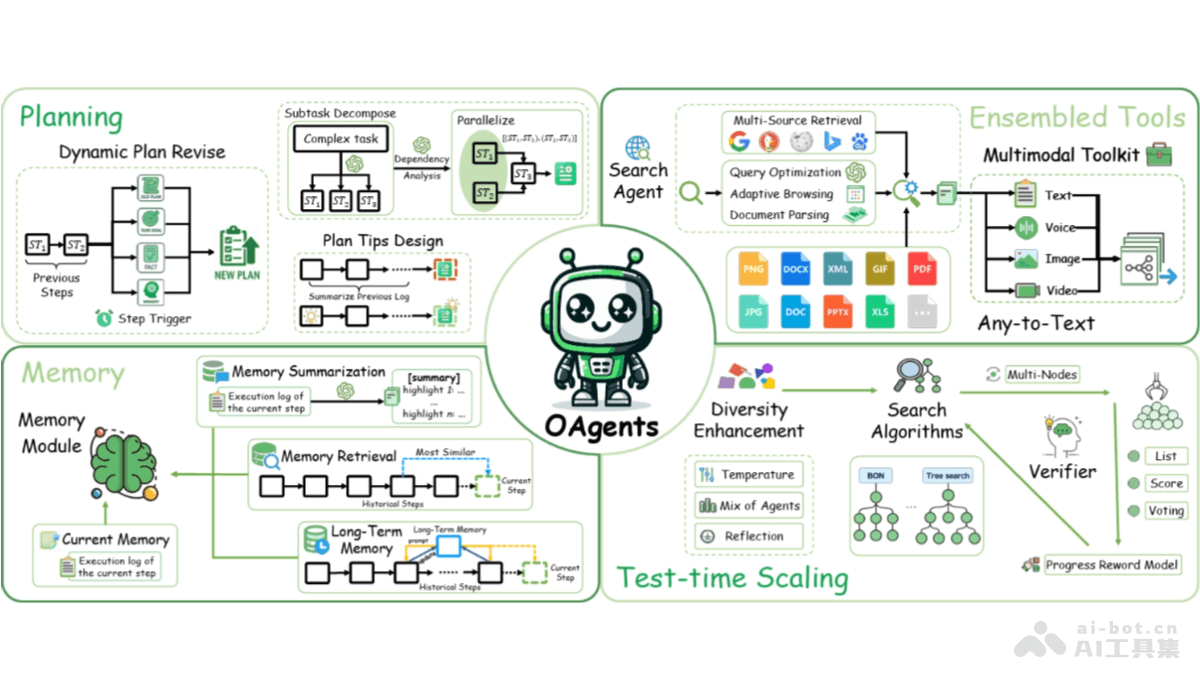
Main features of OAgents
- Multimodal tool integration: OAgents integrates multimodal tools that process text, speech, images, and video, interacting directly with multimodal inputs to enhance the acquisition and interpretation of factual information in complex real-world scenarios.
- Optimized search Agent: Based on optimized multi-source retrieval, query optimization, and a minimalist browsing architecture, OAgents can effectively conduct web searches, expand knowledge boundaries, and provide more accurate information support for complex tasks.
- Dynamic planning and task decomposition: Using a dynamic planning mechanism, complex tasks are decomposed into executable subtasks, and plans are dynamically adjusted based on real-time observations, improving the management capability and reasoning efficiency for complex tasks.
- Memory-enhanced knowledge system: OAgents builds a hierarchical memory module, including current memory, memory summaries, vectorized retrieval, and long-term memory, enhancing the Agent's cognitive capabilities and helping the Agent perceive, reason, and make decisions more effectively in complex environments.
- Test-time scaling strategies: OAgents uses scaling strategies during the testing phase, such as diversity enhancement, optimization, and reward modeling, to dynamically adjust the decision-making process, improving the Agent's adaptability and exploration capability and enhancing overall performance.
Technical principles of OAgents
- Multimodal tool principles: OAgents' multimodal tools convert non-text content into text descriptions and perform cross-modal semantic parsing synchronously, achieving direct interaction with and understanding of multimodal inputs. The formula is expressed as: Response = A(xtext,Timage(I),Tvideo(V )), where A is the Agent function, xtext is the text input, and Timage and Tvideo are the tool functions for images and videos, respectively.
- Search Agentprinciples: OAgents' search Agent framework integrates commercial APIs and archival systems to achieve multi-source retrieval; performs closed-loop optimized queries based on semantic calibration and morphological expansion; and is simplified into three atomic functions—search, visit, and read—reducing complexity.
- Dynamic planning principles: OAgents' dynamic planning module generates high-level plans, decomposes tasks into executable steps, and periodically revises plans based on new observations during execution, adapting to dynamic environments. OAgents adopts hierarchical task decomposition, builds dependency graphs, and dynamically schedules executable subtasks.
- Memory enhancement principles: OAgents' memory module stores short-term information based on current memory, extracts high-value knowledge using memory summaries, quickly retrieves relevant historical memories based on vectorized retrieval, and integrates historical insights using long-term memory to optimize task execution.
- Test-time scaling principles: OAgents' test-time scaling module mixes sampling strategies to enhance diversity, optimizes decision paths based on process-based reward functions, and uses a real-time reflection mechanism for adaptive problem solving.
OAgents project address
- GitHub repository:https://github.com/OPPO-PersonalAI/OAgents
- arXiv technical papers:https://arxiv.org/pdf/2506.15741
Application scenarios of OAgents
- Intelligent customer service: Quickly and accurately answer customer questions, provide personalized solutions, handle complex customer inquiries, and improve customer satisfaction.
- Educational tutoring: Provide students with personalized learning plans, dynamically adjust teaching content based on learning progress and feedback, process a variety of learning materials, and provide a rich learning experience.
- Medical consultation: Assist doctors in medical record analysis, diagnostic suggestions, and treatment plan formulation, obtain the latest medical research and clinical guidelines, and provide data-driven decision support.
- Intelligent office assistant: Assist users in scheduling appointments, writing reports, and organizing meeting minutes, remember users' preferences and habits, and provide personalized office support.
- Smart home control: Integrate a variety of smart home devices, control devices based on voice or text instructions, realize automated scenarios, and provide a natural interaction experience.