
What is O1-CODER
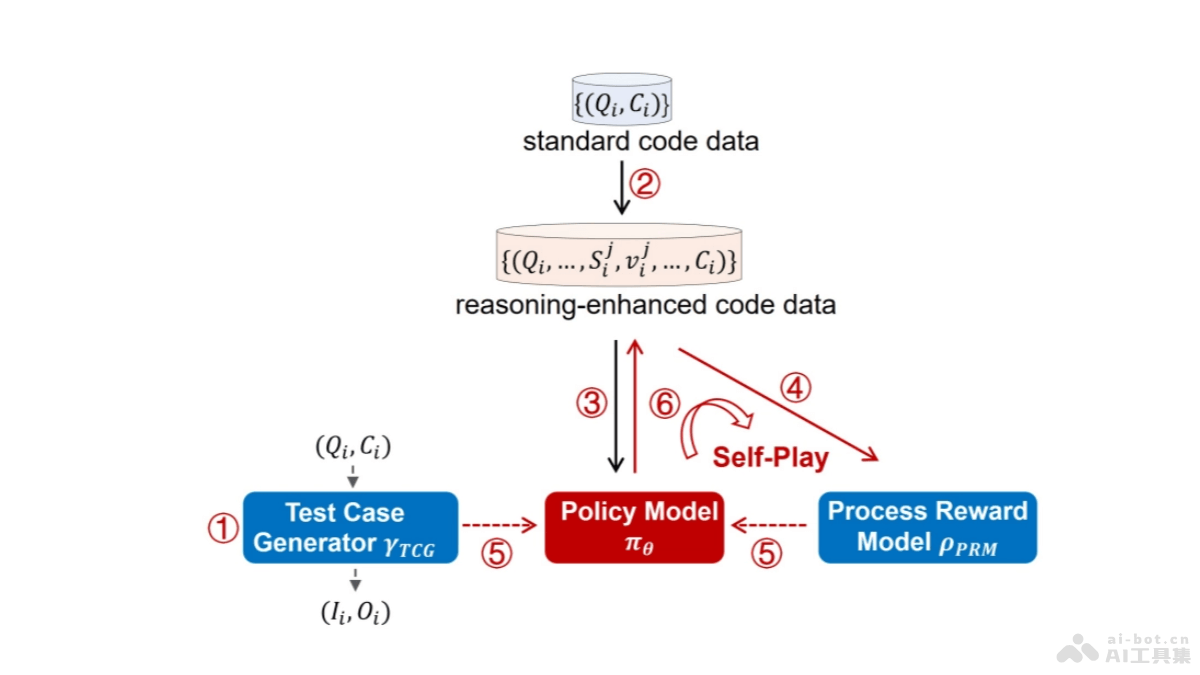
O1-CODER is an open-source project launched by a research team at Beijing Jiaotong University, aiming to replicate OpenAI's O1 model, focusing on coding tasks. O1-CODER combines reinforcement learning (RL) and Monte Carlo Tree Search (MCTS) technologies to enhance the model's System-2 thinking ability, resulting in a more cautious, logical, and step-by-step problem-solving process. The O1-CODER framework includes training a test case generator (TCG) to standardize code testing, using MCTS to generate code data containing reasoning processes, and iteratively fine-tuning a policy model to generate pseudocode and complete code. All source code, datasets, and models have been open-sourced on GitHub.
Main Features of O1-CODER
- Coding Task Focus: O1-CODER focuses on programming coding tasks, using System-2 thinking to improve coding quality and logic.
- Combination of Reinforcement Learning and Monte Carlo Tree Search: By combining reinforcement learning (RL) and Monte Carlo Tree Search (MCTS), the model can self-generate reasoning data and continuously optimize coding strategies.
- Test Case Generation: Training a test case generator (TCG) to automatically produce test cases, standardize code testing, and provide result reward signals.
- Pseudocode Generation: The model first generates pseudocode, then generates the final executable code based on the pseudocode, enhancing the adaptability and controllable granularity of the code.
- Process Reward Model: Initialize and fine-tune a process reward model (PRM) to evaluate the quality of intermediate reasoning steps.
Technical Principles of O1-CODER
- System 2 Thinking: O1-CODER is based on System-2 thinking, which requires a cautious, logical, and step-by-step approach to problem-solving, suitable for complex tasks such as coding.
- Reinforcement Learning (RL): Using RL's exploration ability to discover new strategies, combined with pretraining, to achieve synergy between learning and search.
- Monte Carlo Tree Search (MCTS): MCTS is used to generate code data containing reasoning processes, simulating different action paths to evaluate and optimize code generation strategies.
- Test Case Generator (TCG): TCG automatically generates test cases based on problems and standard code, providing feedback signals for RL to help evaluate the correctness of generated code.
- Pseudocode Reasoning: Using pseudocode prompts to guide the model in deep reasoning, treating pseudocode as a "cognitive tool" in the reasoning process, enhancing the model's logical reasoning ability.
- Process Reward Model (PRM): PRM evaluates the quality of each reasoning step, providing intermediate step reward signals for RL, guiding the model toward better solutions.
Project Address of O1-CODER
- GitHub Repository:https://github.com/ADaM-BJTU/O1-CODER
- arXiv Technical Paper:https://arxiv.org/pdf/2412.00154
Application Scenarios of O1-CODER
- Automated Code Generation: Automatically generate code directly based on programming problems, reducing manual coding workload.
- Code Quality Improvement: Improve code readability and maintainability based on generating pseudocode and step-by-step refinement.
- Education and Learning: As a teaching tool, helping students understand the problem-solving process and logical reasoning of programming problems.
- Software Testing: Automatically generate test cases for software testing and verification, improving software quality.
- Programming Competitions and Practice: In programming contests or practice, serve as an auxiliary tool to help contestants quickly generate and optimize solutions.