
What is NVILA
NVILA is a series of vision-language models introduced by NVIDIA that balance efficiency and accuracy. The model uses an "expand-then-compress" strategy to effectively process high-resolution images and long videos. NVILA performs systematic optimizations during the training and fine-tuning stages, reducing resource consumption, and achieves or surpasses the accuracy of current leading models on multiple image and video benchmarks, including various top open-source models such as Qwen2VL, InternVL, and Pixtral, as well as proprietary models like GPT-4o and Gemini. NVILA introduces new capabilities such as temporal localization, robot navigation, and medical imaging, broadening its application potential across multiple domains.
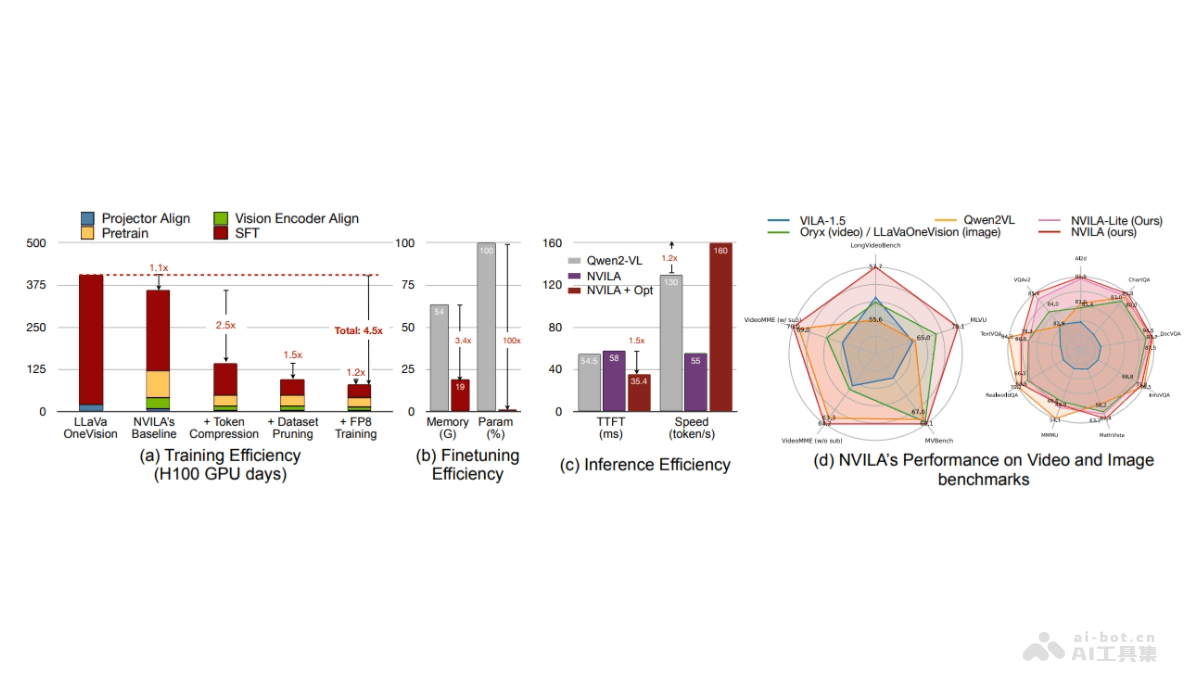
NVILA's Main Features
- High-Resolution Image and Long Video Processing: NVILA can efficiently process high-resolution images and long videos while maintaining high accuracy.
- Efficiency Optimization: Throughout its entire lifecycle, from training to deployment, NVILA has undergone systematic efficiency optimization.
- Temporal Localization: Supports temporal localization functionality in videos.
- Robot Navigation: Serves as the foundation for robot navigation, enabling real-time deployment.
- Medical Multimodal Applications: Integrates multiple expert models in the medical field to improve the accuracy of diagnosis and decision-making.
NVILA's Technical Principles
- "Expand-Compress" Method: First enhances spatial and temporal resolution, then compresses visual tokens to balance accuracy and efficiency.
- Dynamic S2: Adapts to images of different aspect ratios and extracts multi-scale high-resolution features.
- FP8 Mixed-Precision Training: Accelerates model training while maintaining accuracy.
- Dataset Pruning: Uses the DeltaLoss method to filter training data, removing samples that are too easy or too difficult.
- Quantization Techniques: Uses W8A8 and W4A16 quantization techniques to improve model deployment efficiency.
- Parameter-Efficient Fine-Tuning: Selectively fine-tunes different parts of the model for different downstream tasks, reducing memory requirements.
NVILA's Project Address
- GitHub Repository:https://github.com/NVlabs/VILA(to be open-sourced soon)
- HuggingFace Model Library:https://huggingface.co/collections/Efficient-Large-Model/nvila(to be open-sourced soon)
- arXiv Technical Paper:https://arxiv.org/pdf/2412.04468
NVILA's Application Scenarios
- Image and Video Understanding: Used in the analysis of image and video content, including visual question answering, image classification, and video content summarization.
- Robot Navigation: In the robotics field, it serves as the brain for vision-language navigation, helping robots navigate and make decisions based on visual information and language instructions.
- Medical Imaging: Assists in medical imaging analysis and integrates expert models to improve diagnostic accuracy, for example in applications such as pathological image analysis, radiological image segmentation, and classification.
- Temporal Localization: Handles temporal localization problems in video data, which is crucial for applications such as video content retrieval and event detection.
- Multimodal Interaction: In applications that require combining visual and language information for interaction, such as intelligent assistants and customer service robots, it provides a richer and more accurate interactive experience.