
What is NIM
NIM (NVIDIA Inference Microservices) is a microservices solution platform launched by NVIDIA for rapidly deploying accelerated generative AI inference. NIM provides prebuilt, optimized inference microservices that support deployment of the latest AI models on any NVIDIA-accelerated infrastructure, such as cloud, data center, workstation, and edge devices. NIM combines the ease of use of hosted APIs with the security and flexibility of self-hosted models, delivers low-latency, high-throughput inference performance, and supports fine-grained models. NIM's enterprise-grade features, rapid deployment capabilities, and broad model support make it an ideal choice for driving the rapid implementation of enterprise AI applications.
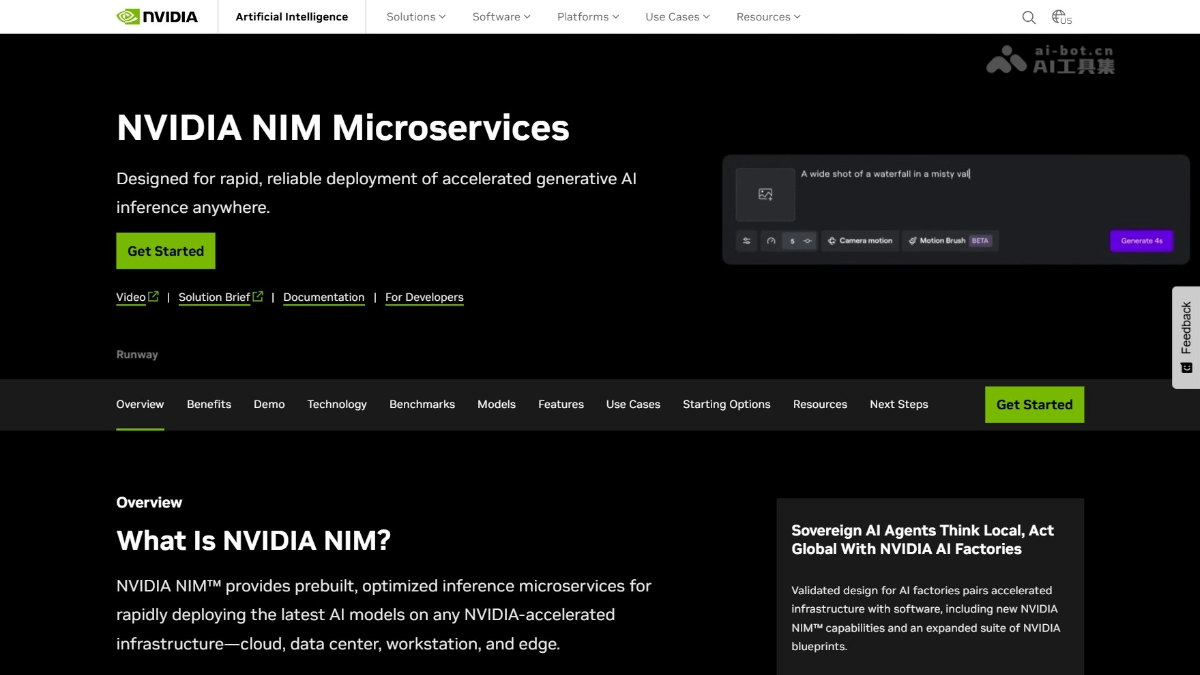
NIM's main features
-
Prebuilt and optimized microservices: Provides pre-optimized inference microservices for the latest AI models, supports rapid deployment, and reduces development and deployment time.
-
High-performance inference: Through NVIDIA's optimization engines (such as TensorRT, TensorRT-LLM, etc.), it achieves low-latency, high-throughput AI inference and improves model operating efficiency.
-
Enterprise-grade features: Supports enterprise-grade deployment, with high security, manageability, and continuous update capabilities, ensuring stable operation of models in production environments.
-
Flexible deployment options: Can be deployed in different environments such as cloud, data center, workstation, and edge devices, supports Kubernetes and cloud service provider environments, and enables seamless scaling.
-
Industry-standard API: Provides standard API interfaces, making it easy to integrate with existing enterprise systems and applications and simplifying the development process.
-
Broad model support: Supports a variety of large language models (LLMs) and customized models, including community-optimized models and user-defined models.
-
Simplified development and deployment: Provides full-process support from prototyping to production deployment, including free API access, development tools, and detailed deployment guides.
-
Scalability and observability: Supports large-scale deployment through Kubernetes and provides detailed performance monitoring and observability metrics for easy management and optimization.
How to use NIM
- Obtain access permissions:
-
Join the NVIDIA Developer Program: Through the NVIDIA Developer Program, users can freely access NIM API endpoints for development and testing.
-
Choose a deployment method:
-
Use NVIDIA-hosted API endpoints: Suitable for rapid prototyping, with no need for self-deployment.
-
Download and self-host NIM microservices: Suitable for production environments, supporting deployment on local data centers, cloud platforms, or edge devices.
-
-
- Choose models and microservices: Choose appropriate models and microservices according to requirements, such as inference, retrieval, multimodal, etc.
- Deploy NIM microservices:
-
Use NVIDIA-hosted APIs:Call directly through the API endpoints provided by NVIDIA, with no need for self-deployment.
-
Self-hosted deployment:
-
Download the NIM microservice container: Obtain prebuilt container images from NVIDIA's official channels.
-
Configure infrastructure: Ensure the target environment supports NVIDIA GPU acceleration (such as RTX, A100, H100, etc.).
-
Deploy Container: Deploy the NIM microservice container with Docker or Kubernetes.
- Configure Microservice: Configure the microservice parameters according to requirements, such as model path, inference engine, etc.
-
-
- Run Inference:
- Call the Model via API: Use standard HTTP requests to call the NIM microservice.
- Integrate into Applications: Integrate the NIM microservice API endpoints into existing applications to achieve seamless interaction.
-
Monitoring and Optimization: Use the monitoring tools provided by NVIDIA to optimize resource allocation and ensure inference performance and efficiency.
-
Scaling and Management: Implement automatic scaling and high availability by deploying in a Kubernetes environment, and continuously optimize with NVIDIA enterprise support.
NIM official website address
- Official Website Address:https://www.nvidia.com/en-us/ai-data-science/products/nim-microservices/
NIM Application Scenarios
-
AI Virtual Assistant: Used to build intelligent customer service, chatbots, etc., improving customer experience and optimizing business processes.
-
Document Intelligence: The platform can process and analyze document content, enabling automated document summarization, classification, and retrieval.
-
Personalized Shopping: Provide personalized recommendations and shopping experiences based on user behavior and preferences.
-
3D Product Configurator: The platform supports creating interactive 3D product visualization tools for design and display.
-
Content Generation: Quickly generate text, images, audio, and other content for creative design and content creation.