
What Is NVIDIA Nemotron Nano 2
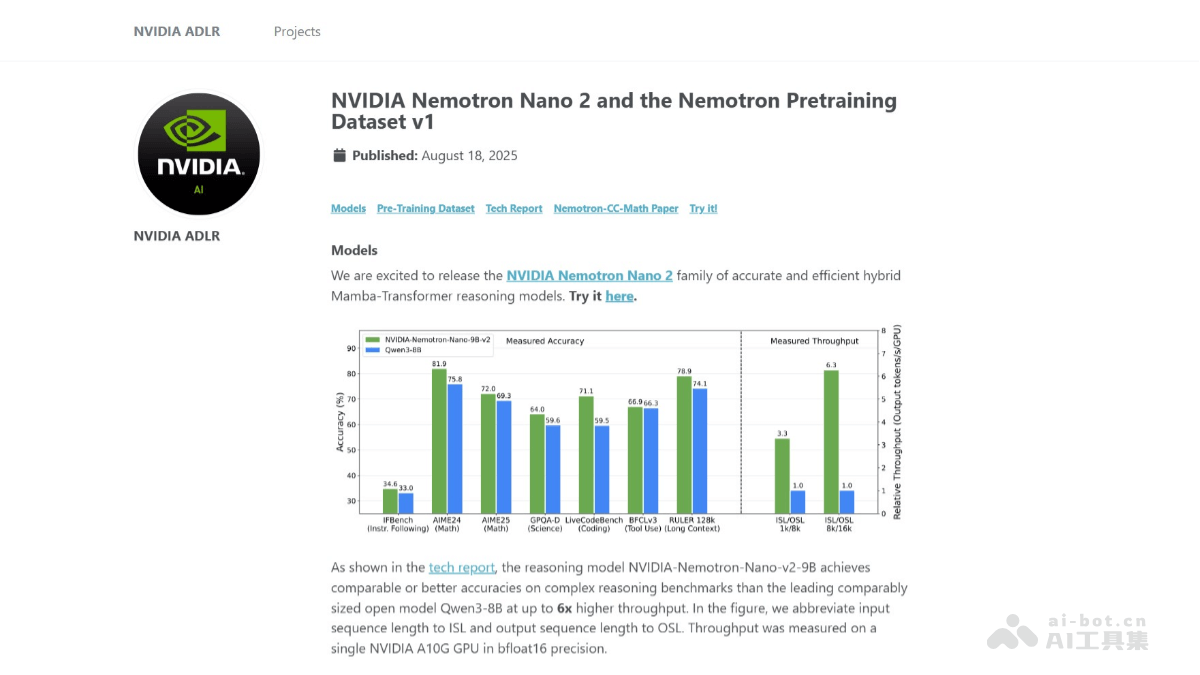
NVIDIA Nemotron Nano 2 is an efficient reasoning model launched by NVIDIA, with 9B parameters. The model is based on a hybrid Mamba-Transformer architecture, pre-trained on 20 trillion tokens, and supports a 128k context length. Compared with Qwen3-8B, inference speed is increased by 6x, with comparable or higher accuracy. The model features thinking budget control, allowing users to specify the number of reasoning tokens. NVIDIA has open-sourced the base model and most of the pre-training dataset, helping developers with further research and applications.
Main Features of NVIDIA Nemotron Nano 2
- High Throughput: NVIDIA Nemotron Nano 2 performs excellently in complex reasoning tasks, with up to 6x the throughput of Qwen3-8B.
- Long Context Support: Supports a 128k context length and can perform inference on a single NVIDIA A10G GPU, making it suitable for processing long texts and complex tasks.
- Reasoning Process Support: The model generates a reasoning trace before generating the final answer, and users can specify the model's "thinking" budget.
- Flexible Output Modes: Users can choose to skip intermediate reasoning steps and directly obtain the final answer.
- Multilingual Capabilities: The pre-training dataset contains data in multiple languages, supporting strong multilingual reasoning capabilities.
- Multi-domain Coverage: Covers data in multiple domains such as mathematics, code, academia, and STEM, making it suitable for a variety of application scenarios.
Technical Principles of NVIDIA Nemotron Nano 2
- Hybrid Mamba-Transformer Architecture: Replaces most self-attention layers in the traditional Transformer with Mamba-2 layers, significantly improving inference speed, especially when generating long reasoning chains. The Transformer layers retain some self-attention layers to maintain the model's flexibility and accuracy.
- Pre-training Process: Pre-trained on 20 trillion tokens using FP8 precision and a Warmup-Stable-Decay learning rate schedule. Through a continued pre-training long-context extension stage, the model can handle a 128k context length without reducing performance on other benchmarks.
- Post-training Optimization: Supervised fine-tuning (SFT) is used to fine-tune the model and improve its performance on specific tasks. Policy optimization improves the model's instruction-following ability. The model's preferences are optimized to better align with human preferences. Reinforcement learning from human feedback improves the model's dialogue capabilities and instruction-following ability.
- Model Compression: Based on pruning and knowledge distillation techniques, the 12B parameter base model is compressed to 9B parameters while maintaining model performance. The optimized model supports 128k token context inference on a single NVIDIA A10G GPU, significantly reducing inference costs.
- Reasoning Budget Control: Based on truncation training, the model can perform reasoning according to a user-specified "thinking" budget, avoiding unnecessary computation. Users can flexibly control the model's reasoning process and choose whether to display the reasoning process or directly obtain the final answer.
Project Address of NVIDIA Nemotron Nano 2
- Project Official Website:https://research.nvidia.com/labs/adlr/NVIDIA-Nemotron-Nano-2/
- HuggingFace Model Library:https://huggingface.co/collections/nvidia/nvidia-nemotron-689f6d6e6ead8e77dd641615
- Technical Paper:https://research.nvidia.com/labs/adlr/files/NVIDIA-Nemotron-Nano-2-Technical-Report.pdf
- Online Experience Demo:https://build.nvidia.com/nvidia/nvidia-nemotron-nano-9b-v2
Application Scenarios of NVIDIA Nemotron Nano 2
- Education: In the field of education, help students solve complex mathematics and science problems. Explain complex mathematical formulas or physical laws through step-by-step reasoning, helping students better understand and master knowledge.
- Academic Research: Researchers conduct academic research, generate detailed reasoning processes and analysis reports, and assist with paper writing and experimental design.
- Software Development: Developers generate high-quality code snippets to help quickly develop and optimize code.
- Programming Education: In programming education, the model provides code examples and explanations to help beginners better understand programming languages and algorithms.
- Customer Service: In the field of customer service, serve as a multilingual chatbot to provide efficient and accurate customer support.