
What is Open NotebookLM
Open NotebookLM is an open-source AI tool that converts PDF documents into podcast-style audio content based on the latest open-source AI models, such as Llama 3.1 405B, MeloTTS, and Bark. The tool is suitable for users who want to convert written information into an auditory format, such as students, researchers, and podcast producers. By analyzing document content, it generates natural and fluent dialogue and outputs it as MP3 files, allowing users to consume written information in an auditory way. Technically, Open NotebookLM relies on open-source large language models (LLMs) and text-to-speech (TTS) models, such as Llama 3.1 405B and MeloTTS, supports multiple languages, and provides customizable tone. Users upload PDFs through a Gradio-based interface, select a dialogue style, and generate audio.
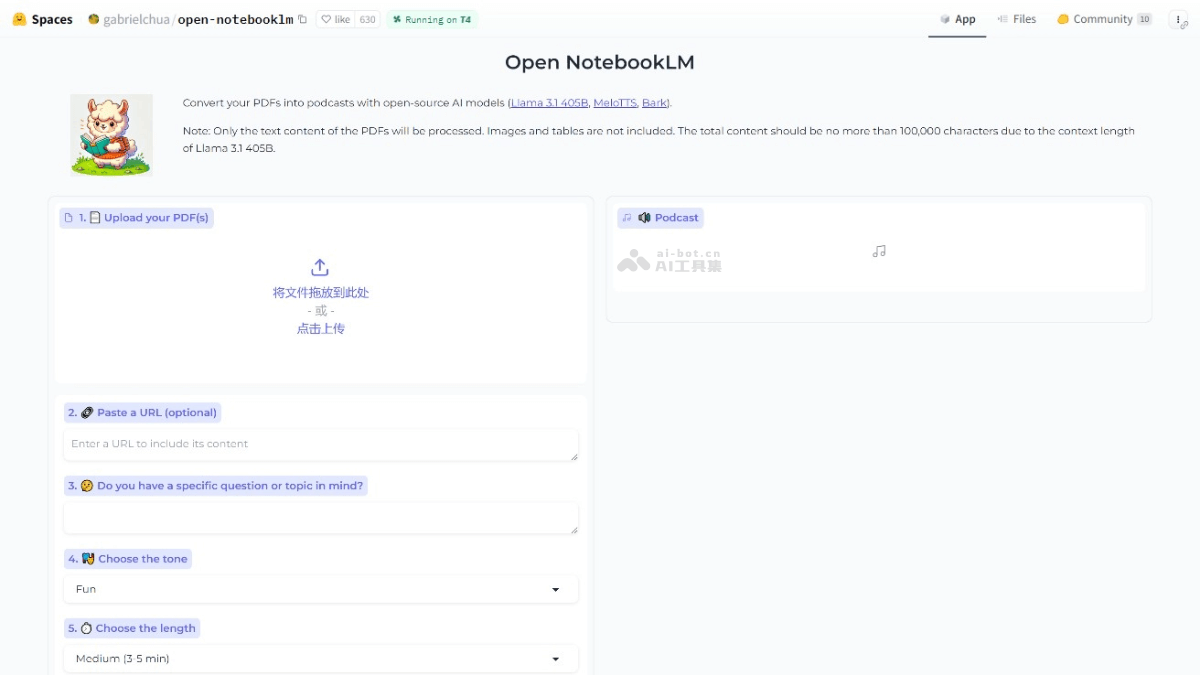
Main features of Open NotebookLM
- PDF to podcast: Users upload PDF files, and the tool converts the file content into podcast-style audio dialogue.
- Natural dialogue generation: The generated dialogue is designed to be informative while remaining entertaining and engaging.
- User-friendly interface: A simple interactive interface provided by the Gradio framework lets users easily upload and convert files.
- Multilingual support: Supports multiple languages, including Chinese, so users of different languages can use it.
- Tone customization: Users can adjust the tone of the podcast as needed, making it sound fun or formal.
- MP3 output: The converted audio is output in MP3 format, making it easy for users to play and share on various devices.
Technical principles of Open NotebookLM
- Llama 3.1 405B: Used to understand and process long text data and generate dialogue content.
- MeloTTS: Converts generated text into naturally sounding speech.
- Bark: Generates multiple audio types, including speech, music, and nonverbal communication (such as laughter and crying).
- Gradio: A Python library for creating interactive interfaces for machine learning models, used to build the user interface.
- Environment variables: Use environment variables (such as
FIREWORKS_API_KEY) to manage API keys and enhance security. - Virtual environment: Use a virtual environment to isolate project dependencies and ensure that dependency packages between different projects do not conflict with each other.
Open NotebookLM project address
- GitHub repository:https://github.com/gabrielchua/open-notebooklm
- Online demo experience:https://huggingface.co/spaces/gabrielchua/open-notebooklm
Application scenarios of Open NotebookLM
- Education and learning: Students and teachers use Open NotebookLM to convert textbooks, lecture notes, or research reports into audio podcasts, making it convenient to study while commuting or doing other things.
- Research and publishing: Researchers convert academic papers and journal articles into podcasts to quickly obtain information when they do not have time to read the full text.
- Business reports: Business analysts and consultants convert market research reports or business plan summaries into podcasts, making it convenient for clients or team members to quickly understand the key points.
- News and media: News organizations convert press releases or articles into audio content, providing listeners with a third media format besides video and text.
- Podcast production: Podcast producers use Open NotebookLM to quickly generate program drafts or convert text scripts of programs into audio content.
- Language learning: Language learners convert learning materials into audio podcasts to improve listening and pronunciation.