
What is NMT
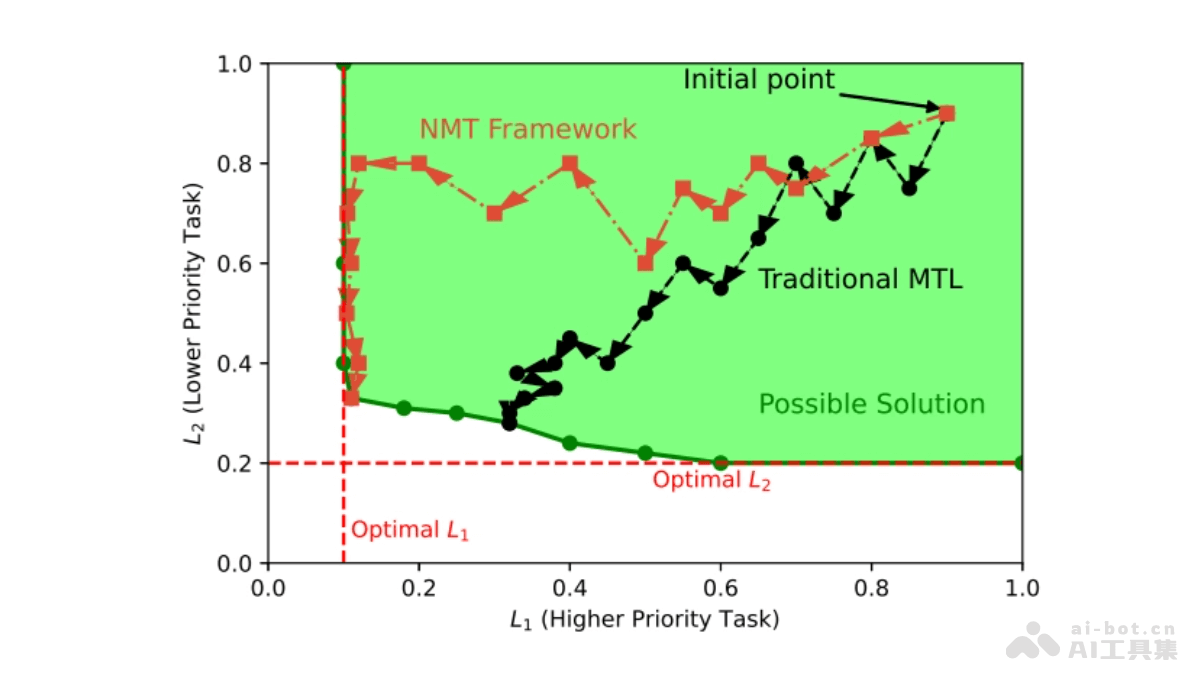
NMT (No More Tuning) is a multi-task learning framework jointly launched by UC Berkeley and Alibaba Group, capable of addressing the issue of optimizing different task priorities in multi-task learning. NMT transforms the multi-task learning problem into a constrained optimization problem, treating the performance of high-priority tasks as constraints and maintaining the performance of high-priority tasks while optimizing low-priority tasks. NMT is based on the Lagrangian differential multiplier method, converting the constrained problem into an unconstrained problem and solving it with gradient descent, avoiding the complex hyperparameter tuning process in traditional methods. The NMT framework is easy to integrate with gradient descent-based multi-task learning methods, requires no additional hyperparameters, effectively simplifies the model training process, and improves the performance of high-priority tasks.
Main Features of NMT
- Task Priority Optimization: The NMT framework can optimize based on task priorities, ensuring that the performance of high-priority tasks is not affected when optimizing secondary tasks, achieving an effective balance among different tasks in multi-task learning.
- Simplified Hyperparameter Tuning: By directly embedding task priorities into the constraints of the optimization problem, the NMT framework eliminates the need for manual tuning of hyperparameters in traditional multi-task learning methods, simplifies the model training process, and reduces the risk of suboptimal performance caused by improper parameter settings.
- Easy to Integrate and Extend: It seamlessly integrates into existing gradient descent-based multi-task learning methods without the need for large-scale modifications to the original architecture, offering good compatibility and extensibility.
- Theoretical Performance Guarantee: Under certain assumptions, the NMT framework can provide theoretical guarantees for the optimization process, ensuring that the performance optimization of high-priority tasks meets expectations and enhancing the reliability and stability of model training.
Technical Principles of NMT
- Transformation into a Constrained Optimization Problem: It transforms the multi-task learning problem into a constrained optimization problem, treating the performance of high-priority tasks as inequality constraints, requiring that the performance of high-priority tasks is not lower than the optimal value when optimizing low-priority tasks.
- Application of the Lagrange Multiplier Method: It uses the Lagrange multiplier method to transform the constrained optimization problem into an unconstrained problem. By introducing Lagrange multipliers, the constraints are incorporated into the objective function to form the Lagrangian function, turning the problem into an optimization problem of solving the Lagrangian function.
- Combination of Gradient Descent and Ascent: It employs gradient descent to optimize model parameters, minimizing the objective function; at the same time, it uses gradient ascent to update the Lagrange multipliers, satisfying the maximization requirement of the constraints. This combined use of gradient descent and ascent allows NMT to balance task priorities and performance constraints during the optimization process.
- Stepwise Optimization Strategy: Based on a stepwise optimization strategy, it first optimizes the highest-priority task to obtain the optimal solution; then, while keeping the performance of high-priority tasks unchanged, it sequentially optimizes other lower-priority tasks. This strategy ensures that during the optimization process, the performance of high-priority tasks is always given priority protection.
NMT Project Address
- arXiv Technical Paper:https://arxiv.org/pdf/2412.12092
Application Scenarios of NMT
- Recommendation Systems: Optimizing product recommendations on e-commerce platforms, prioritizing the improvement of purchase conversion rates while also considering click-through rates and user satisfaction, enhancing the shopping experience and sales.
- Search Engines: In search engine optimization result ranking, prioritize ensuring result relevance, while also taking into account authority and user satisfaction, to improve search quality and experience.
- Natural Language Processing: In machine translation, prioritize ensuring translation accuracy, optimize fluency and consistency, improve translation quality, and meet cross-language communication needs.
- Financial Risk Control: In credit approval, prioritize controlling credit risk, ensure loan security, improve approval efficiency and customer satisfaction, and optimize the approval process.