
What is NitroGen
NitroGen is an open-source general game AI model developed by NVIDIA in collaboration with Stanford University, Caltech, and other institutions. It is trained on video data covering more than 1,000 games over 40,000 hours, using a large-scale behavioral cloning approach. The model takes game video frames as input and outputs gamepad operation signals, making it suitable for many types of games. In unseen games, NitroGen improves task success rate by 52% compared with models trained from scratch.
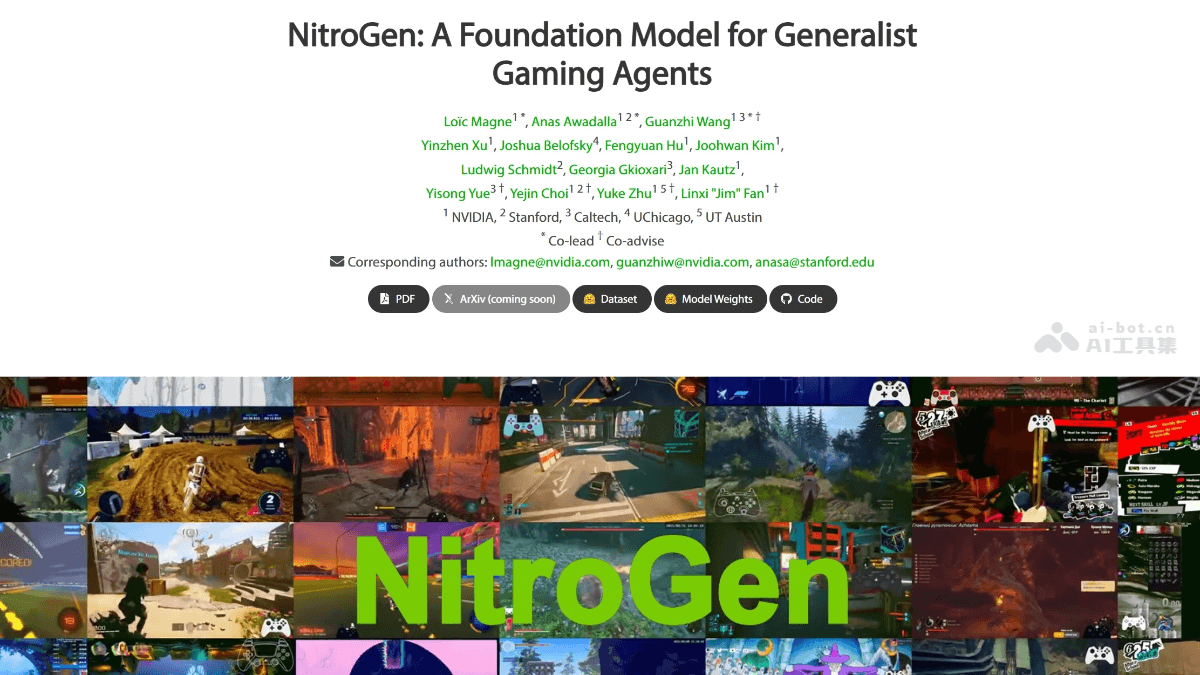
Main features of NitroGen
-
Multi-game adaptability: It can play more than 1,000 games, covering role-playing, platformers, battle royale, racing, and many other genres, including almost everything from 2D to 3D games.
-
Input and output: It directly takes game video frames as input and outputs real gamepad operation signals, naturally adapting to all games that support gamepads.
-
Post-training capability: When facing a new game, it does not need to learn the rules from scratch. Only a small amount of fine-tuning or lightweight adaptation is needed to get up to speed quickly, showing potential for cross-game generalization.
-
Performance: In procedurally generated game worlds and in new games it has never encountered before, the task success rate achieves a 52% relative improvement compared with models trained from scratch.
-
Open-source sharing: The research outputs, including pretrained model weights, the complete action dataset, and related code, have all been made publicly available, making it convenient for developers to conduct further research and development.
Technical principles of NitroGen
-
Video frame-based input and output: NitroGen directly takes game video frames as input, understands the game state by analyzing the game visuals, and outputs real gamepad operation signals. This end-to-end processing approach enables it to directly adapt to various games that support gamepads.
-
Large-scale behavioral cloning training: The model is trained on more than 40,000 hours of videos of game streamers' operations, covering more than 1,000 games. By imitating human players' operating behavior, the model can learn the gameplay and strategies of different types of games.
-
Post-training and fine-tuning capability: NitroGen supports post-training. When facing a new game, it does not need to learn the rules from scratch. Only a small amount of fine-tuning or lightweight adaptation is needed to get up to speed quickly, showing potential for cross-game generalization.
-
Underlying architecture modification: Its underlying architecture is GROOT N1.5, which was originally designed for robotics and has been modified for the gaming field. The flexibility and extensibility of this architecture provide the basis for the model's multi-game adaptability and generalization ability.
-
Multi-task learning and generalization: Through multi-task learning, NitroGen can transfer knowledge and skills between different games, quickly adapt to new games, and perform well.
NitroGen project addresses
-
Project official website:https://nitrogen.minedojo.org
-
Github repository:https://github.com/MineDojo/NitroGen
-
HuggingFace model library:https://huggingface.co/nvidia/NitroGen
- Paper address:https://nitrogen.minedojo.org/assets/documents/nitrogen.pdf
-
HuggingFace dataset:https://huggingface.co/datasets/nvidia/NitroGen
Application scenarios of NitroGen
-
Game development and testing: It helps game developers quickly test the gameplay and mechanics of new games, simulate player behavior through AI, discover potential issues in advance, and optimize the game experience.
-
Game content creation: Provide inspiration and materials for game content creators, using AI-generated gameplay and controls to assist in creating game guides, tutorials, or entertainment videos.
-
Player Assistance and Training: As an assistive tool for players, it provides operation suggestions or demonstrations to help players improve their gaming skills, and is especially suitable for novice players to quickly get started with complex games.
-
Game Research and Analysis: Used for game behavior research, analyzing players' operation patterns and decision-making processes in different games, providing data support for game design and user experience research.
-
Cross-Game Generalization Research: As a platform for researching general artificial intelligence and cross-game generalization capabilities, it advances research on AI adaptability and generalization ability in different game environments.
-
Education and Training: In the field of education, it is used to develop educational games or simulated training environments, using AI to simulate real operation scenarios and improve learning outcomes and training efficiency.