
What is New API
New API is a next-generation AI gateway and asset management system. As an AI foundation platform, it provides unified infrastructure access to 30+ mainstream AI services worldwide (OpenAI, Claude, Gemini, DeepSeek, etc.). The platform's core features include a unified OpenAI-compatible interface, intelligent routing and load balancing, fine-grained billing and permission control, and real-time data dashboards. The platform supports advanced features such as multi-format conversion, reasoning effort control, and cache billing. It adopts the AGPLv3 open-source license, supports one-click Docker deployment, and is suitable for scenarios ranging from individual developers to enterprise-level multi-tenant use.
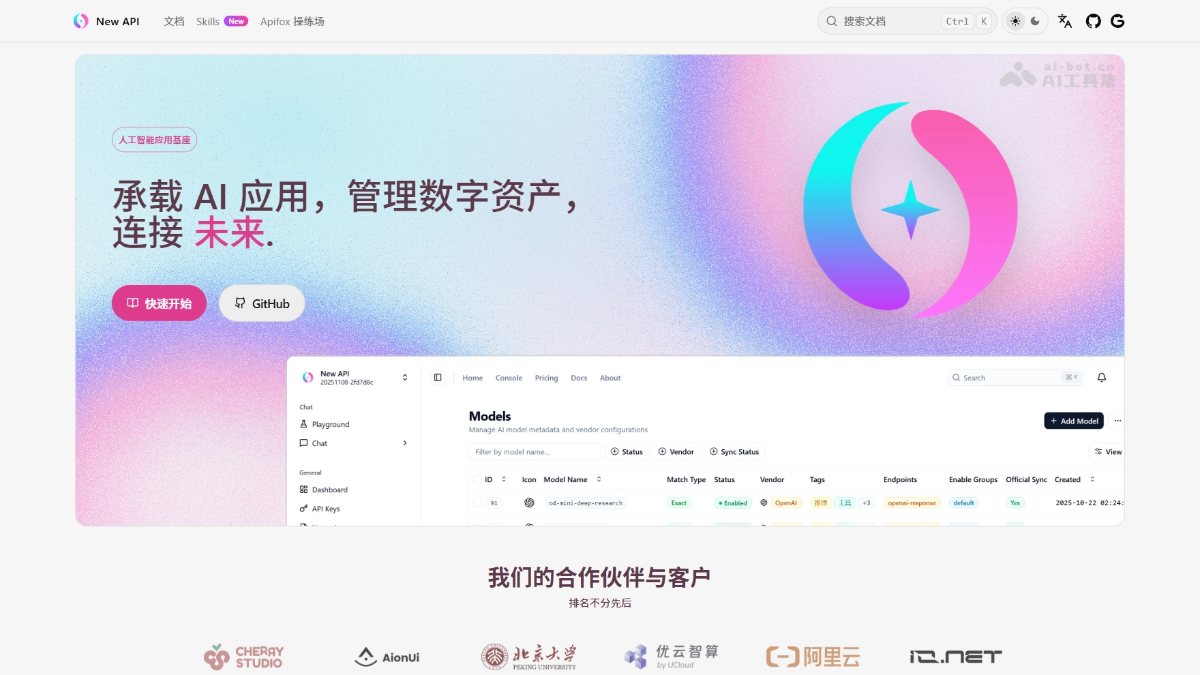
Main Features of New API
-
Unified Interface Management: Provides a single API endpoint compatible with the OpenAI format, seamlessly connecting to 30+ mainstream AI service providers worldwide.
-
Intelligent Routing and Scheduling: Supports multi-channel load balancing, automatic failover, and weighted random distribution to ensure high service availability.
-
Fine-Grained Billing System: Supports per-request or usage-based billing, prepaid top-ups, multi-rate configuration, and cache billing support.
-
Security and Permission Control: Provides token group management, model access restrictions, API call auditing, and multi-platform authorized login.
-
Format Conversion Capability: Supports mutual conversion among multiple API formats such as OpenAI, Claude Messages, and Google Gemini.
-
Reasoning Effort Control: Supports flexible configuration of high, medium, and low reasoning effort levels through model name suffixes.
-
Real-Time Data Dashboard: Provides a visual console, usage statistics analysis, and cost monitoring data insight features.
Key Information and Usage Requirements of New API
-
Project Positioning: Next-generation AI gateway and asset management system, AI foundation platform
-
Open-Source License: GNU AGPLv3 (free to use, SaaS deployment requires open source)
-
Compatibility Basis: Developed based on One API, fully compatible with the original database
-
Supported Languages: Simplified Chinese, Traditional Chinese, English, French, Japanese
-
Deployment Methods: Docker / Docker Compose / BaoTa Panel
-
Database: SQLite (default) / MySQL ≥ 5.7.8 / PostgreSQL ≥ 9.6
-
Docker Image:calciumion/new-api:latest
Core Advantages of New API
-
Unified Access: Through a single API endpoint compatible with the OpenAI format, it can seamlessly connect to 30+ mainstream AI service providers worldwide, completely eliminating the cumbersome work of multi-platform integration.
-
Intelligent Routing: The platform has built-in multi-channel load balancing, automatic failover, and weighted random distribution mechanisms to ensure high availability and request stability of AI services.
-
Cost Optimization: Supports cache billing, usage-based or per-request billing, and flexible multi-rate configuration, helping users achieve fine-grained cost control and expense management.
-
Format Interoperability: Provides free conversion among multiple API formats such as OpenAI, Claude Messages, and Google Gemini, significantly lowering the barrier to integrating different models.
-
Ready to Use Out of the Box: Supports one-click Docker deployment, fully compatible with the One API database, and provides visual installation via the BaoTa panel, greatly simplifying the deployment process.
How to Use New API
- Deployment and Installation: After cloning the project repository locally, edit the configuration file, run the Docker command to start the service, and access the system through the default port 3000 in a browser.
- Initial Configuration: Log in to the admin backend to set up the administrator account, add API keys for each AI service provider in channel management, and configure weights and failover strategies.
- Create Access Credentials: Create an API Key on the token management page, set quota limits, validity period, and available model scope, and assign independent credentials for different scenarios to achieve permission isolation.
- Integration and Usage: Point the application's API base URL to the New API deployment address, use the generated token to replace the original key, and maintain the OpenAI standard format to seamlessly call models across multiple platforms.
New API Project Address
- Project Official Website:https://www.newapi.ai/
- GitHub Repository:https://github.com/QuantumNous/new-api
Comparison of New API with Similar Competing Products
| Comparison Dimension | New API | One API | LiteLLM |
|---|---|---|---|
| Project Positioning | AI gateway and asset management system, AI foundation platform | Open-source AI interface aggregation and management platform | Multi-LLM routing and load balancing tool |
| Development Team | QuantumNous | Community open-source project | BerriAI team |
| Open-Source License | GNU AGPLv3 | MIT | MIT |
| Core Features | Unified interface, intelligent routing, fine-grained billing, format conversion, permission control | Channel management, token distribution, quota control | Model routing, failover, observability and monitoring |
| Supported Models | 30+ mainstream service providers (OpenAI, Claude, Gemini, DeepSeek, Midjourney, Suno, etc.) | 20+ mainstream service providers | 100+ model providers |
| Format Conversion | OpenAI ↔ Claude, OpenAI → Gemini, Thinking content conversion | Mainly compatible with OpenAI format | Unified output in OpenAI format |
New API Application Scenarios
-
Individual Developers Building Sites: Quickly set up a private AI interface relay station, uniformly manage API keys for multiple platforms, control personal usage costs through fine-grained billing, and avoid the tedious operation of frequently switching between different service providers.
-
Startup Team Product Development: Provide stable multi-model backend support for AI applications, ensure high availability of product services, and at the same time monitor usage and costs through data dashboards to optimize resource allocation.
-
Enterprise Internal AI Middle Platform: The platform supports building an enterprise-level AI asset management system, uniformly controls model access and expenses, meets compliance requirements, and improves management efficiency.
-
AI Model Comparison Testing: Users can quickly switch between models from different vendors through a unified interface, compare the performance of GPT, Claude, Gemini, DeepSeek, etc. in actual tasks, and assist technical selection decisions.