
What is NeuTTS Air
NeuTTS Air is an ultra-realistic, offline-capable TTS (text-to-speech) model developed by Neuphonic. It has high-fidelity speech synthesis capabilities, with natural and fluent voice that is almost indistinguishable from real. It supports local operation, is provided in GGML format, is compatible with CPUs, and can be deployed on devices such as phones, laptops, or Raspberry Pi, and can be used without an internet connection. NeuTTS Air supports instantvoice cloning, and can clone a speaker's voice with just a 3-second audio sample. It adopts a hybrid architecture based on LM + Codec, built on the Qwen 0.5B language model and the self-developed NeuCodec audio codec, achieving a balance between performance, speed, and quality. It can achieve real-time inference on mid-range devices, with power optimization adapted for mobile, and generated results come with a watermark, ensuring traceability and compliant use. NeuTTS Air can be applied to offline voice assistants, smart toys, embedded voice interfaces for local AI Agents, voiceovers for games and interactive characters, and privacy-sensitive fields such as healthcare, justice, and education.
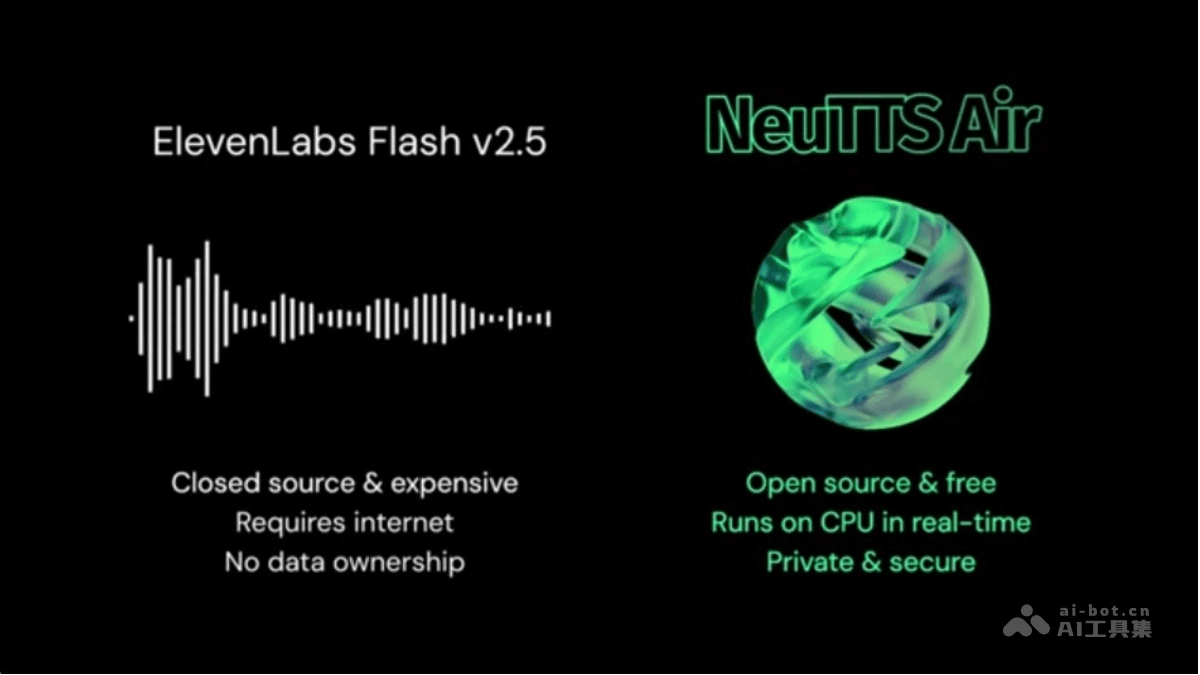
Main features of NeuTTS Air
-
High-fidelity speech synthesis: The generated speech is natural and fluent, almost indistinguishable from a real person, providing a high-quality voice experience.
-
Offline operation support: It can run on local devices without an internet connection, and supports a variety of devices, including phones, laptops, and Raspberry Pi.
-
Instant voice cloning: With just a 3-second audio sample, it can quickly clone the speaker's voice and achieve personalized voice output.
-
Lightweight architecture: It adopts an optimized hybrid structure, balancing performance, speed, and quality, and is suitable for a variety of application scenarios.
-
Privacy protection: Local operation avoids uploading voice data to the cloud, ensuring user privacy and data security.
-
Multi-platform compatibility: It is provided in GGML format, is compatible with multiple operating systems and devices, and is easy to deploy and use.
-
Real-time inference capability: It can achieve real-time speech synthesis on mid-range devices, suitable for application scenarios with response speed requirements.
Technical principles of NeuTTS Air
-
Hybrid architecture based on LM + Codec: It combines a language model (LM) and an audio codec (Codec) to achieve efficient text-to-speech synthesis.
-
Language model optimization: It adopts the Qwen 0.5B language model, optimizes text understanding and generation, and improves the naturalness and accuracy of speech synthesis.
-
Self-developed NeuCodec: It develops an audio codec with a single-codebook structure, achieving high-fidelity, low-bitrate audio generation and ensuring speech quality.
-
GGML format support: It is provided in GGML format, supports efficient execution on multiple platforms (such as CPU and mobile), and enables offline operation.
-
Real-time inference optimization: Through power optimization, it ensures real-time speech synthesis on mid-range devices, meeting instant interaction needs.
-
Voice cloning technology: It uses a small amount of audio samples (3 seconds) to quickly clone the speaker's voice and achieve personalized voice output.
Project address of NeuTTS Air
- Github repository:https://github.com/neuphonic/neutts-air
- HuggingFace model library:https://huggingface.co/neuphonic/neutts-air
Application scenarios of NeuTTS Air
-
Offline voice assistant: In environments without a network connection, provide voice interaction services for users, such as smart home control, in-car voice assistants, etc.
-
Smart Toys: Provide natural voice interaction for children's toys, enhancing the fun and interactivity of the toys.
-
Local AI Agent: As the voice interface of a locally running AI assistant, it provides a safer and more private voice interaction experience.
-
Games and Interactive Entertainment: Generate personalized voices for game characters and interactive applications to improve the user experience.
-
Privacy-Sensitive Fields: In scenarios with high data privacy requirements such as healthcare, justice, and education, provide localized voice solutions.
-
Mobile Device Applications: On mobile devices such as phones and tablets, provide offline voice functionality for various applications, reducing dependence on the network.