
What is NeuralSVG
NeuralSVG is an innovative text-driven vector graphics generation technology. Through a small multi-layer perceptron network, it transforms text prompts into vector graphics with a hierarchical structure. The network takes shape indices as input, outputs shape parameters, and then generates pixel outputs through a differentiable renderer. It optimizes the network weights based on score distillation sampling, forming an implicit neural representation of the graphics. It also employs a regularization technique based on random dropout, making the generated graphics semantically clear, orderly, and editable. NeuralSVG supports inference-time control and can dynamically adjust graphics attributes, such as background color, etc. It performs excellently in generating structured vector graphics, bringing new ideas to graphics generation.
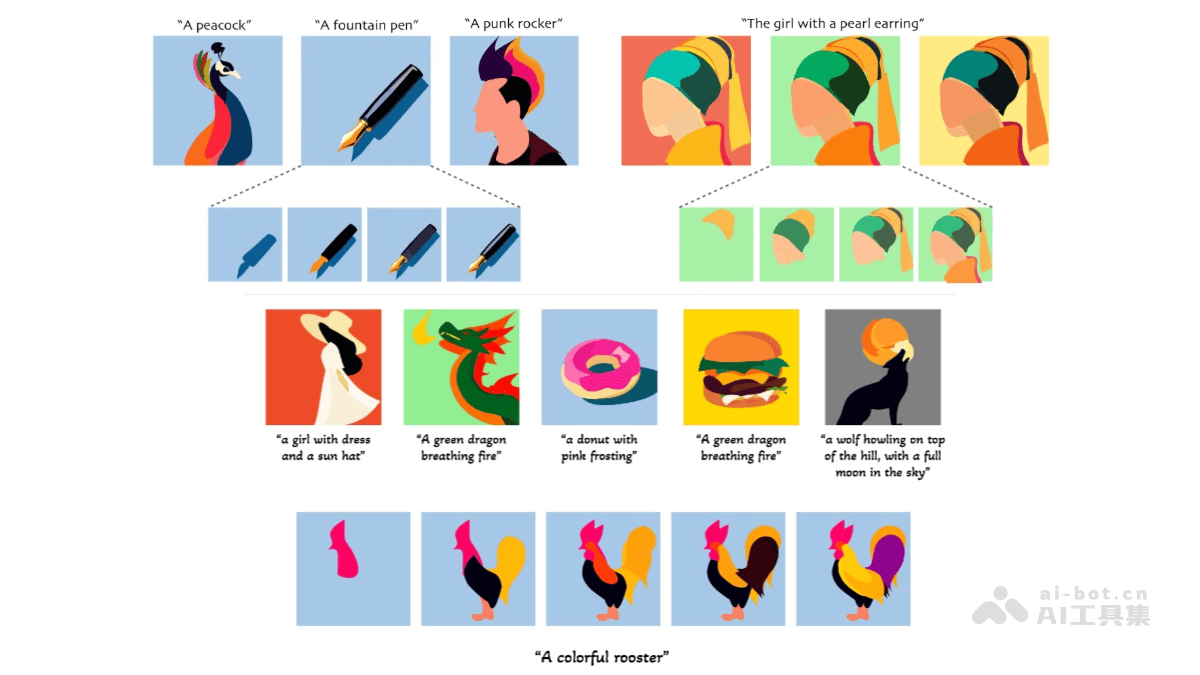
NeuralSVG's main features
- Text-to-vector graphics generation: It can generate vector graphics with orderly and editable shapes based on text prompts, solving the problem of traditional methods generating vector graphics with complex structures that are difficult to re-edit.
- Support for dynamic conditions: It supports users to dynamically adjust the generated SVG as needed during the generation process, such as background color, aspect ratio, etc., enabling quick switching between multiple color schemes and adapting to different design layout needs.
- Sketch generation: It can generate sketches with different numbers of strokes, without any modifications to the framework.
- Hierarchical structure generation: By introducing a dropout-based regularization technique, it encourages the generated SVG to have a layered structure, giving each shape an independent meaning in the overall scene, facilitating later editing.
NeuralSVG's technical principles
- Implicit neural representation: NeuralSVG adopts implicit neural representation, encoding the entire vector graphics scene into the weights of a small multi-layer perceptron (MLP) network. This representation is similar to neural radiance fields (NeRFs), outputting individual shapes through the network and then aggregating them to form the complete SVG.
- Score distillation sampling optimization: It uses the Score Distillation Sampling (SDS) method to optimize the network weights. SDS can ensure the high quality of the generated SVG files while promoting the formation of a graphics hierarchy, giving each shape a unique meaning and role in the overall image.
- Dropout-based regularization technique: It introduces a regularization technique based on random dropout, encouraging each learned shape to have a meaningful and orderly role in the overall composition. This makes the generated graphics more structured and easier to edit and modify later.
- Inference-time control capability: Based on the advantages of neural representation, NeuralSVG supports inference-time control, allowing users to dynamically adjust the generated SVG according to the provided input, such as background color, aspect ratio, etc.
NeuralSVG's project address
- Project website:https://sagipolaczek.github.io/NeuralSVG
- Github repository:https://github.com/SagiPolaczek/NeuralSVG
- arXiv technical paper:https://arxiv.org/pdf/2501.03992
NeuralSVG's application scenarios
- Artistic creation: Artists can use NeuralSVG to generate vector graphics with a sense of hierarchy and editability based on creative text, facilitating further creation and modification.
- Design field: Designers can quickly generate vector graphics that meet their needs, for use in web design, UI design, etc., and can dynamically adjust elements such as colors and backgrounds of the graphics according to different scenarios.
- Education and academiaIn the field of education, it can be used to generate examples of vector graphics needed for teaching; in academic research, it helps researchers explore the relationship between text and vector graphics generation.