
What is Nemotron-Mini-4B-Instruct
Nemotron-Mini-4B-Instruct is an open-source small language model released by NVIDIA, specifically optimized for role-playing, retrieval-augmented generation (RAG), and function calling tasks. The model is optimized through distillation, pruning, and quantization techniques to improve running speed and on-device deployment capabilities, with lower VRAM usage, and can quickly generate responses. The model is based on the Transformer decoder architecture, supports a 4096 context window token limit, and is suitable for real-time interactive scenarios, such as in-game character dialogue, providing a more natural and smooth communication experience.
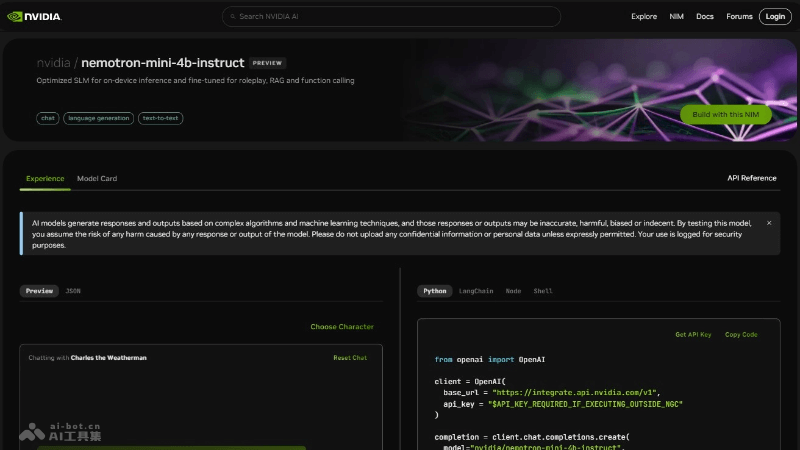
Main features of Nemotron-Mini-4B-Instruct
- Role-playing: Optimizes the model to generate more natural and accurate responses in role-playing scenarios, suitable for applications such as games and virtual assistants.
- Retrieval-augmented generation (RAG): Improves the model's performance in information retrieval and knowledge base applications, generating answers by combining retrieved information.
- Function calling: The model can understand and execute specific function calls, which is very useful for applications that need to interact with APIs or other automated processes.
- Fast response: Through optimization, the model can quickly generate the first Token, reducing latency and improving real-time interaction.
- On-device deployment: The model's size and VRAM usage are optimized, making it suitable for deployment on various devices, including personal computers and laptops.
Technical principles of Nemotron-Mini-4B-Instruct
- Transformer architecture: The model is based on the Transformer architecture, which can effectively process sequence data and capture dependencies between tokens.
- Distillation: A model compression technique that trains a small model to imitate the behavior of a large, complex model. Distillation helps retain the key information of the large model while reducing the model's size and computational requirements.
- Pruning: Pruning is a technique that reduces model size by removing unimportant weights from a neural network. It improves the model's efficiency while maintaining its performance.
- Quantization: Quantization is the process of converting the model's weights and activations from floating-point numbers to low-precision representations (such as INT4 or INT8), reducing the model's memory usage and accelerating inference.
- Autoregressive language model: Nemotron-Mini-4B-Instruct is an autoregressive model. When generating text, the prediction of each token depends on the previously generated tokens.
Project address of Nemotron-Mini-4B-Instruct
- Project official website:build.nvidia.com/nvidia/nemotron-mini-4b-instruct
- HuggingFace model library:https://huggingface.co/nvidia/Nemotron-Mini-4B-Instruct
Application scenarios of Nemotron-Mini-4B-Instruct
- Video games: In role-playing games (RPGs), the model is used to enhance the dialogue capabilities of non-player characters (NPCs), communicate with players more naturally, and provide a richer interactive experience.
- Virtual assistants: In virtual assistants or chatbots, the model is used to understand and respond to user queries, providing more accurate and personalized services.
- Customer service: In customer support systems, the model helps automate answers to common questions, improving service efficiency and reducing response time.
- Educational software: In educational applications, the model serves as a teaching aid, providing personalized learning suggestions and interactive learning experiences.
- Content Creation: In content generation applications, the model helps users generate creative text, such as stories, poems, or marketing copy.