
What is NeMo
NeMo is an end-to-end cloud-native framework provided by NVIDIA for building, customizing, and deploying generative AI models. It supports applications such as large language models (LLMs), multimodal models, speech recognition, and text-to-speech (TTS). NeMo's design philosophy emphasizes modularity and flexibility, enabling researchers and enterprise users to select and customize AI modules according to their needs. Built on deep learning frameworks, based on optimized algorithms and techniques, it provides multimodal fusion capabilities, is suitable for multiple industries such as finance, healthcare, and education, and supports distributed training to improve training efficiency. NeMo can integrate with existing systems and promote enterprise digital transformation.
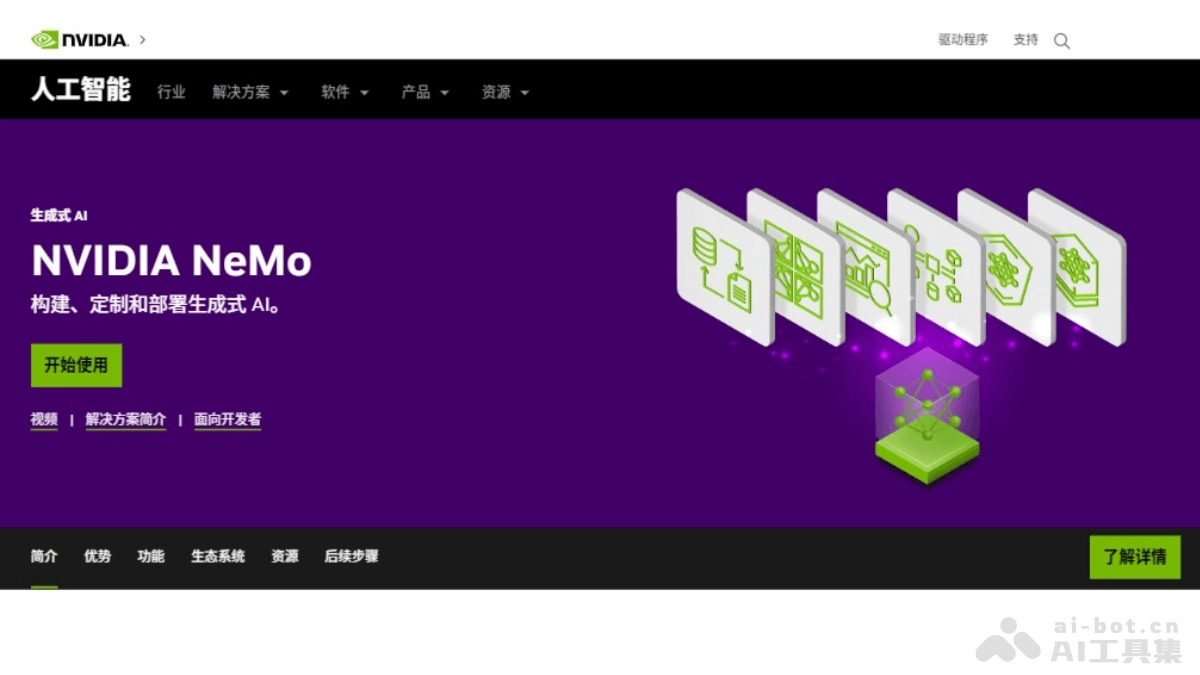
NeMo's main features
- Modular design: NeMo provides modular building blocks, supporting developers in flexibly combining and reusing different modules to build customized AI models.
- Multimodal support: It can process and fuse multiple data types such as text, images, and speech, suitable for a broader range of application scenarios.
- Deep learning framework: Built on PyTorch, based on the powerful capabilities of deep learning to handle complex data patterns.
- Optimization algorithms: Includes a series of optimization algorithms, such as adaptive learning rate adjustment and gradient clipping, improving the efficiency and stability of model training.
- Distributed training: Supports model training on multiple GPUs, accelerating the model training process.
- Pretrained models: Provides a variety of pretrained models, helping developers quickly start projects and fine-tune on this basis.
- End-to-end platform: From data preprocessing to model training, inference, and deployment, NeMo provides a complete set of tools and processes.
NeMo's technical principles
- Modular architecture: NeMo adopts a modular design, supporting developers in selecting, combining, and reusing prebuilt modules, such as data loaders, model components, loss functions, and optimizers, to build customized AI models.
- Deep learning framework: NeMo is built on PyTorch, based on powerful deep learning capabilities, and supports dynamic computation graphs and automatic gradient computation.
- Neural modules: The "neural modules" in NeMo are the basic units for building complex models and can be any part of a neural network, such as layers, loss functions, or evaluation metrics.
- Neural types: NeMo introduces the concept of "neural types," used to define the data types and formats passed between neural modules, ensuring that data flows correctly between modules.
- Parallel and distributed training: NeMo supports data parallelism, model parallelism, and pipeline parallelism, supporting model training on multiple GPUs and nodes to improve training efficiency and scalability.
- Pretrained models: NeMo provides a variety of pretrained models. The models have already been trained on large amounts of data and can serve as a starting point for new tasks, adapting to specific applications through fine-tuning.
NeMo's project address
- Project official website:nvidia.cn/ai-data-science/products/nemo/
- Github repository:https://github.com/NVIDIA/NeMo
NeMo's application scenarios
- Speech recognition: Transcribe audio content into text, used for meeting minutes, podcasts, lectures, etc.
- Natural language processing: Includes text classification, sentiment analysis, question-answering systems, machine translation, etc.
- Text-to-Speech: Converts text into natural-sounding speech, used for voice assistants, audiobooks, announcement systems, etc.
- Conversational AI: Builds chatbots and virtual assistants for customer service, smart home control, etc.
- Content Creation: Automatically generates articles, stories, or other text content.
- Medical Imaging Analysis: Assists diagnosis, such as identifying abnormalities in X-rays and CT scans.