
What is NativeMind
NativeMind is an open-source AI assistant that runs entirely on local devices. NativeMind supportsDeepSeek、Qwen、Llamaand other models, based onOllamaintegration enables seamless loading and switching. NativeMind features include intelligent conversation, web content analysis, translation, writing assistance, etc., all completed within the browser without cloud synchronization. NativeMind ensures 100% local data processing, no cloud dependency, no tracking, no logs, giving users complete control over their data.
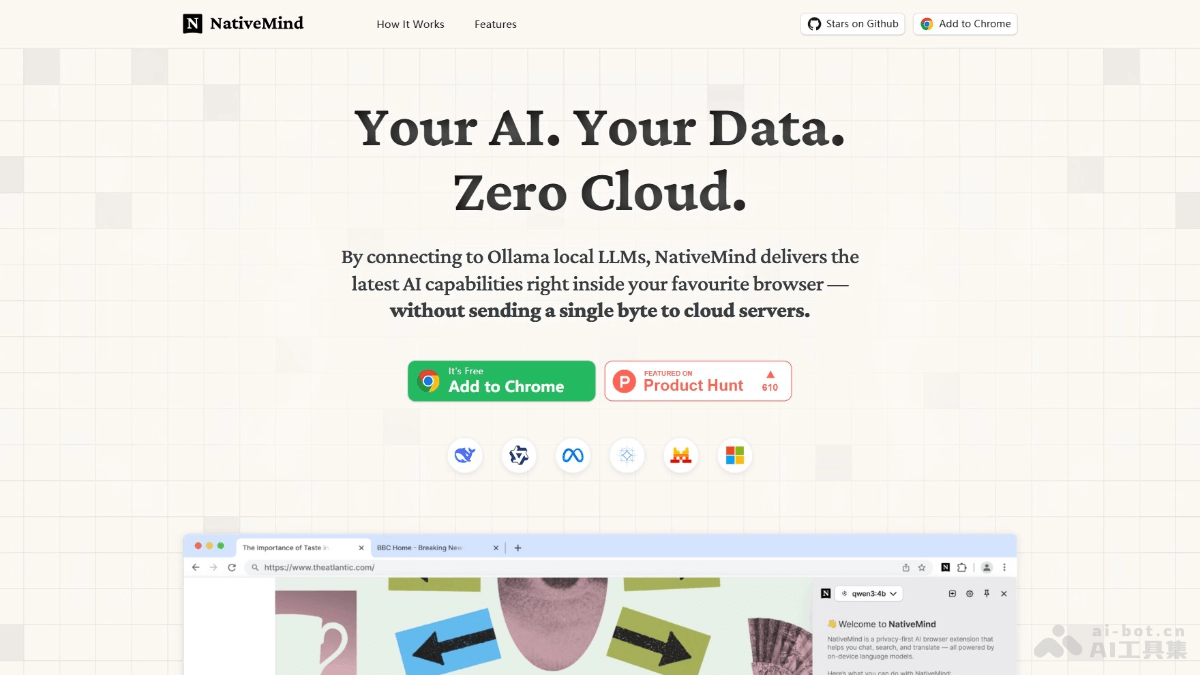
NativeMind's main features
- Intelligent conversation: With multi-tab context awareness, conduct comprehensive AI conversations, able to understand and integrate information from different pages, making conversations more coherent and in-depth.
- Intelligent content analysis: Instantly summarize web content, quickly extract key information; supports understanding document content, helping users quickly grasp core points and save reading time.
- Universal translation: Provides full-page translation with bilingual side-by-side display for easy comparison; supports translation of selected text to meet different translation needs.
- AI-driven search: Enhances the browser's search capabilities, allowing users to directly enter questions in the browser. NativeMind automatically browses web pages to provide precise answers, improving search efficiency.
- Writing enhancement: Automatically detects text, provides intelligent rewriting, proofreading, and creative suggestions, helping users optimize writing content and improve writing quality.
- Real-time assistance: While browsing web pages, dynamically displays a floating toolbar based on context, providing relevant function buttons such as translation, summarization, etc., for convenient use anytime.
NativeMind's technical principles
- Locally running AI models: The core of NativeMind is AI models that run entirely on local devices, without relying on cloud servers. All data processing and computation are completed on the user's device, ensuring data privacy and security.
- Ollama integration: NativeMind is tightly integrated with Ollama. Ollama is a locally running AI model management platform that supports various advanced AI models such as DeepSeek, Qwen, Llama, Gemma, Mistral, etc. Users can choose and switch between different models according to their needs.
- WebLLM support: NativeMind supports WebLLM, a lightweight AI model based on WebAssembly that can run directly in the browser without additional software installation.
- Browser extension architecture: NativeMind is provided to users through channels such as the Chrome Web Store. It interacts with the user's browser based on browser extension APIs to implement various functions. The front-end interface is built with Vue 3 and TypeScript, providing a user-friendly interactive interface. The back-end logic communicates with locally running AI models based on the APIs of WebLLM and Ollama, processing user input and model output. The communication mechanism uses WebSockets or other communication protocols for real-time interaction with the locally running Ollama server, ensuring low latency and efficient data transmission.
NativeMind's project address
- Project website:https://nativemind.app/
- GitHub repository:https://github.com/NativeMindBrowser/NativeMindExtension
NativeMind's application scenarios
- Academic research assistant: Students and researchers quickly extract key information from literature, integrate knowledge from different documents based on multi-tab context awareness, improving research efficiency.
- Enterprise document management: Enterprise employees use intelligent content analysis to quickly understand the core of documents, optimize document language with writing enhancement features, and improve document quality and information delivery efficiency.
- Online Learning Assistance: Online learners use general translation to overcome language barriers, obtain material summaries or key interpretations based on real-time assistance, and deepen their understanding of knowledge.
- Market Research Analysis: Market researchers quickly find key information based on local web search, organize research data with content analysis, and quickly generate market analysis reports.
- Personal Knowledge Management: Individual users use intelligent dialogue to record thoughts and answers at any time, integrate information from different sources based on cross-tab chat, and build a personal knowledge system.