
What is Dia
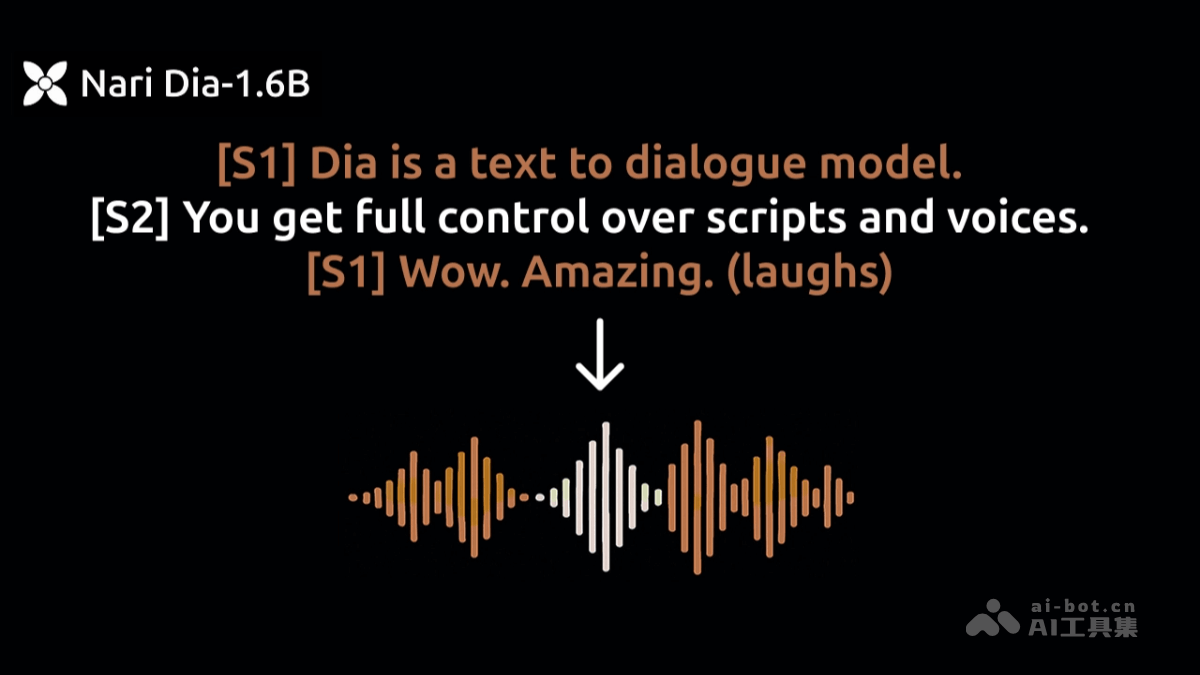
Dia is an open-sourcetext-to-speech(TTS) model launched by Nari Labs, with 1.6 billion parameters. It directly generates highly realistic conversational speech from a text script, supports multi-speaker tags, emotional tone control, and non-verbal cues (such as laughter, coughing, etc.), and generates voices similar to specific audio throughvoice cloningfeatures. Dia's code and weights have been open-sourced on Hugging Face and GitHub. Users can download and deploy it locally, and can also experience it online through the Gradio interface.
Dia's main features
- Natural dialogue generation: can generate highly realistic conversational speech from a text script, supports multi-speaker tags (such as
[S1]、[S2], etc.), suitable for generating multi-person dialogue scenes. - Emotion and tone control: users can adjust the emotion and tone of the generated speech through audio prompts or fixed seeds, making the speech more expressive.
- Non-verbal cues: supports generating non-verbal audio cues, such as laughter, coughing, throat clearing, etc., making the dialogue more vivid and natural.
- Zero-shot voice cloning: Dia supports zero-shot voice cloning. Users can upload a short reference audio clip, and the model will replicate the voice style of that clip. This allows users to generate personalized speech without fine-tuning for each new speaker.
- Real-time speech synthesis: Dia optimizes the inference pipeline and can achieve real-time speech generation on consumer-grade devices. On enterprise-grade GPUs, Dia can generate audio at real-time speed.
Dia's technical principles
- Based on the Transformer architecture: Dia uses the Transformer architecture, a powerful deep learning architecture applied to natural language processing and speech synthesis tasks. It can handle long text sequences and generate high-quality speech output.
- Single-pass dialogue generation: Unlike traditional TTS models, Dia can directly generate a complete dialogue from a text script without splicing together each speaker's speech segments. This makes the generated dialogue more natural and fluent.
Dia's project addresses
- Github repository:https://github.com/nari-labs/dia
- HuggingFace model library:https://huggingface.co/nari-labs/Dia-1.6B
- Online experience Demo:https://huggingface.co/spaces/nari-labs/Dia-1.6B
Dia's application scenarios
- Video production: generate natural and fluent conversational speech for videos, including narration, character dialogue, etc., to enhance the appeal of the content.
- Audio content creation: generate audio content such as podcasts and audiobooks, supporting multiple tones and emotional expressions.
- Language learning: by generating natural dialogue, help learners practice speaking and listening, supporting multiple tones and emotional expressions.
- Customer service and virtual assistants: generate natural and fluent voice dialogue for customer service systems or virtual assistants, improving user experience.
- Advertising and promotion: generate voice content for advertising and promotion, supporting emotion and tone control, improving advertising effectiveness.