
What is Multi-Agent Swarm
Multi-Agent Swarm is the world's first L4-level agent system launched by 360 Group. It overturns the previous mode of agents operating as lone soldiers, enabling multiple reasoning agents to flexibly form groups, nest in multiple layers, and collaborate in teams, working closely together like a swarm to complete complex tasks. Through its original swarm collaboration framework, the system solves key issues in multi-agent collaboration such as task allocation, parameter passing, and context management, enabling multiple agents to collaborate efficiently like a team.
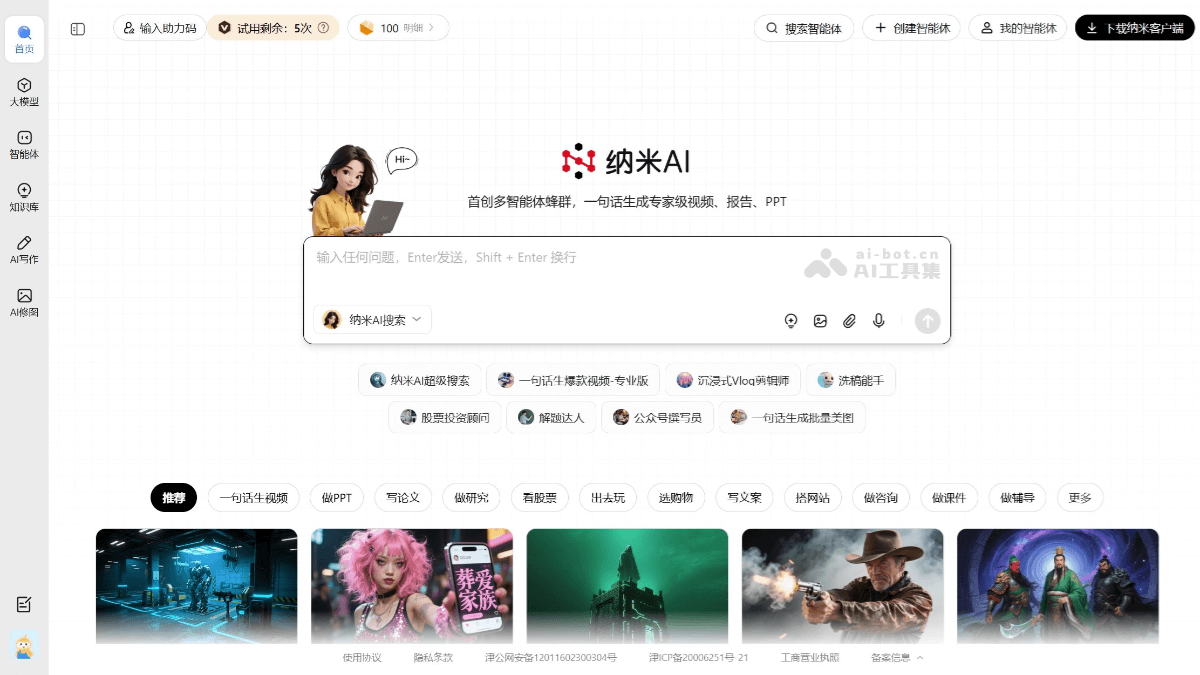
Main features of Multi-Agent Swarm
-
Multi-agent collaboration: Multi-Agent Swarm can combine multiple reasoning agents to collaborate closely like a swarm and complete complex multi-step tasks. It breaks through the capability boundaries of a single agent and achieves evolution from "lone soldier operations" to "group collaboration."
-
Flexible configuration: Users can flexibly configure the number and types of agents according to task requirements. The swarm can operate as lone soldiers or form a phalanx, and can change formation at any time according to new tasks, demonstrating extremely high flexibility.
-
Ultra-long task processing: Multi-Agent Swarm can continuously execute tasks of more than 1,000 steps, with a duration of up to 2 hours and consumption of more than 20 million tokens. It can handle complex and large-scale task requirements.
-
Efficient delivery: Through the collaborative work of multiple agents, task execution efficiency is greatly improved. For example, in the field of video production, tasks that originally took two hours can now be completed in only 20 minutes.
-
Swarm collaboration framework: The original swarm collaboration framework solves issues in multi-agent collaboration such as task allocation, parameter passing, and context management, enabling multiple agents to work together efficiently.
-
Multi-Agent Swarm engine: Supports unlimited tool calls and unlimited context length, and can execute super tasks with unlimited steps, providing strong technical support for handling complex tasks.
How to use Multi-Agent Swarm
-
Create or select a multi-agent swarm:On the Nano AI platform, users can create or select an existing Multi-Agent Swarm according to their needs. The platform has launched more than 10 types of multi-agent swarms, covering multiple scenarios such as video production, content creation, e-commerce sales, and travel planning.
-
Task allocation and collaboration:Users can describe task requirements in natural language, and Nano AI will automatically assign suitable agents for collaboration based on the task type. For example, in a video production scenario, the user only needs to enter "generate a short video about travel," and the system will automatically call multiple agents for script creation, image generation, voiceover, and music to collaboratively complete the task.
-
Flexible configuration and dynamic adjustment:Users can flexibly configure the number and types of agents according to the complexity and requirements of the task. For example, when more complex tasks need to be handled, the number of agents can be increased or the agents' areas of expertise can be adjusted.
-
Task execution and monitoring:Nano AI multi-agent swarm can continuously execute tasks of more than 1,000 steps, with a duration of up to 2 hours. Users can monitor the task execution progress in real time on the platform and make adjustments as needed.
-
Result delivery:After the task is completed, Nano AI will deliver the final result to the user. For example, in a video production scenario, users can obtain a complete video work in a short time.
Application scenarios of the multi-agent swarm
-
Video production: The multi-agent swarm can achieve full-process automation from script creation, storyboard design, image generation, voiceover, and soundtrack to edited final video.
-
E-commerce sales: It can translate sales videos into multiple languages with one click, generate sales videos, and support international marketing in the e-commerce field.
-
Content creation: It supports the rapid generation of various types of content, including articles, reports, etc., helping users improve creation efficiency.
-
Industry research: It provides support for research in different industries, helping users obtain and analyze information more efficiently.
-
Travel planning: It provides users with personalized travel planning services, from itinerary arrangements to attraction recommendations, all available.