
What Is MyContext
MyContext is an Agent context infrastructure open-sourced by the Alibaba Cloud Qwen Office team. It runs in a local-first manner and can process multi-source work data such as IM communications from DingTalk and Feishu, documents, and meetings into a continuously updated, traceable dedicated "work profile," including scope of responsibilities, collaborative relationships, and work conclusions. When conflicting information is encountered, semantic analysis is used to determine whether to merge or overwrite, and if uncertain, it is left to the user to confirm. Based on the profile, a dedicated Agent can be built to enable work information queries and anthropomorphic automatic replies.
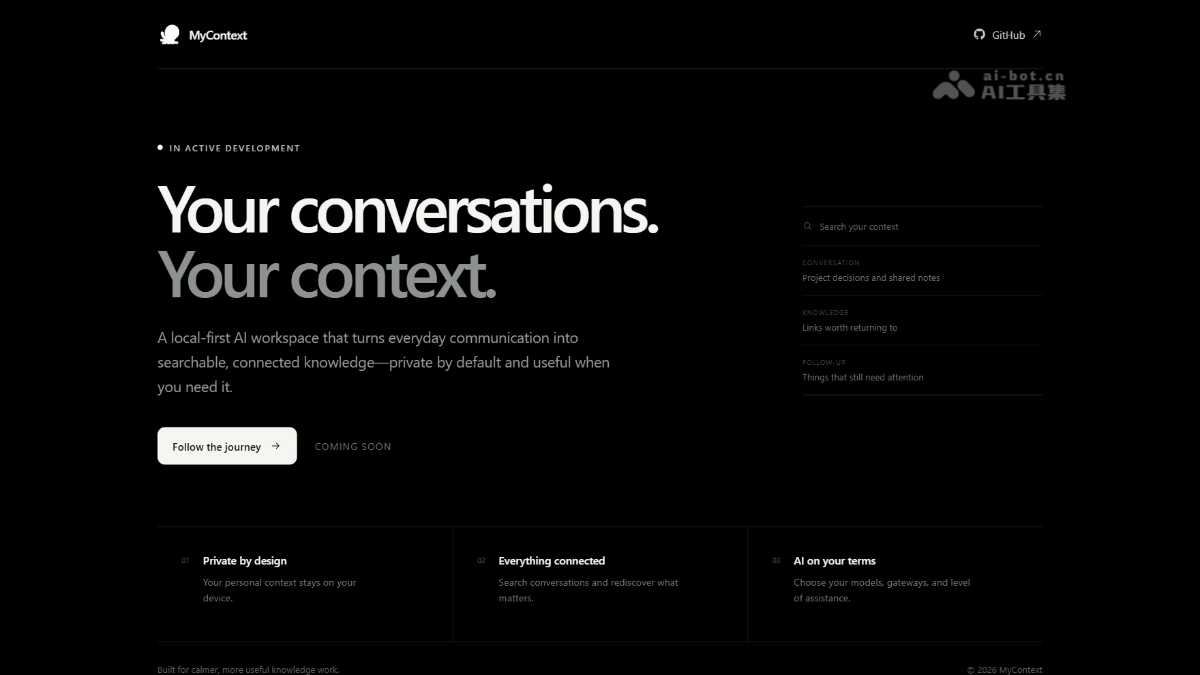
MyContext's Main Features
- Build a work profile: Precipitate multi-source data such as IM from DingTalk and Feishu, documents, and meetings into a continuously updated personal work profile covering responsibilities, collaborative relationships, and discussion conclusions.
- Traceable information: Every piece of information in the profile is labeled with its source, time, and content, and can be traced back to the original source.
- Handling of conflicting information: For information that is contradictory before and after, semantic analysis is used to determine whether to merge or overwrite. When it cannot be determined, it is left to the user to confirm and will no longer be overwritten by the model.
- Search-based Q&A: Supports natural language queries about work history, combining full-text search, semantic recall, and graph queries to provide answers with sources.
- Digital avatar: Build a dedicated Agent based on the profile, which can draft replies to work messages in the user's tone. Operations such as sending require user authorization.
How to Use MyContext
-
Download and deploy: Obtain the project from the GitHub repository and run the desktop application on a local device in a local-first manner.
-
Authorize access to data sources: Connect and authorize IM systems such as DingTalk and Feishu, as well as work data sources such as documents and meetings.
-
Import data: Import personal work data into MyContext, and the system automatically completes standardization processing and incremental synchronization.
-
Generate a work profile: The system automatically precipitates a dedicated work profile containing scope of responsibilities, collaborative relationships, behavioral habits, and discussion conclusions, and continuously updates it.
-
Build a dedicated Agent: Generate a dedicated Agent assistant based on the profile, which can be used to query work information, summarize knowledge, and assist in replying to messages in the user's own tone.
-
Manual confirmation of key steps: When conflicting information is encountered or consequential operations such as sending messages are involved, execution occurs after user confirmation to ensure accuracy and safety.
MyContext's Core Advantages
-
Positioning as context infrastructure: Process work data scattered across IM, documents, and meetings into a dedicated work profile that Agents can understand, completing the memory foundation for Agents to land in work scenarios.
-
Intelligent governance of conflicting information: Use semantic analysis to determine whether information should be merged or overwritten. When uncertain, it is left to the user to confirm and will no longer be overwritten by the model, avoiding the information loss of traditional solutions.
-
Fully traceable and anti-hallucination: Every piece of information is labeled with source, time, and content, and answers are evidence-based, improving the credibility of results.
-
Local-first privacy protection: Data and indexes are stored on the user's local machine. AI is only a user rather than the owner, meeting enterprise data security requirements.
-
Human-machine safety gate mechanism: Operations with consequences, such as sending messages, must be explicitly authorized by the user, balancing automation with safety and controllability.
MyContext's project address
- Project website:https://mycontext.md/
- GitHub repository:https://github.com/openTrinity/mycontext
Comparison of MyContext with similar competing products
| Comparison dimension | MyContext (Alibaba Qwen Office) | Mem0 |
|---|---|---|
| Publisher | Alibaba Cloud · Qwen Office team | Mem0 AI (U.S. startup, founded in 2023) |
| Product positioning | Agent context infrastructure for office scenarios | General-purpose Agent memory layer (Memory as a Service) |
| Product form | Local-first desktop application + complete nine-layer architecture | API/SDK middleware, requires developer integration |
| Target users | Workplace individuals and enterprises, ready to use out of the box | AI application developers |
| Data sources | Native integration with DingTalk, Feishu, and other IM, documents, and meeting records | Mainly processes conversation history; data sources must be integrated by the user |
| Memory architecture | Memory graph + hybrid full-text/semantic/graph retrieval | Vector-first memory extraction and retrieval |
| Contradictory information handling | Semantic analysis determines merge/overwrite; when uncertain, manual confirmation is required and cannot be overridden by the model | Heuristic add-or-update, no manual adjudication mechanism, old facts may "resurrect" |
| Traceability | Each piece of information is labeled with source, time, and content, fully traceable throughout | Memory traceability is relatively weak; there is the problem of "citing a memory but being unable to locate its source" |
| Privacy and security | Local-first; data and indexes are stored on the user's own machine | Cloud-hosted by default; self-hosting requires additional deployment |
MyContext's application scenarios
-
Intelligent message replies: Based on a personal work profile and communication habits, the Agent automatically drafts and replies to DingTalk/Feishu work messages in the user's tone.
-
Work information Q&A: Query personal work history in natural language (such as "What was the plan decided at last week's meeting?"), with answers accompanied by original sources.
-
Personal knowledge accumulation: Automatically organizes scope of responsibility, collaborative relationships, and discussion conclusions scattered across IM, documents, and meetings into a continuously updated work profile.
-
Collaborative relationship mapping: Presents the connections among people, projects, and topics through a memory graph, quickly clarifying cross-departmental collaboration context.
-
New hire/role transfer handover: The work profile is complete and traceable, reducing the cost of position handover and knowledge transfer.