
What is MVoT
MVoT (Multimodal Visualization-of-Thought) is a new multimodal reasoning paradigm launched by Microsoft Research, the Language Technology Lab at the University of Cambridge, and the Institute of Automation of the Chinese Academy of Sciences. It enhances the performance of multimodal large language models (MLLMs) in complex spatial reasoning tasks by generating visual reasoning traces through images. MVoT mimics the mechanism by which humans use both language and images when thinking, enabling the model to generate interleaved reasoning traces of text and images during the reasoning process, expressing the reasoning process more intuitively. MVoT introduces a token discrepancy loss to address the inconsistency between the language and visual embedding spaces in autoregressive MLLMs, significantly improving the quality of generated images and the accuracy of reasoning.
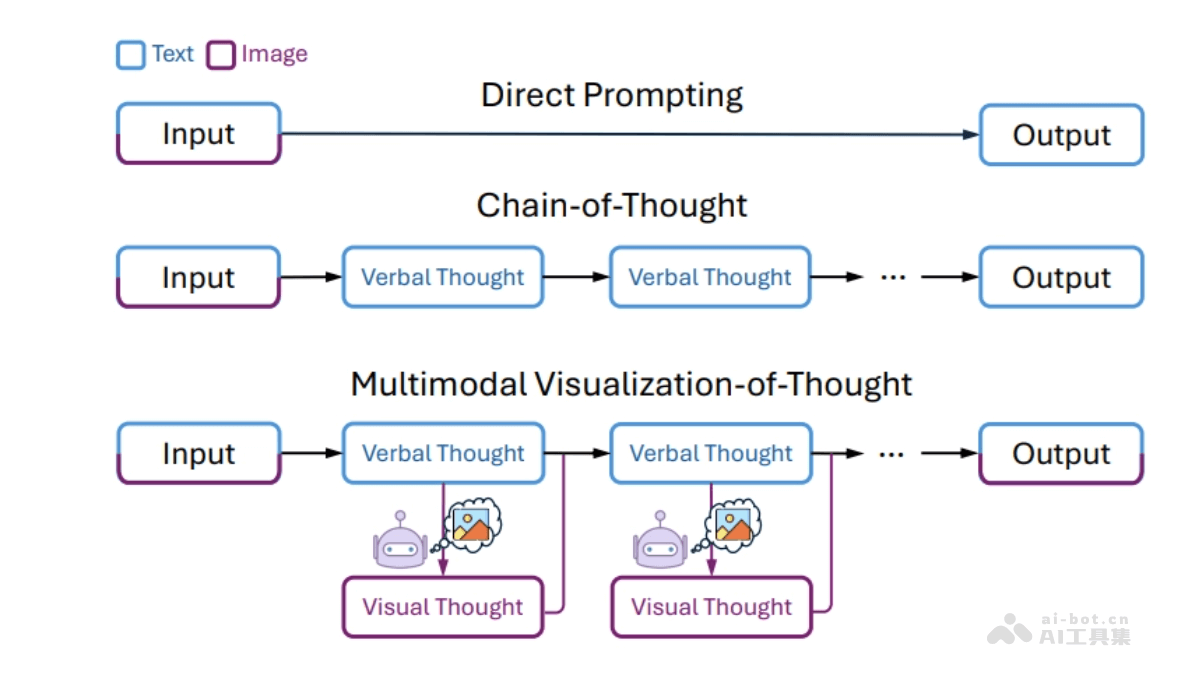
Main features of MVoT
- Generate visual reasoning traces: Generate the reasoning process in the form of images, helping the model better understand and express the logic and changes in spatial reasoning tasks.
- Improve reasoning accuracy: Based on visual reasoning traces, more accurately capture spatial layouts and visual patterns, improving the model's performance in complex spatial reasoning tasks.
- Enhance model interpretability: The visual reasoning traces generated by MVoT provide intuitive explanations for the model's reasoning process, allowing users to understand more clearly how the model reaches its conclusions.
- Improve reasoning robustness: In complex environments, MVoT shows better stability and adaptability, handling environmental complexity and dynamic changes more effectively.
Technical principles of MVoT
- Multimodal reasoning paradigm: Based on generating visual reasoning traces through images, allowing the model to useboth language and image modalities during the reasoning process. This paradigm is similar to the mechanism by which humans use both language and images when thinking, expressing complex reasoning processes more naturally.
- Token Discrepancy Loss: To address the inconsistency between the language and visual embedding spaces in autoregressive MLLMs, token discrepancy loss is introduced. By minimizing the difference between predictions and labels in the visual embedding space, it improves the quality and visual coherence of generated images.
- Interleaved reasoning traces: Generate interleaved text and image reasoning traces during the reasoning process. Each reasoning step includes a textual description and also the corresponding image visualization, allowing the model to express the reasoning process more comprehensively.
- Training strategy: Based on training on multimodal inputs and corresponding output labels, the model learns to generate interleaved reasoning traces. The training data includes multimodal inputs, language and image sequences in the reasoning process, and the final answer. This enables the model to better understand and generate multimodal reasoning processes.
- Recursive generation: During the reasoning process, recursively generate multimodal reasoning traces, continuing reasoning based on the images and text generated in the previous step. The recursive generation method can more naturally simulate the human reasoning process and avoid potential errors introduced in image descriptions.
MVoT project address
- arXiv technical paper:https://arxiv.org/pdf/2501.07542
Application scenarios of MVoT
- Robot navigation and path planning: In complex environments, help robots generate visual reasoning traces, dynamically update environmental maps, and predict obstacles and target positions along the path.
- Autonomous driving and traffic scene understanding: Visual reasoning traces generated by autonomous driving systems for traffic scenarios help the system predict traffic dynamics more accurately and improve the accuracy and safety of decisions.
- Intelligent Education and Learning Assistance: In the field of education, generating visual reasoning traces of the problem-solving process helps students understand the steps of solving problems more intuitively and enhances learning outcomes.
- Medical Imaging Analysis and Diagnosis: Medical imaging generates visual reasoning traces of image analysis to assist doctors in more accurately identifying the location and extent of lesions, improving the accuracy and efficiency of diagnosis.
- Interaction in Virtual Reality and Augmented Reality: In virtual reality (VR) and augmented reality (AR) applications, generating visual reasoning traces of the user interaction process helps the system better understand the user's intentions and actions, providing a more natural and smooth interaction experience.