
What is MVGenMaster
MVGenMaster is a multi-view diffusion model jointly launched by Fudan University, Alibaba DAMO Academy, and Hupan Lab. It is based on enhanced 3D priors to handle diverse novel view synthesis (NVS) tasks. The model is based on 3D priors warped by metric depth and camera poses, improving the generalization and 3D consistency of NVS. MVGenMaster can generate up to 100 novel views from a single image in a single forward pass. The research team also introduced a large-scale multi-view image dataset MvD-1M containing 1.6 million scenes, along with multiple training and model optimization techniques to enhance the model's performance on large-scale datasets.
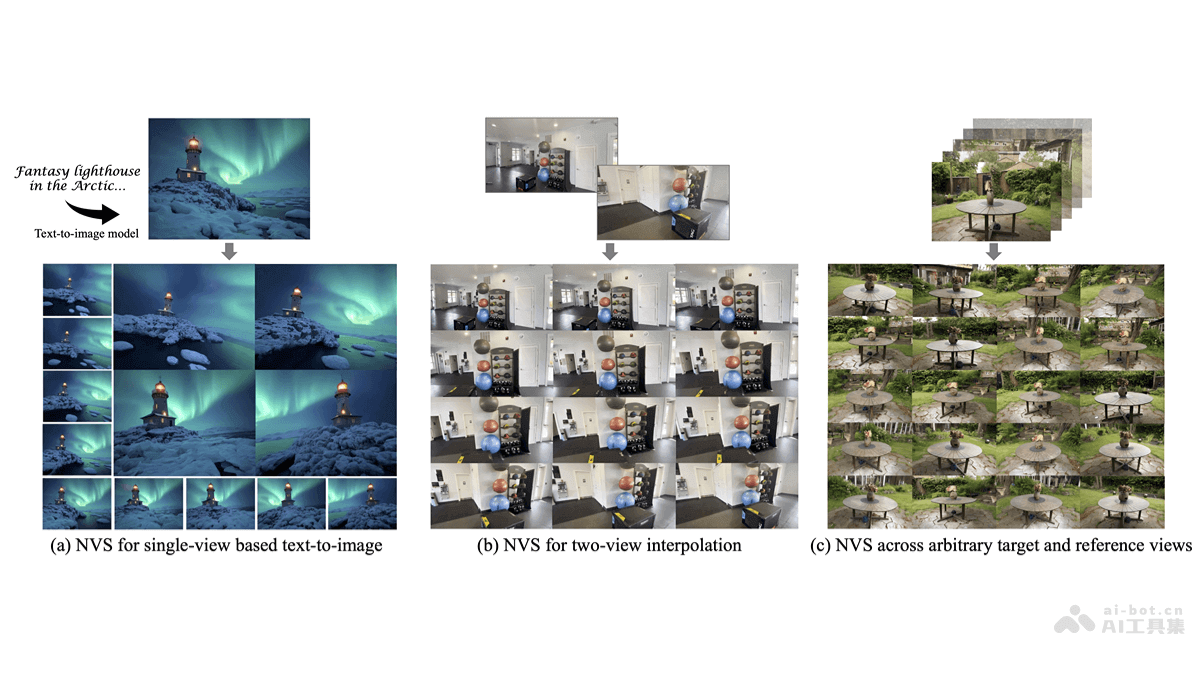
Main Features of MVGenMaster
- Multi-view generation: Generates up to 100 novel views from a single image or multiple reference images, suitable for different NVS tasks such as single-view NVS, two-view interpolation, and flexible NVS with arbitrary reference views and target views.
- 3D prior integration: Using 3D priors warped by metric depth and camera poses, the model maintains consistent 3D structure within a 2D diffusion model.
- Flexibility and generalization: The model is flexibly designed, can adapt to different viewpoints and scenes, and demonstrates generalization ability across various scenarios.
- Efficient forward process: Completes multi-view generation in a single forward process, without the need for complex iterative inference or dataset updates.
- Large-scale dataset support: Combined with the MvD-1M dataset, containing 1.6 million scenes and well-aligned metric depth.
Technical Principles of MVGenMaster
- 3D priors: MVGenMaster uses metric depth and camera poses to create 3D priors. The 3D priors are used in the model to guide the generation of novel views and ensure the consistency of 3D structure.
- Geometric warping: Based on geometric warping functions, the model warps the reference view's pixels and canonical coordinate mapping (CCM) from the source view to the target view.
- Multi-view diffusion model (LDM): MVGenMaster is based on a latent diffusion model (LDM), learning how to synthesize target view images from reference images and 3D priors.
- Attention mechanism: The model uses a full attention mechanism across all reference and target views, capturing dense camera pose representations.
- Plücker rays: Uses Plücker rays to represent camera poses, providing the model with precise camera position and direction information.
- Key rescaling technique: To handle extremely long sequences of target views, MVGenMaster introduces a key rescaling technique to enhance the guidance of reference views and balance the attention dilution problem.
Project Addresses of MVGenMaster
- Project official website:ewrfcas.github.io/MVGenMaster
- GitHub repository:https://github.com/ewrfcas/MVGenMaster
- arXiv technical paper:https://arxiv.org/pdf/2411.16157
Application Scenarios of MVGenMaster
- Video games: In video games, it is used to generate high-quality 3D content, enhancing the realism and immersion of game graphics.
- Film and visual effects: In film production and visual effects, it creates complex 3D scenes and effects, reducing the cost of actual shooting and post-production.
- Virtual reality (VR) and augmented reality (AR): In VR and AR applications, it generates realistic 3D environments, providing users with richer and more interactive experiences.
- 3D modeling and design: Designers create 3D models from 2D images, accelerating the process of product design and prototyping.
- Architectural Visualization: In architecture and urban planning, it helps architects and planners display architectural designs from different angles for better solution evaluation.