
What is MVDrag3D
MVDrag3D is an innovative 3D editing framework that combines multi-view generation and reconstruction priors to achieve flexible and creative drag-based editing. The framework uses a multi-view diffusion model as a generative prior to ensure consistent drag-based editing across multiple rendered views, reconstructs a 3D Gaussian representation of the edited object based on a reconstruction model, and uses a view-specific deformation network to adjust Gaussian positions to achieve alignment across views. Finally, a multi-view score function is used to enhance view consistency and visual quality. MVDrag3D can handle significant topological changes and generate new textures across multiple object categories, supports various 3D representations such as 3D Gaussians and meshes, and demonstrates precision, generativity, and flexibility.
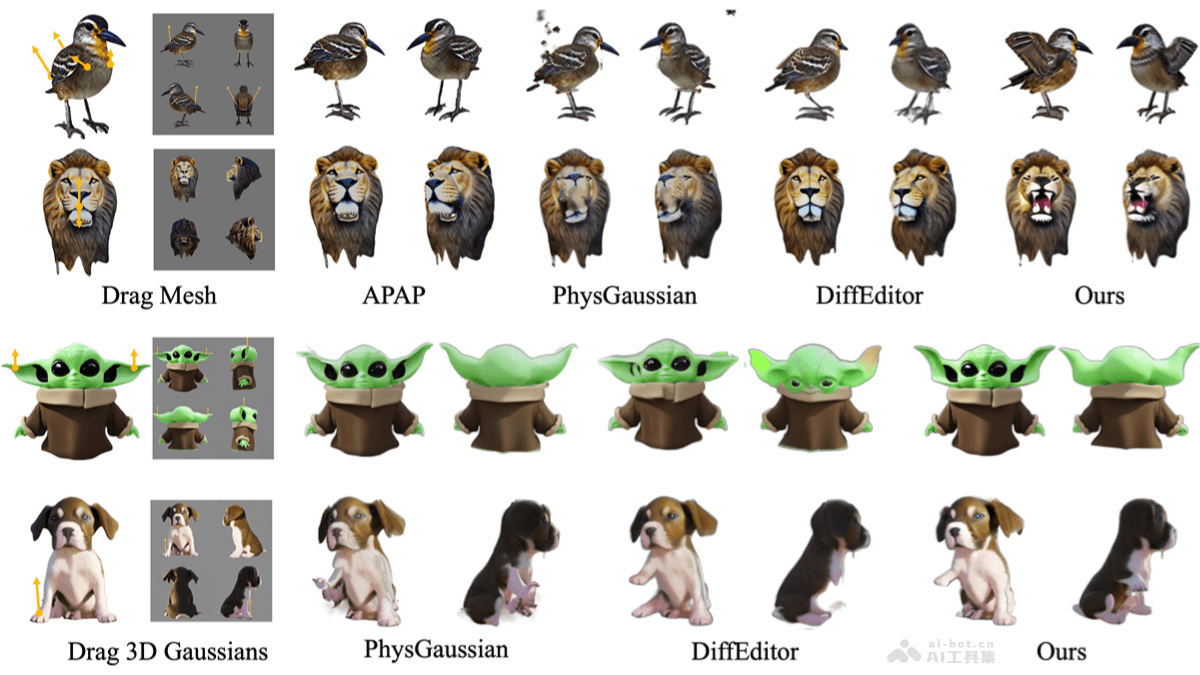
Main features of MVDrag3D
- Multi-view consistent editing: MVDrag3D performs consistent drag-based editing across multiple orthogonal views, ensuring that 3D editing operations remain consistent from different viewpoints.
- 3D Gaussian reconstruction: The framework uses a reconstruction model to convert the edited 2D views into a 3D Gaussian representation, capturing the structure of the 3D object.
- View alignment: A view-specific deformation network is used to adjust the positions of 3D Gaussians, addressing alignment issues between different views.
- Visual quality enhancement: A multi-view score function is used to extract generative priors from multiple views, enhancing the visual quality and view consistency of the final output.
- Support for diverse editing: It is suitable for multiple object categories and 3D representations, such as 3D Gaussians and meshes, providing a broader range of editing effects.
- Handling topological changes: It handles significant topological changes, such as generating new textures and structures during the editing process.
Technical principles of MVDrag3D
- Multi-view diffusion model: As a generative prior, the multi-view diffusion model is used to perform consistent drag-based editing across multiple rendered views, ensuring consistency of editing operations.
- 3D Gaussian representation: The edited views reconstruct a 3D Gaussian representation of the 3D object, a probabilistic distribution method for describing 3D shapes.
- View-specific deformation network: To address potential alignment issues of the initial 3D Gaussians across different views, a deformation network is used to adjust the positions of the Gaussians and achieve precise alignment.
- Multi-view score function: A multi-view score function is proposed to extract generative priors from multiple views, enhancing view consistency and improving visual quality.
- Two-stage optimization process: The deformation network is used to adjust Gaussian positions to improve geometric alignment, and an image-conditioned multi-view score function is used to refine the 3D Gaussians, enhancing the visual quality of the final output.
- DDIM inversion and random noise: Random noise is introduced during the DDIM inversion process to help the latent variables become closer to a Gaussian distribution, improving the stability of the editing process and the preservation of object identity.
Project address of MVDrag3D
- Project website:chenhonghua.github.io/MyProjects/MvDrag3D
- GitHub repository:https://github.com/chenhonghua/MvDrag3D
- arXiv technical paper:https://arxiv.org/pdf/2410.16272
Application scenarios of MVDrag3D
- 3D content creation: Artists and designers can intuitively edit and create 3D models, such as game characters, film special effects, and virtual environments.
- Virtual reality (VR) and augmented reality (AR): In VR and AR applications, 3D objects can be edited in real time, providing a more immersive user experience.
- Computer-aided design (CAD): Engineers make precise 3D model modifications, accelerating the product design and iteration process.
- Digital sculpting and modeling: Digital artists perform digital sculpting, simulating the intuitive operations of the traditional sculpting process.
- Education and training: Used as a teaching tool in the education field to help students better understand 3D space and geometric structures.