
What is MV-Adapter
MV-Adapter is a multi-view consistent image generation model launched by the research teams of Beihang University, VAST, and Shanghai Jiao Tong University. MV-Adapter can transform a pre-trained text-to-image diffusion model into a multi-view image generator without changing the original network structure or feature space. Based on an innovative attention architecture and a unified condition encoder, MV-Adapter efficiently models multi-view consistency and the relevance of reference images, supports the generation of high-resolution multi-view images, and can be adapted to a variety of customized models and plugins, enabling a wide range of application scenarios.
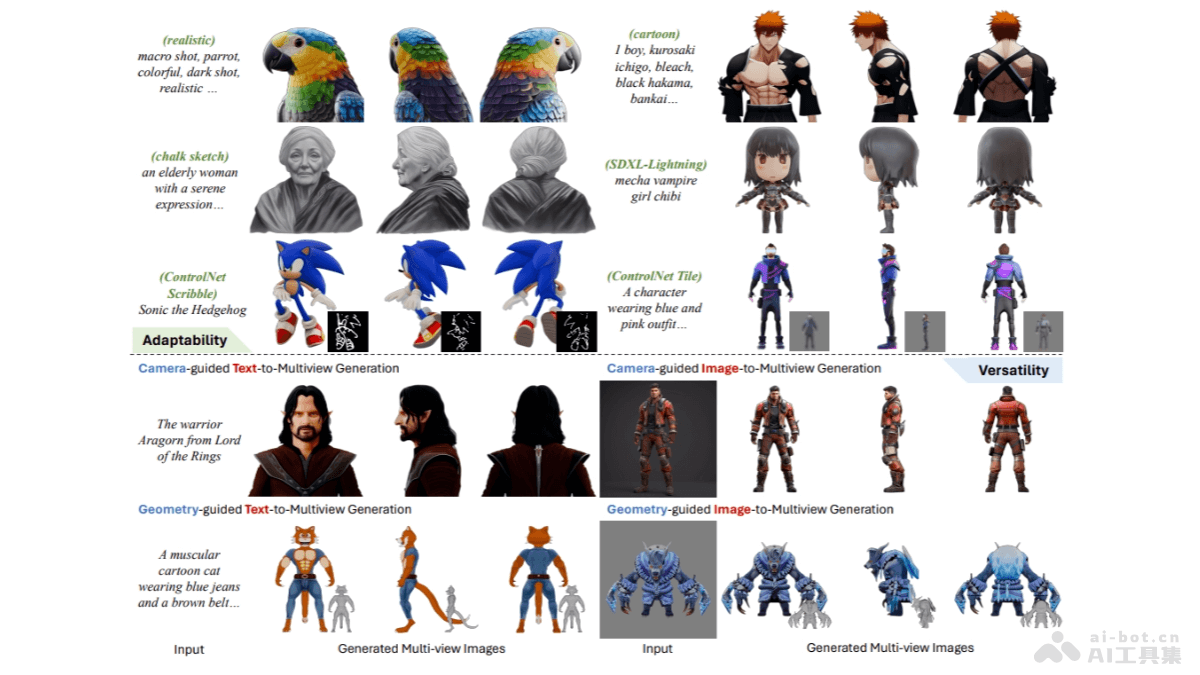
Main Features of MV-Adapter
- Multi-view image generation: MV-Adapter can generate 768-resolution multi-view consistent images, making it one of the highest-resolution multi-view image generators currently available.
- Adaptation to customized models: It perfectly adapts to customized text-to-image models, Latent Consistency Models (LCM), ControlNet plugins, etc., enabling multi-view controllable generation.
- 3D model reconstruction: It supports generating multi-view images from text and images, and reconstructing 3D models.
- High-quality 3D textures: It uses known geometry guidance to generate high-quality 3D textures.
- Arbitrary viewpoint generation: It can be extended to generate images from arbitrary viewpoints, supporting a broader range of downstream tasks.
Technical Principles of MV-Adapter
- General condition guider: A general condition guider is designed to encode camera and geometry information, providing different types of guidance for text-to-image models, including camera conditioning and geometry conditioning.
- Decoupled attention layers: A decoupled attention mechanism is introduced, replicating existing spatial self-attention layers to add new multi-view attention layers and image cross-attention layers, avoiding invasive modifications to the base model.
- Parallel attention architecture: The design of MV-Adapter adds multi-view attention layers and image cross-attention layers in parallel, ensuring that the newly introduced attention layers share input features with the pre-trained self-attention layers and fully inherit the image prior information of the original model.
- Specific implementation of the multi-view attention mechanism: According to different application requirements, multiple multi-view attention strategies are designed, such as row-level self-attention, a combination of row-level and column-level self-attention, and full self-attention, adapting to different multi-view generation needs.
- Specific implementation of the image cross-attention mechanism: To more precisely guide reference image information during the generation process, an innovative image cross-attention mechanism is introduced, fully utilizing the detailed information of reference images without changing the feature space of the original text-to-image model.
Project Address of MV-Adapter
- Project official website:huanngzh.github.io/MV-Adapter
- GitHub repository:https://github.com/huanngzh/MV-Adapter
- HuggingFace model library:https://huggingface.co/huanngzh/mv-adapter
- arXiv technical paper:https://arxiv.org/pdf/2412.03632
- Online experience Demo
- Single image to multi-view:https://huggingface.co/spaces/VAST-AI/MV-Adapter
- Text to anime-style multi-view:https://huggingface.co/spaces/huanngzh/MV-Adapter
Application Scenarios of MV-Adapter
- 2D/3D content creation: It helps artists and designers create richer and more realistic visual content in the 2D and 3D fields.
- Virtual Reality (VR) and Augmented Reality (AR): In VR and AR applications, generate 3D environments and objects that align with changes in the user's perspective, enhancing immersion and interactive experience.
- Embodied Perception and Simulation: In the fields of robotics and automation, train and test machine vision systems to improve navigation and manipulation capabilities in complex environments.
- Autonomous Driving: Generate multi-view traffic scene images to assist autonomous driving systems in environmental perception and decision-making.
- 3D Scene Reconstruction: In fields such as cultural heritage preservation and architectural modeling, rapidly generate high-precision 3D models.