
What is Muse Spark 1.3
Muse Spark 1.3 is a new-generation large language model released by Meta, personally endorsed by Zuckerberg, positioned as Meta's major breakthrough in coding and agent tasks. The model performs exceptionally well in code understanding and long-text processing, significantly reduces tool calls and Token consumption, and opens its API to developers at a highly competitive price.
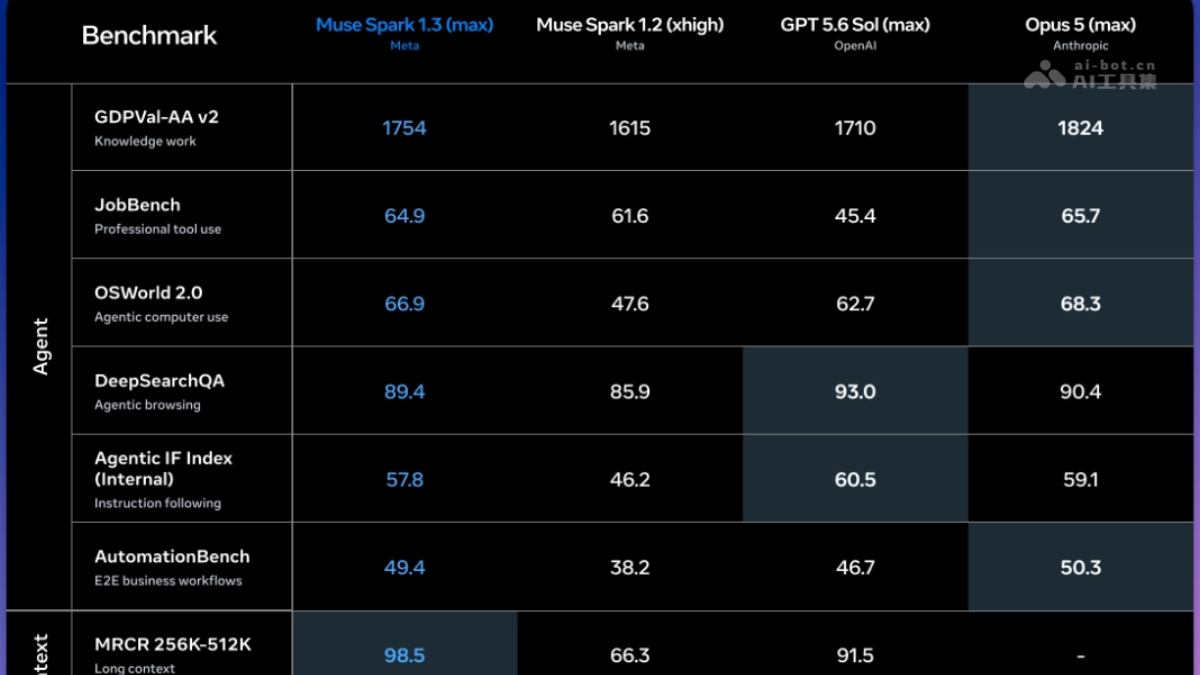
Main Features of Muse Spark 1.3
-
Long-horizon Agent Workflows: Supports long-running open-ended tasks, can autonomously gather context, organize clues from messy information, proactively adjust after discovering gaps in the plan, and continuously record status until delivery.
-
Enhanced Coding Capabilities: Optimized for long-duration coding tasks, reduces unnecessary conversation turns, produces cleaner code style, and performs outstandingly in codebase understanding and terminal programming.
-
Complex Instruction Following: In multi-step, multi-constraint tasks, it can continuously remember earlier requirements, reducing problems of missing conditions or deviating from the process in the latter half.
-
Long-context Processing: Supports a 1M tokens context window, with extremely high accuracy in long-text retrieval.
-
Human-AI Collaboration Optimization: Proactively asks users follow-up questions when facing ambiguous instructions, proactively seeks help when tasks are blocked, and confirms before performing irreversible operations.
-
Improved Cost Efficiency: When completing the same task, tool calls are reduced by about 20%, and Token consumption is reduced by about 25%.
Technical Principles of Muse Spark 1.3
-
Post-training and Test-time Scaling: Performs additional post-training based on the Avocado model, while strengthening test-time scaling capabilities, enabling the model to dynamically allocate more computing resources during inference to improve output quality.
-
Multi-environment Agent Training: The model was trained in a variety of different Agent harnesses, allowing it to maintain similar working capabilities after leaving a specific environment.
-
Capability Boundary Alignment: Meta specifically strengthened the model's training in awareness of its own capability boundaries, enabling it to more accurately distinguish "what it knows, what it does not know, what it can do, and what it cannot do," and to clearly express itself when encountering obstacles rather than fabricating results.
-
Long-horizon Coding Task Data: Added a large amount of training data for long-duration coding tasks and optimized usability for daily engineering scenarios, making the model more efficient and more restrained in real development workflows.
How to Use Muse Spark 1.3
-
Muse Code Terminal Programming: Execute in the terminal
curl -fsSL https://dev.meta.ai/install.sh | bashInstall Muse Code to directly call Muse Spark 1.3 as the underlying model in coding workflows. -
Meta Model API Access: Developers can call it directly through the official API, with standard pricing of $1.25 per million tokens for input and $4.25 per million tokens for output.
-
Contributor Discount Tier: Enabled by default after installing Muse Code, usable at the low price of $0.10 input and $0.20 output, at the cost that prompts and code output will be used by Meta for training, and it can be manually switched off.
-
Third-party Platform Integration: Partner platforms such as Vercel AI Gateway have already integrated Muse Spark 1.3, making it convenient to quickly integrate calls into existing workflows.
Core Advantages of Muse Spark 1.3
-
Leading Coding Capabilities: Ranked first in multiple programming benchmarks such as DeepSWE, SWEAtlas, and Terminal-Bench, surpassing GPT-5.6 Sol and Claude Opus 5.
-
Extremely strong long context: Supports a 1M tokens context, with long-text retrieval accuracy as high as over 98%, far ahead of competitors.
-
Excellent in both cost and efficiency: For the same tasks, tool calls are reduced by about 20% and Token consumption by about 25%, and API pricing is far lower than models of the same tier.
-
Autonomy for long-horizon Agent tasks: Can autonomously gather information, proactively adjust after discovering gaps in a plan, and continuously maintain state in complex open-ended tasks.
-
More natural human-machine collaboration: Proactively asks follow-up questions when faced with ambiguous instructions, proactively seeks help when tasks are blocked, and confirms execution before irreversible operations.
-
Highly competitive cost-effectiveness: The standard-tier pricing is only about 1/5 of Claude Opus 5, and the Contributor discount tier is as low as "almost negligible."
Comparison of Muse Spark 1.3 with similar competitors
| Comparison dimension | Muse Spark 1.3 | Claude Opus 5 |
|---|---|---|
| Publisher | Meta | Anthropic |
| Context window | 1M tokens | 200K tokens |
| Programming capability | DeepSWE v1.1 score 75.4%, leading | DeepSWE v1.1 score 74.0%, slightly inferior |
| Knowledge work | GDPVal-AA v2 score 1754 | GDPVal-AA v2 score 1824, stronger |
| Computer control | OSWorld 2.0 score 66.9 | OSWorld 2.0 score 68.3, slightly better |
| Standard input pricing | $1.25 / million tokens | $5 / million tokens |
| Standard output pricing | $4.25 / million tokens | $25 / million tokens |
Application scenarios of Muse Spark 1.3
- Intelligent programming development: Completes complex code writing, cross-file debugging, and understanding of large codebases through Muse Code, with significantly reduced tool calls and Token consumption.
- In-depth analysis of long documents: Uses a 1M tokens context window to process long texts at the million-word level, performing cross-chapter information extraction, association analysis, and precise retrieval.
- Long-term task management for personal Agents: Continuously tracks user goals, autonomously gathers information, proactively adjusts strategies after discovering gaps in the plan, and continues until the final deliverable is produced.
- Generation of complex engineering reports: Integrates multi-source heterogeneous data (such as CFD simulation results and CAD models) and automatically generates structured professional reports in the specified format.