
What is Mu
Mu is a small-parameter language model released by Microsoft, with only 330 million parameters, and supports efficient operation on NPUs and edge devices. The model is based on an encoder-decoder architecture, and through hardware-aware optimization, model quantization, and task-specific fine-tuning, it achieves a response speed of over 100 tokens per second. Mu supports a Windows Settings agent, enabling real-time conversion of natural language instructions into system operations, such as adjusting screen brightness, mouse pointer size, and more. Compared with Phi-3.5-mini, Mu has 10 times fewer parameters but comparable performance. Its innovations include dual layer normalization, rotary position embeddings, and grouped-query attention, among other techniques, improving training stability and inference efficiency.
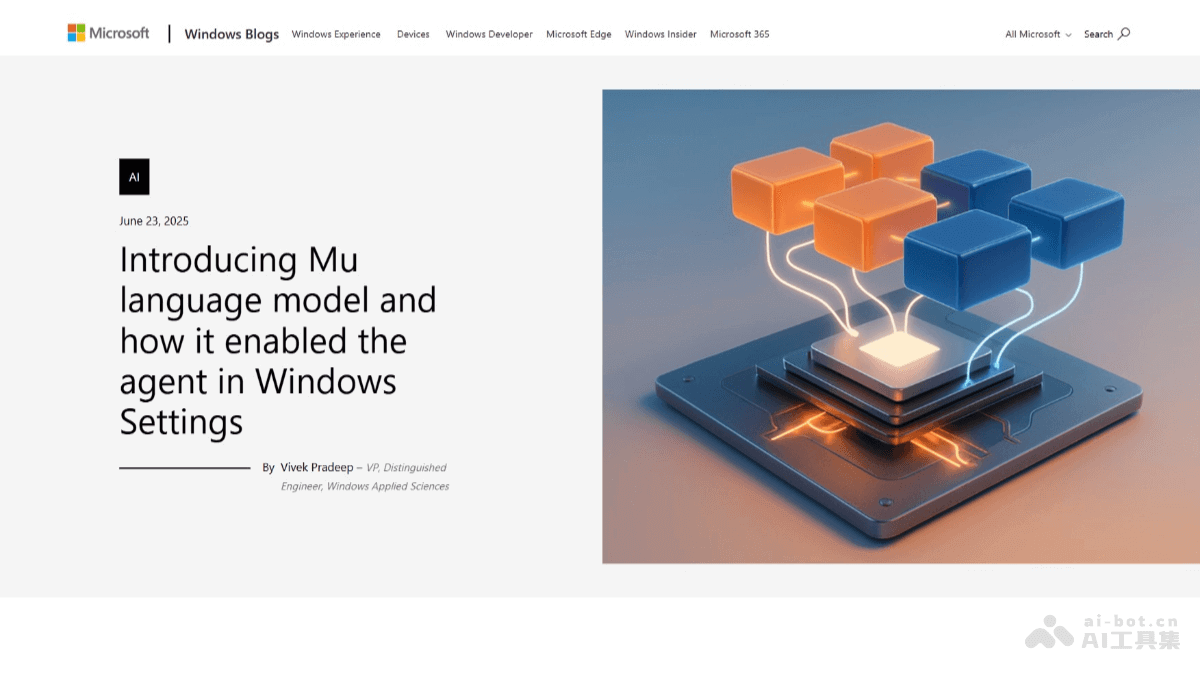
Main features of Mu
- System settings adjustment: Users adjust system settings based on natural language instructions, such as "make the mouse pointer larger" or "adjust screen brightness."
- Low-latency response: Mu can respond quickly on-device, with a response speed exceeding 100 tokens/second, ensuring a smooth user experience.
- Integrated into Windows Settings: Mu is integrated into the search box in Windows Settings. Users directly enter natural language instructions in the search box, and the system automatically recognizes and executes the relevant operations.
- Supports multiple settings: Mu can handle hundreds of system settings, covering various needs in users' daily use.
Technical principles of Mu
- Encoder-decoder architecture: Mu is based on an encoder-decoder architecture. The encoder converts the input text into a fixed-length latent representation, and the decoder generates the output based on the representation.
- Hardware-aware optimization: Mu is optimized for NPUs, including adjusting the model architecture and parameter shapes to adapt to hardware parallelism and memory constraints, ensuring efficient operation of the model on NPUs.
- Model quantization: Based on post-training quantization (PTQ), model weights and activations are converted from floating point to integer representations, mainly using 8-bit and 16-bit integers, significantly reducing the model's memory footprint and computational requirements while maintaining model accuracy.
- Innovative Transformer upgrades:
- Dual LayerNorm: LayerNorm operations are performed before and after each sublayer, ensuring a well-distributed activation distribution and stabilizing the training process.
- Rotary Positional Embeddings (RoPE): Based on rotation operations in the complex number domain, position encodings are dynamically generated, supporting extrapolation capability for long sequences and avoiding the limitations of traditional absolute position encodings.
- Grouped-Query Attention (GQA): Based on sharing keys and values among head groups, it reduces the number of attention parameters and memory footprint, maintains head diversity, and improves model efficiency.
- Training techniques: Pretraining is performed using A100 GPUs, knowledge distillation is conducted from the Phi model, and task-specific fine-tuning is performed based on the low-rank adaptation (LoRA) method, further improving model performance.
Mu project address
- Project official website:https://blogs.windows.com/windowsexperience/2025/06/23/introducing-mu-language-model-and-how-it-enabled-the-agent-in-windows-settings/
Application scenarios of Mu
- System settings adjustment: Mu can understand natural language instructions and help users quickly adjust Windows system settings, such as screen brightness, mouse pointer size, and more, without manually searching through settings menus, improving operational convenience.
- Real-time interaction: Mu can respond quickly on-device, with a response speed exceeding 100 tokens/second, making it suitable for real-time interaction scenarios.
- Multilingual support: Mu supports multiple natural languages. Users can input commands in different languages, and Mu can accurately understand and execute them.
- Accessibility features: Mu helps users with poor vision or limited mobility complete system settings based on voice commands, improving system accessibility.
- Future expansion: Mu has good extensibility and can be expanded in the future into a more general-purpose intelligent assistant to handle commands such as schedule management and file operations.