
What is MSQA
MSQA (Multi-modal Situated Question Answering) is a large-scale multi-modal situated reasoning dataset that enhances the understanding and reasoning capabilities of embodied AI agents in 3D scenes. The dataset contains 251K question-answer pairs, covering 9 question categories, and was collected in real-world 3D scenes based on 3D scene graphs and vision-language models. MSQA uses interleaved multi-modal inputs of text, images, and point clouds to reduce the ambiguity of single-modal inputs. It introduces the MSNN (Multi-modal Next-step Navigation) benchmark to evaluate the ability of models to navigate between situations, helping to develop more powerful situated reasoning models and advancing the development of 3D scene understanding technology.
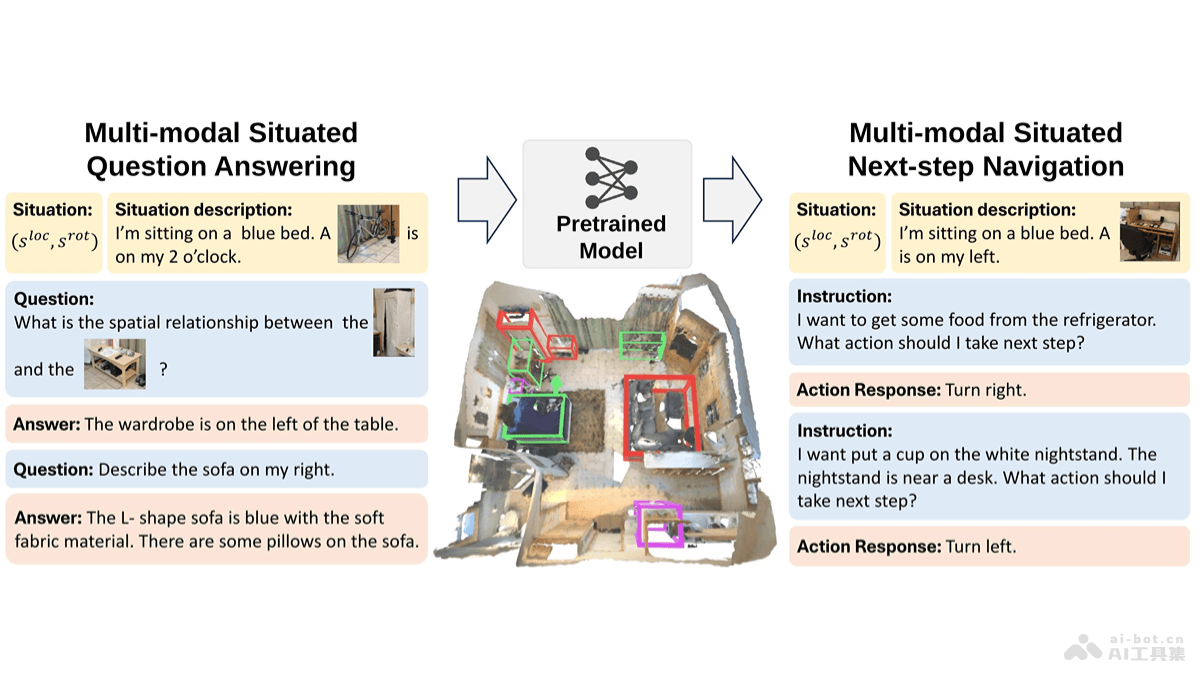
Main Features of MSQA
- Multi-modal Situated Reasoning: MSQA provides a dataset containing 251K question-answer pairs, covering 9 different question categories, involving complex situations and object modalities in 3D scenes.
- Diversity of Data Modalities: Supports multiple data modalities such as text, images, and point clouds, providing more comprehensive situation descriptions and reducing the limitations and ambiguity of single-modal inputs.
- Evaluating Model Performance: Designs two benchmark tasks, MSQA and MSNN, to evaluate and compare the situated reasoning and navigation capabilities of different models in 3D scenes.
- Advancing AI Research: Based on providing a large-scale multi-modal dataset, MSQA promotes research progress in the fields of embodied AI and 3D scene understanding.
- Pre-training and Model Development: The MSQA dataset serves as pre-training material, helping to develop and optimize more powerful situated reasoning models.
Technical Principles of MSQA
- Data Collection and Generation: Uses 3D scene graphs and vision-language models (VLMs) to automatically and scalably collect data in real-world 3D scenes.
- Multi-modal Input Setup: Introduces interleaved multi-modal inputs, combining text, image, and point cloud data to provide more accurate situation and question descriptions.
- Situation Awareness Modeling: Integrates input data from different modalities to improve the model's perception and understanding of situations.
- Evaluation Benchmark Design: Designs two benchmarks, MSQA and MSNN, targeting situated question answering and next-step navigation tasks respectively, to comprehensively evaluate the model's multi-modal understanding and situated reasoning capabilities.
- Model Evaluation and Analysis: Conducts experiments on MSQA and MSNN, analyzes the limitations of existing models, and explores the importance of handling multi-modal inputs and situation modeling.
MSQA Project Address
- Project Website:msr3d.github.io
- arXiv Technical Paper:https://arxiv.org/pdf/2409.02389
Application Scenarios of MSQA
- Intelligent Navigation Systems: In indoor or outdoor environments, helps develop intelligent systems that understand complex spatial relationships and provide navigation instructions.
- Augmented Reality (AR) and Virtual Reality (VR): In AR and VR applications, provides in-depth understanding and interaction with virtual environments, enhancing user experience.
- Robot Interaction: Enables robots to understand and respond to questions about their surrounding environment, improving their operation and interaction capabilities in complex 3D spaces.
- Autonomous Vehicles: Assists autonomous vehicles in understanding traffic scenes, providing more accurate decision support, and handling complex road conditions.
- Intelligent Assistants and Chatbots: Understand the user's 3D spatial queries and provide more accurate and contextually relevant answers.