
What is MotionClone
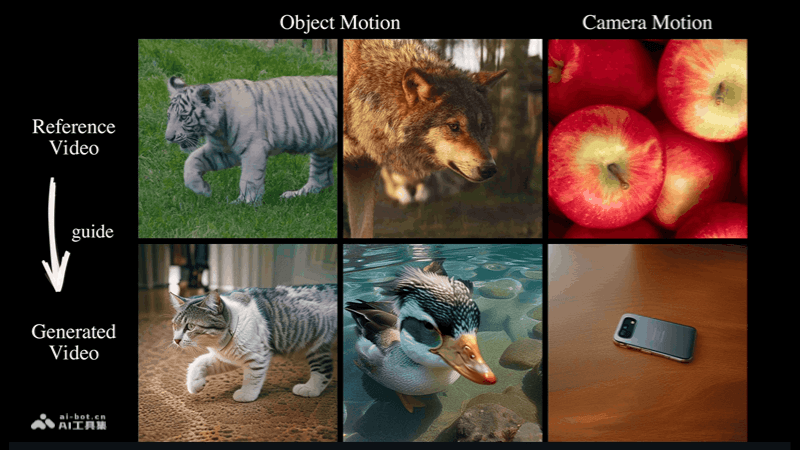
MotionClone is a text-driven AI video motion cloning framework that clones motions from reference videos through temporal attention mechanisms and combines text prompts to generate new videos. It can handle complex global camera movements and fine local limb motions, enabling highly realistic and controllable video content creation. MotionClone introduces a position-aware semantic guidance mechanism to ensure the accuracy of video motion and the reasonableness of the scene.
Main Features of MotionClone
- Training-free video motion cloning: MotionClone can extract motion information from reference videos without training or fine-tuning.
- Text-to-video generation: Combined with text prompts, MotionClone can generate new videos with specified motions.
- Global and local motion control: It simultaneously supports global camera motion and fine motion control of local objects (such as human limbs).
- Temporal attention mechanism: MotionClone can capture and replicate key motion features in videos.
- Position-aware semantic guidance: It introduces a position-aware mechanism to ensure the reasonableness of spatial relationships during video generation and enhance the ability to follow text prompts.
- High-quality video output: It can provide high-quality video generation results in terms of motion fidelity, text alignment, and temporal consistency.
Technical Principles of MotionClone
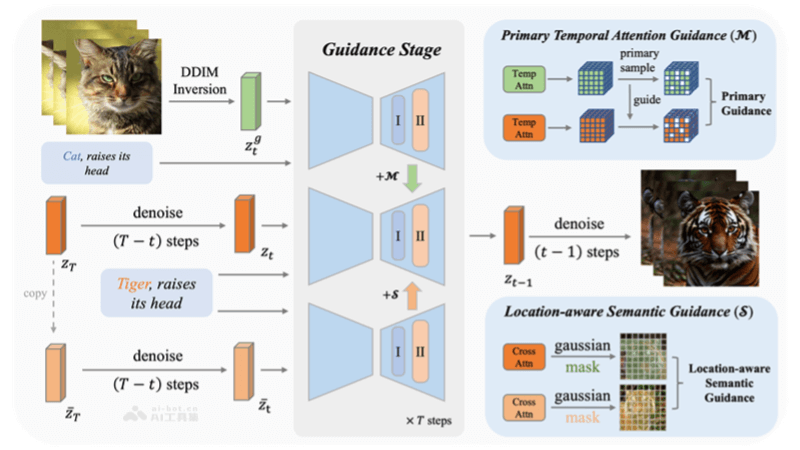
- Temporal attention mechanism: By analyzing the temporal correlations between video frames, it captures core motion information, thereby understanding motion patterns in videos.
- Main temporal attention guidance: It filters out the most important parts of temporal attention, focuses on the main motion, reduces noise interference, and improves the accuracy of motion cloning.
- Position-aware semantic guidance: It combines the foreground positions and semantic information in the reference video to guide the generation model in creating video content with reasonable spatial relationships and consistency with text descriptions.
- Video diffusion model: It uses the encoding and decoding process of the diffusion model to convert the input video into a latent representation, and then gradually generates new video frames.
- DDIM inversion: It uses the DDIM algorithm to invert the latent representation and obtain a time-related latent set, providing a dynamic foundation for video generation.
- Joint guidance: It combines temporal attention guidance and semantic guidance to work together to generate videos with high motion realism, text alignment, and temporal coherence.
MotionClone Project Address
- Project official website:https://bujiazi.github.io/motionclone.github.io/
- GitHub repository:https://github.com/Bujiazi/MotionClone
- arXiv technical paper:https://arxiv.org/pdf/2406.05338
Application Scenarios of MotionClone
- Film and television production: The film and television industry can use MotionClone to quickly generate animation or special effects scenes, reducing the complexity and cost of actual shooting.
- Virtual reality (VR) and augmented reality (AR): In VR and AR applications, MotionClone can create realistic dynamic environments and character motions.
- Game development: Game designers can use MotionClone to generate unique character motions and animations, accelerating the game development process.
- Advertising creativity: The advertising industry can quickly produce attractive video ads and capture the audience's attention through dynamic content.
- Social media content: Content creators can use MotionClone on social media to generate interesting and innovative short videos, increasing fan interaction and engagement.