
What is MotionCanvas
MotionCanvas is an image-to-video (I2V) generation method introduced by The Chinese University of Hong Kong, Adobe Research, and Monash University. It can transform static images into videos with rich dynamic effects. MotionCanvas is based on the introduction of a motion design module, allowing users to intuitively plan camera motion and object motion on the image, enabling complex shot design. With the motion signal conversion module, MotionCanvas accurately translates the user's motion intent in 3D scene space into control signals in 2D screen space, driving the video diffusion model to generate high-quality videos. MotionCanvas supports joint control of camera and object motion, generates long videos with complex trajectories, and achieves fine-grained control of local object motion.
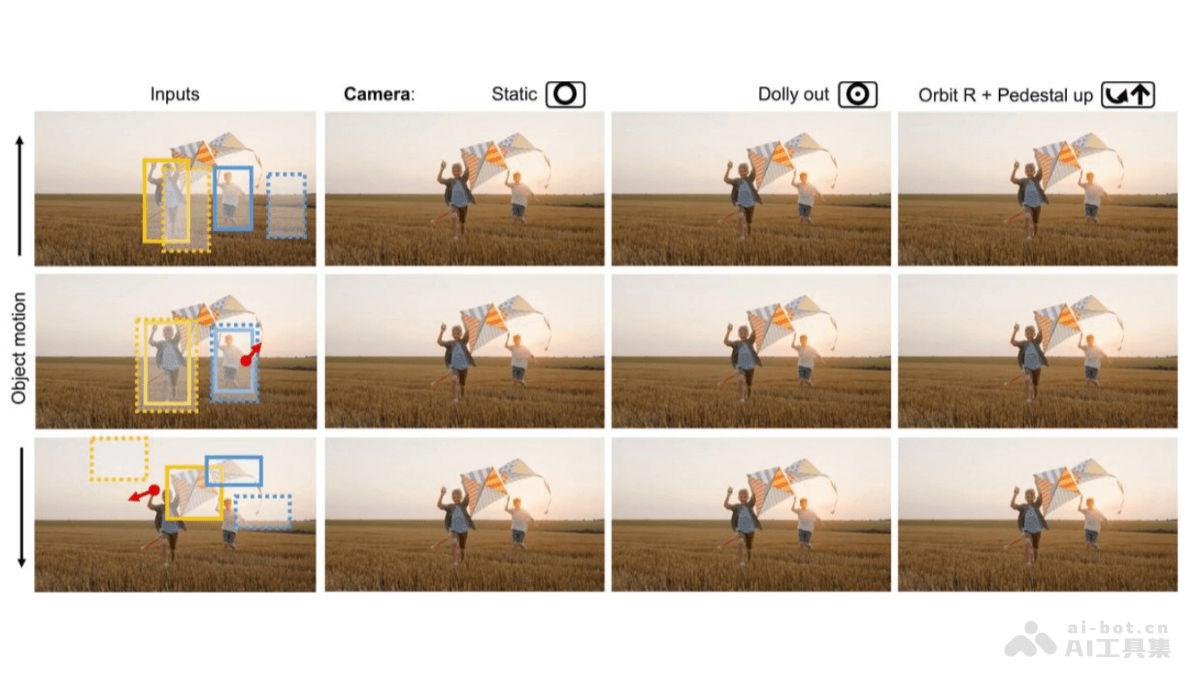
Main Features of MotionCanvas
- Joint control of camera and object motion: Users intuitively design the camera's motion path (such as translation, rotation, zoom, etc.) and the object's global motion (such as movement, scaling, etc.), as well as the object's local motion (such as arm swinging, etc.) on the input image.
- 3D-aware motion control: The system is based on depth estimation and a motion signal conversion module, enabling motion design in 3D scene space, converting it into motion signals in 2D screen space, and generating videos with 3D-aware effects.
- Long video generation: Supports the generation of videos of arbitrary length, and supports complex motion trajectories and continuous shot design.
- Diverse application scenarios: Supports application to simple video editing tasks, such as motion transfer and video generation based on initial frame editing.
Technical Principles of MotionCanvas
- Motion design module: The user input image serves as a "canvas" for designing camera motion and object motion in 3D scene space. Camera motion is achieved based on the camera pose of specified keyframes, while object motion is defined through scene-anchored bounding boxes and sparse point trajectories.
- Motion signal conversion module: Converts the motion intent designed by the user in 3D scene space into motion signals in 2D screen space. The module is based on depth estimation and camera parameter estimation, converts the 3D camera path into 2D point trajectories, and converts scene-anchored bounding boxes and point trajectories into signals in screen space.
- Motion-conditioned video generation model: Based on a pre-trained DiT (Diffusion Transformer) model, fine-tuned so that it can generate videos according to motion conditions in screen space. The model is based on encoded point trajectories and bounding box sequences, which are input as conditional signals to the video generation model to generate videos that match the user's intent.
- Autoregressive generation: Uses an autoregressive approach, taking generated video clips as conditions for subsequent generation, and gradually generating continuous video content, avoiding the motion discontinuity problems that may result from directly generating long videos.
Project Address of MotionCanvas
- Project official website:https://motion-canvas25.github.io/
- arXiv technical paper:https://arxiv.org/pdf/2502.04299
Application Scenarios of MotionCanvas
- Film and video production: Quickly design complex shots, transform static images into dynamic videos, and use them in advertising, promotion, etc., to enhance visual appeal.
- Animation creation: Generate animation previews and character actions, extract dynamic effects from static storyboards or images, and improve creation efficiency.
- VR/AR experience: Generate dynamic scenes for virtual and augmented reality applications, enhancing user immersion and supporting real-time interaction.
- Game Development: Create game cutscenes and dynamic scenes, improving game narrative and visual effects, and enriching the player experience.
- Education and Training: Transform static teaching images into dynamic videos for classroom instruction and professional simulation training, improving teaching interest and effectiveness.