
What is Motion Prompting
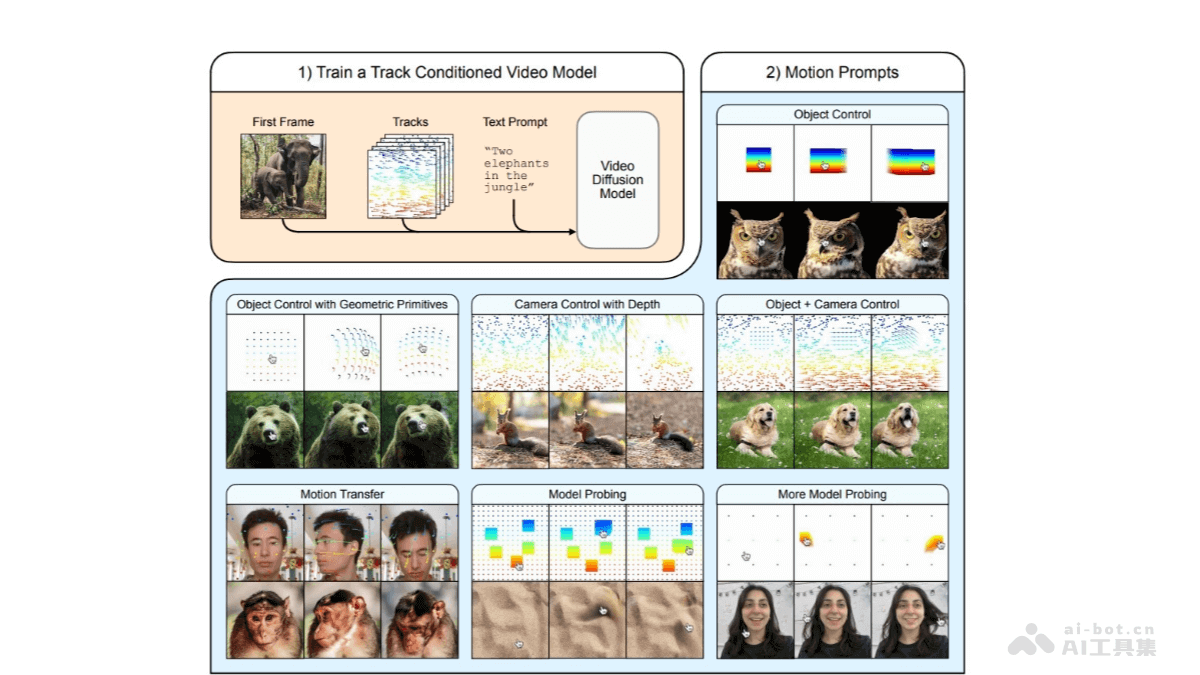
Motion Prompting is a video generation technology jointly launched by Google DeepMind, the University of Michigan, and Brown University. It controls and guides the generation of video content based on motion trajectories. Motion Prompting uses point trajectories as a flexible motion representation, capable of encoding motion of arbitrary complexity from a single point to a global scene. Users can design "motion prompts," similar to text prompts, to elicit different capabilities of video models, including object control, camera control, physical phenomenon simulation, and more. Motion Prompting improves the flexibility and accuracy of video generation, offering new possibilities for future interactive video generation and world model queries.
Main features of Motion Prompting
- Object control: Based on motion prompts, finely control the motion of specific objects in a video, such as rotation or movement.
- Camera control: Enable camera motion control in videos, including panning, rotation, and zooming.
- Physical phenomenon simulation: Demonstrate physical phenomena in videos, such as fluid dynamics (water, smoke) and rigid body dynamics.
- Simultaneous object and camera control: Combine motion prompts for object control and camera control to achieve complex scene interactions.
- Drag-based image editing: Support users in editing images based on drag operations, enabling dynamic image editing.
- Motion transfer: Transfer motion from one video to the first frame of another video, enabling reuse of motion.
- Motion magnification: Magnify subtle motion in videos, making subtle motion more noticeable.
Technical principles of Motion Prompting
- Point trajectory representation: Use point trajectories as a motion representation method, capturing the motion of any number of points in a video, including object-specific motion or global scene motion.
- Conditional video generation model: Based on a pre-trained video diffusion model, train a control network (ControlNet) that accepts motion prompts as conditional input.
- Motion prompt construction: Convert user input (such as mouse dragging) into point trajectories, or generate detailed motion trajectories from high-level user requests based on computer vision technology.
- Trajectory encoding: Encode point trajectories into a space-time volume, placing a unique embedding vector at each position visited by each trajectory.
- Model training: Train the model with trajectory data extracted from videos to generate videos based on trajectory prompts.
- Trajectory sparsity adjustment: Users can adjust the sparsity of trajectories to balance the fineness of control and the degrees of freedom of the video model.
- Multi-task processing: Based on combining different motion prompts, implement multiple complex video generation tasks in a single model.
Project address of Motion Prompting
- Project official website:motion-prompting.github.io
- arXiv technical paper:https://arxiv.org/pdf/2412.02700
Application scenarios of Motion Prompting
- Film and video production: Directors and video creators can create complex dynamic scenes, such as special effects shots or action sequences, without complex manual animation production.
- Game development: Game developers generate dynamic background videos in games or use them for dynamic interactions between in-game characters and environments.
- Virtual reality (VR) and augmented reality (AR): In VR and AR applications, create more natural and realistic virtual environments and interactive effects.
- Interactive media art: Artists create new interactive artworks, and audiences interact with the artworks based on body movements.
- Education and training: Based on simulating real-world physical phenomena and dynamic scenes, used in the education field, such as physics, engineering, and medical training.