
What is Motion Anything
Motion Anything is a multimodal motion generation framework launched by the Australian National University, the University of Sydney, Tencent, McGill University, JD.com, and other institutions. It generates high-quality, controllable human motion based on text, music, or a combination of both. Motion Anything introduces an attention-based masked modeling method to achieve fine-grained control over keyframes and actions in motion sequences, addressing the problem that existing methods cannot prioritize the generation of dynamic content based on conditions. The framework is based on temporally adaptive and spatially aligned transformers, effectively integrating multiple modal conditions and improving the coherence and diversity of generated motion. At the same time, it releases the Text-Music-Dance (TMD) dataset, containing 2,153 paired samples of text, music, and dance, providing a new benchmark for research on multimodal motion generation.
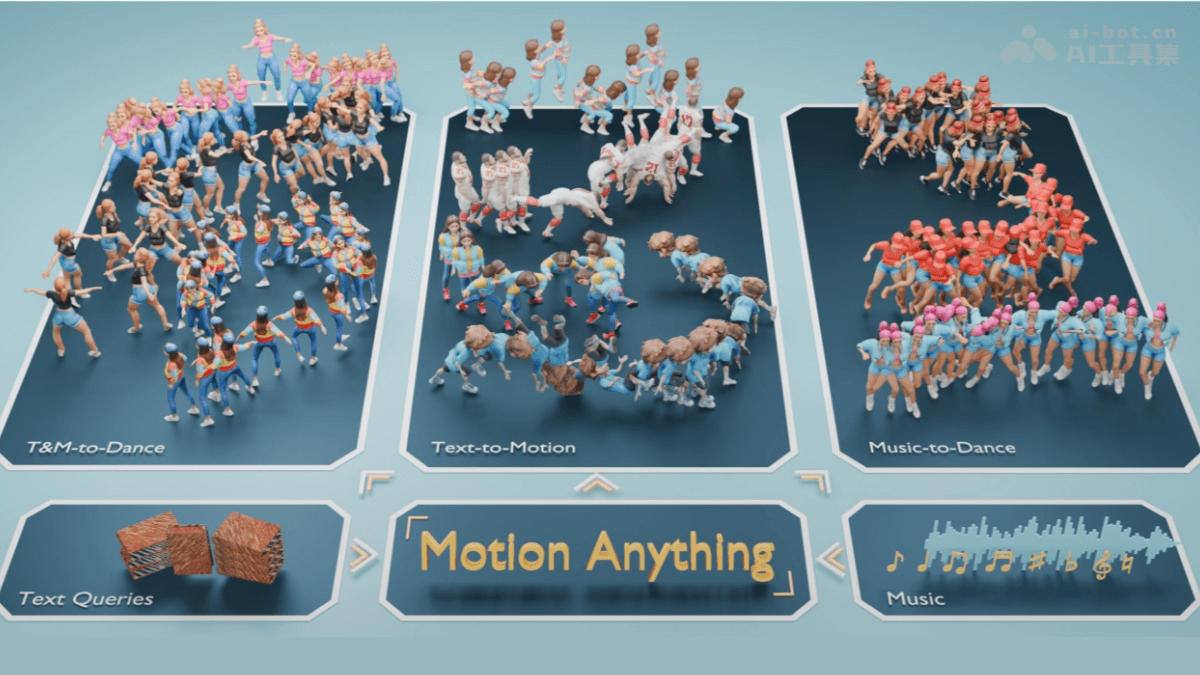
Main Features of Motion Anything
- Motion generation under multimodal conditions: Generates high-quality human motion based on text descriptions, music, or a combination of both.
- Fine-grained control: Based on an attention mechanism, it provides fine-grained control over keyframes and actions in motion, achieving more precise generation results.
- Dynamic priority adjustment: Dynamically adjusts the priority of motion generation according to given conditions (such as text or music), prioritizing the generation of dynamic frames and body parts most relevant to the conditions.
- Cross-modal alignment: Effectively aligns text, music, and motion in the temporal and spatial dimensions, improving the coherence and consistency of generated motion.
Technical Principles of Motion Anything
- Attention-based masked modeling: Based on an attention mechanism, it selects the motion parts most relevant to the conditions (text or music) for masking. During generation, the model prioritizes restoring the masked keyframes and actions, achieving focus on dynamic content.
- Temporally adaptive transformer: Dynamically adjusts attention computation according to the modality of the conditions (text, music, or a combination of both). It aligns keyframes of motion with keywords in text or beats in music, improving coherence in the temporal dimension.
- Spatially aligned transformer: Rearranges condition and motion embeddings to expose the spatial dimension. It restores masked key actions, ensuring spatial consistency between motion and conditions.
- Multimodal condition encoding: Simultaneously processes multiple modal conditions such as text and music, and integrates information from different modalities into motion generation based on an adaptive encoder. It achieves controllable motion generation under multimodal conditions and improves generation results.
- Dataset support: Provides a new Text-Music-Dance (TMD) dataset, containing 2,153 paired samples of text, music, and dance, offering rich data support for multimodal motion generation.
Project Address of Motion Anything
- Project Official Website:https://steve-zeyu-zhang.github.io/MotionAnything/
- GitHub Repository:https://github.com/steve-zeyu-zhang/MotionAnything
- arXiv Technical Paper:https://arxiv.org/pdf/2503.06955
Application Scenarios of Motion Anything
- Film and television animation: Quickly generates high-quality animation, reduces production costs, and improves visual effects.
- VR/AR: Generates realistic actions for virtual characters, enhances immersion, and enables natural interaction.
- Game development: Generates character actions based on the plot or music, improving the fun and smoothness of the game.
- Human-computer interaction: Generate natural movements to make robot-human interaction friendlier and enable voice-command-driven motion generation.
- Education and Training: Generate standard movement demonstrations to assist teaching in sports, dance, and more, improving training outcomes.