
What Is MOSS-VL-Realtime
MOSS-VL-Realtime is an 11B-parameter streaming vision-language model open-sourced by OpenMOSS, designed specifically for real-time video understanding. The model supports answering while watching, instant correction, and proactive silence, upgrading video understanding from watching recordings to watching live streams. Through a dual-channel cross-attention architecture and absolute timestamp encoding, the model achieves parallel perception and generation, keeping AI temporally synchronized with the physical world and reaching open-source SOTA on multiple streaming benchmarks.
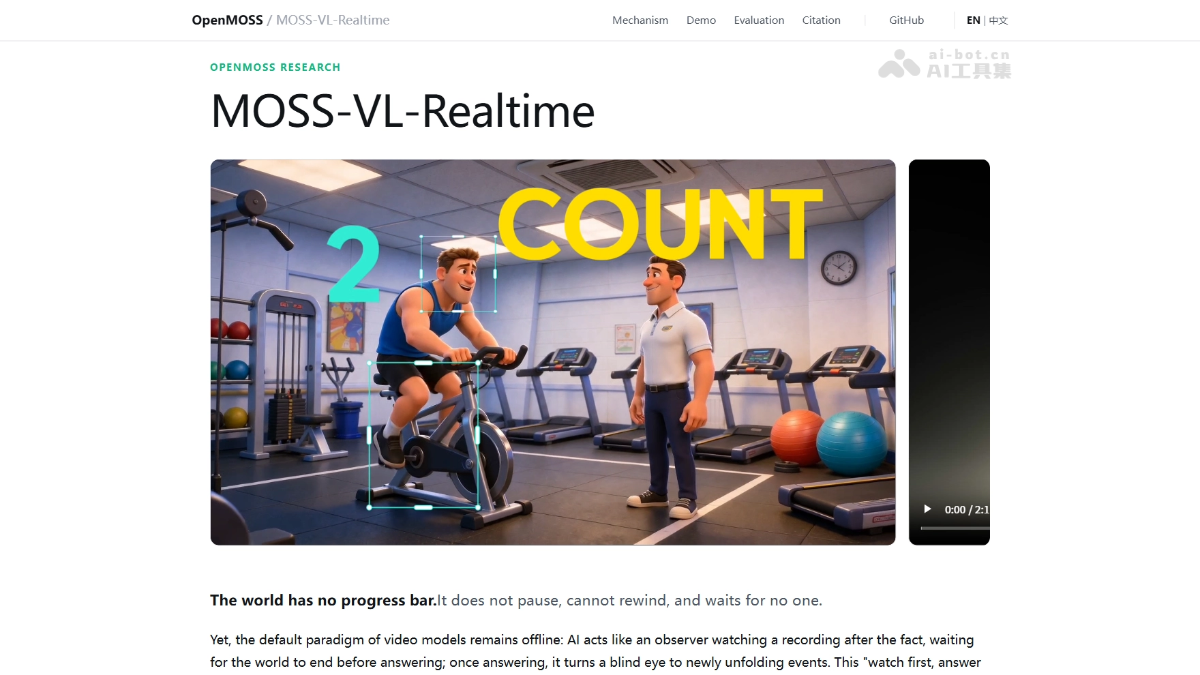
MOSS-VL-Realtime's Main Features
-
Real-Time Video Understanding: Continuously receives video streams, generating answers while watching without waiting for the video to end.
-
Instant Q&A Response: Users can insert questions at any time, and the model responds instantly based on the current frame.
-
Proactive Silence Mechanism: When information is insufficient or there are no key events, the model autonomously remains silent and waits.
-
Dynamic Answer Correction: When the scene changes, the model adjusts and corrects previous answers in real time.
-
Spatiotemporal Localization Awareness: Through absolute timestamp encoding, it precisely perceives the physical time stream and spatial positions.
-
Long-Context Processing: Supports continuous understanding and interaction with long video streams.
MOSS-VL-Realtime's Technical Principles
-
Dual-Channel Cross-Attention Architecture: Visual features enter through a side channel and are decoupled from text generation, allowing perception and generation to run in parallel without blocking each other.
-
Decoupled Cross-Attention: Separates the cross-attention computation of video feature extraction and text generation, reducing the end-to-end latency of high-frequency frames.
-
Absolute Timestamp Encoding: Embeds absolute time information into each frame, enabling the model to perceive the physical time stream and eliminating dependence on a fixed frame rate.
-
XRoPE Cross-Dimensional Rotary Position Encoding: Uniformly maps the spatial dimensions (h, w) and temporal dimension (t) of video features to construct a unified spatiotemporal representation.
-
Streaming SFT Training Paradigm: Restructures multimodal corpora, converting dense captions into Q&A data with real-time revisions, training the model to predict when to speak and when to stay silent.

Follow WeChat and reply "open source" to join theAI Open-Source Project Exchange Group
How to Use MOSS-VL-Realtime
- Obtain Model Resources: Go to the OpenMOSS official websitehttps://openmoss.ai/MOSS-VL/浏览演示案例并下载开源权重与代码。
- Prepare the Hardware Environment: A single H200 GPU is recommended, supporting real-time inference and low-latency response for 256-frame video sequences.
- Deploy Model Weights: Load the 11B-parameter model into the local environment, completing dependency installation and weight initialization configuration.
- Connect to a Video Stream: Connect a real-time camera or import a video stream input to ensure frame data can be continuously transmitted to the model.
- Start Real-Time Interaction: Enter text questions at any time during video playback, and the model will instantly generate or revise answers based on the current frame.
Core advantages of MOSS-VL-Realtime
-
Streaming open-source SOTA: Achieves open-source state-of-the-art performance on multiple streaming video understanding benchmarks, with industry-leading real-time interaction capabilities.
-
Ultra-low latency and high throughput: On a single H200 GPU, first token generation time is accelerated by about 5x, and decoding throughput is increased by 2.7x.
-
Offline capability without degradation: V*Bench 89.0, BLINK 78.0; long video and document chart understanding still aligns with top open-source baselines.
-
Human-like interaction rhythm: Autonomously determines when to speak, naturally supporting interruption, instant correction, proactive silence, and other natural conversational behaviors.
-
Unified streaming representation: Video frames, user questions, and model responses are interwoven into a single token sequence, enabling seamless real-time interaction.
MOSS-VL-Realtime project address
- Project website:https://openmoss.ai/MOSS-VL/
- HuggingFace model repository:https://huggingface.co/OpenMOSS-Team/MOSS-VL-Realtime
Comparison of MOSS-VL-Realtime with similar competitors
| Dimension | MOSS-VL-Realtime | Qwen2.5-VL-7B |
|---|---|---|
| Architecture | Cross-attention dual-channel, perception and generation decoupled and parallel | Decoder-only, visual tokens embedded in autoregressive sequence |
| Interaction mode | Streaming real-time, watch and speak simultaneously, instant correction | Offline batch processing, requires watching the entire video before answering uniformly |
| First token latency | About 5x speedup, millisecond-level response | Baseline level, blocked by visual processing |
| Decoding throughput | 2.7x improvement, smooth generation at high frame rates | Baseline level |
| Proactive behavior | Supports proactive silence, instant correction, arbitrary interruption | No real-time behavior control capability |
| Temporal awareness | Absolute timestamp encoding, perceives the physical flow of time | Relative position encoding, depends on fixed frame rate |
| Model scale | 11B open-source weights | 7B open-source weights |
Application scenarios of MOSS-VL-Realtime
- Real-time monitoring alerts: In street monitoring scenarios, it automatically stays silent when nothing happens, and instantly triggers an alert when a target person falls or an abnormal intrusion occurs.
- Live event commentary: Captures key actions such as passes, shots, and goals in real time during football and other sports events, with synchronized professional commentary.
- Speech slide companion reading: Follows PPT page-turning progress in real time, delivering impromptu and coherent narration for each page from start to finish.
- Experiment process recording: Watch plant growth time-lapse photography, accurately capture key changes and accurately report the specific number of days on which they occur.
- Real-time teaching tutoring: Watch the handwritten problem-solving process, transcribe each line of formulas as it is written and simultaneously explain the reasoning logic.