
What is MoshiVis
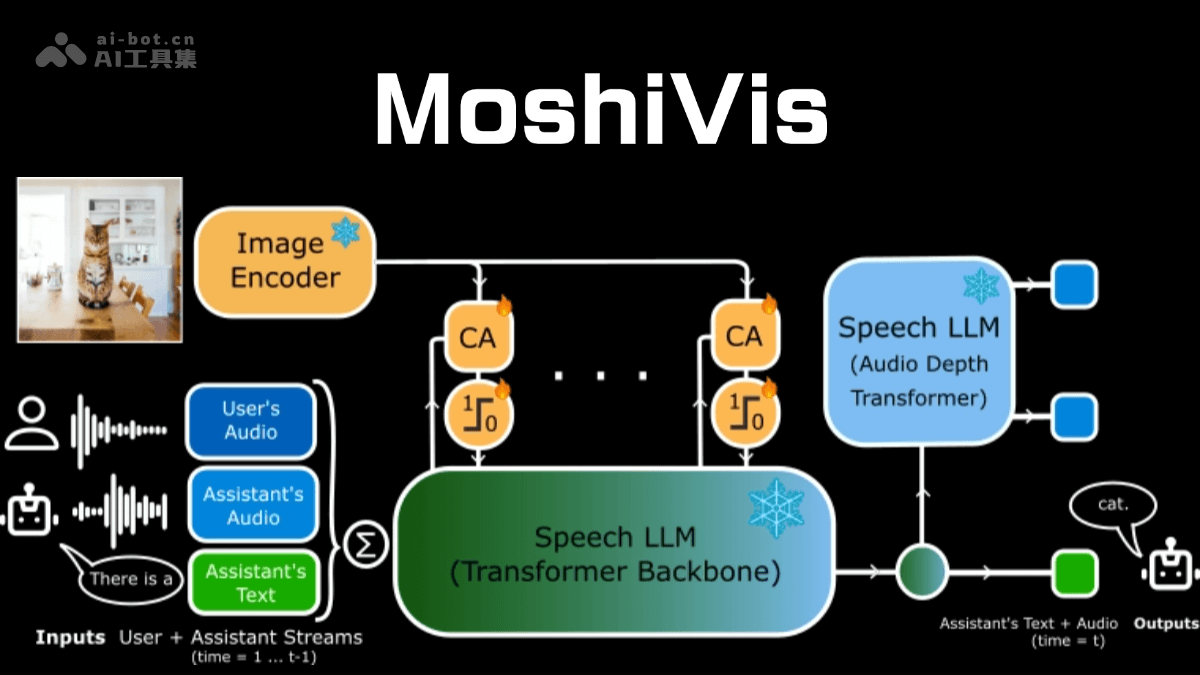
MoshiVis is an open-source multimodal speech model launched by Kyutai. It is developed based on the Moshi real-time conversational speech model and adds visual input capabilities. It enables natural, real-time speech interaction with images, combining speech and visual information so that users can communicate about image content through speech. On Moshi's 7B foundation architecture, the model adds approximately 206M adapter parameters and integrates a 400M PaliGemma2 vision encoder. Through cross-attention and gating mechanisms, MoshiVis can naturally integrate visual information into the speech stream while maintaining low latency and a natural conversational style. It supports three backends: PyTorch, Rust, and MLX, and the Web UI frontend is recommended for interaction.
Main Features of MoshiVis
- Visual Input Functionality: MoshiVis can receive image input and combine it with speech interaction. Users can communicate about image content through speech commands, for example asking about scenes, objects, people, and other information in the image.
- Real-Time Interaction: The model supports real-time speech interaction, allowing users to converse naturally with the model without waiting for long processing times.
- Multimodal Fusion: MoshiVis combines visual information with the speech stream through a cross-attention mechanism, enabling the model to process both speech and visual input simultaneously.
- Low Latency and Natural Conversation: When processing image and speech information, MoshiVis can maintain low latency and ensure real-time interaction. The model inherits Moshi's natural conversational style and can generate natural and fluent speech responses.
- Multi-Backend Adaptation: MoshiVis supports three backends: PyTorch, Rust, and MLX. Users can choose the appropriate backend for deployment according to their needs. The Web UI frontend is recommended for interaction.
- Accessibility Applications: MoshiVis is suitable for accessible AI interfaces and can help visually impaired people understand visual scenes through speech interaction.
Technical Principles of MoshiVis
- Multimodal Fusion Mechanism: MoshiVis injects visual information from the vision encoder into Moshi's speech token stream by integrating a lightweight cross-attention module. This enables the model to process both speech and visual input simultaneously and achieve interaction between speech and image content. Specifically, the vision encoder extracts image features, which are then fused with the speech stream through the cross-attention mechanism, allowing the model to understand image content and generate speech responses related to it.
- Dynamic Gating Mechanism: To better handle switching between visual input and non-visual conversation topics, MoshiVis introduces a dynamic gating mechanism. It can dynamically adjust the influence of visual information according to the context of the conversation, ensuring that the model can fully utilize visual input when discussing image-related topics and reduce interference from visual information in other topics, thereby improving the naturalness and fluency of the conversation.
- Parameter-Efficient Fine-Tuning: MoshiVis adopts a single-stage, parameter-efficient fine-tuning process. During training, the model uses a mixture of image-text and image-speech samples, reducing training costs and improving the model's adaptability. It reduces the need for large-scale image-speech paired data and preserves the prosodic features of the speech model, such as the speaker's intonation.
MoshiVis Project Address
- Project Website:kyutai.org/moshivis
- Github Repository:https://github.com/kyutai-labs/moshivis
- arXiv Technical Paper:https://arxiv.org/pdf/2503.15633
Application Scenarios of MoshiVis
- Assistance for the Elderly: For elderly people with poor vision or limited mobility, MoshiVis can serve as a smart assistant, helping them identify objects, read text, or obtain environmental information.
- Smart Home Control: In a smart home environment, users can use voice commands to have MoshiVis identify devices or scenes in the room and perform corresponding control operations.
- Visual-Assisted Learning: In the field of education, MoshiVis can help students learn image content through voice interaction, such as identifying animals, plants, historical artifacts, etc.
- Social Media Interaction: Users can upload images, and MoshiVis generates interesting descriptions or comments through voice, enhancing the interactivity of social media.
- Industrial Inspection: In industrial environments, MoshiVis can help workers inspect equipment status and identify faulty parts through voice interaction.