
What is Moonshine
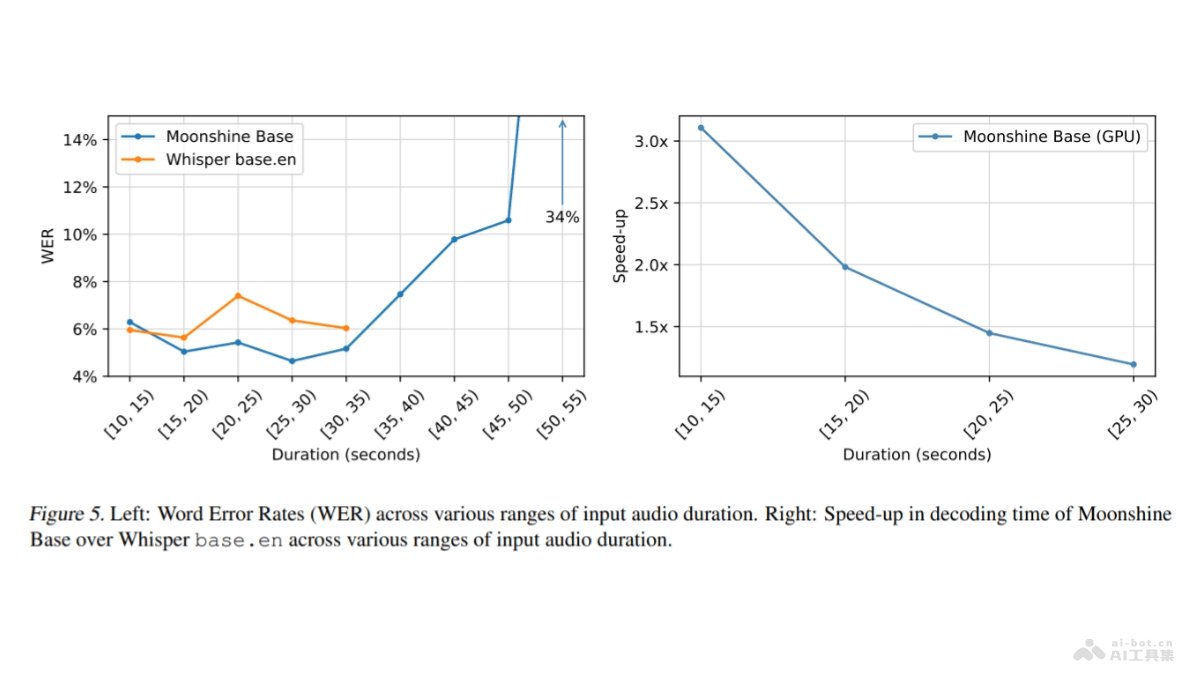
Moonshine is a speech recognition model optimized for resource-constrained devices, providing fast and accurate real-time speech-to-text services. It is suitable for application scenarios requiring instant response, such as live transcription and voice command recognition. Moonshine is based on an advanced encoder-decoder architecture and rotary position embedding technology, improving the model's efficiency when processing audio inputs of different lengths. Compared with OpenAI's Whisper model, Moonshine shows lower word error rates on multiple standard datasets, and its computational requirements are proportional to audio length, significantly improving the processing speed of short audio. Moonshine is very suitable for deployment on edge devices, providing a new solution for real-time speech recognition applications.
Main Features of Moonshine
- Real-time transcription: Moonshine can convert speech into text in real time, suitable for live transcription scenarios such as meetings and speeches.
- Voice command processing: Suitable for smart devices and wearable devices, it can quickly recognize and respond to users' voice commands.
- Low latency: Optimized for on-device applications, providing accurate speech recognition results with minimal latency.
- Resource efficient: Specially designed for resource-constrained environments, it can run on low-cost hardware, such as ARM processors.
- High accuracy: Shows a lower word error rate (WER) than similar Whisper models on standard datasets.
Technical Principles of Moonshine
- Encoder-decoder architecture: Moonshine is based on the Transformer model, using an encoder to process the input speech signal and a decoder to generate text output.
- Rotary position embedding (RoPE): Unlike traditional absolute position embeddings, Moonshine uses RoPE to capture the positional relationships of elements in a sequence, helping the model better understand the temporal structure of speech signals.
- Variable-length processing: Moonshine's encoder can process speech segments of different lengths without zero padding, reducing unnecessary computational overhead and improving processing efficiency.
- Efficient computation: Moonshine's computational requirements are proportional to the length of the input audio, making it faster than models with fixed-length processing when handling shorter audio.
- Large-scale training: Moonshine is trained on a large number of public ASR datasets and internally prepared data, using advanced data augmentation and preprocessing techniques to improve the model's generalization ability.
Moonshine Project Address
- Project official website:moonshine-the-new-state-of-the-art-for-speech-to-text/
- GitHub repository:https://github.com/usefulsensors/moonshine
- HuggingFace model library:https://huggingface.co/UsefulSensors/moonshine
- arXiv technical paper:https://arxiv.org/pdf/2410.15608v2
Application Scenarios of Moonshine
- Real-time meeting transcription: In business meetings or academic seminars, Moonshine can convert meeting content into text records in real time, facilitating subsequent document organization and information retrieval.
- Voice assistant: In smart homes or wearable devices, Moonshine serves as the core of the voice assistant, quickly and accurately recognizing users' voice commands to achieve intelligent control of devices.
- Hearing assistance tool: For people with hearing impairment, Moonshine serves as a real-time speech-to-text tool, helping them better understand and participate in conversations.
- Multilingual translation: In multilingual communication environments, Moonshine combines machine translation technology to achieve real-time speech translation and facilitate cross-language communication.
- Education and Learning: In the field of education, Moonshine is used to transcribe teachers' lectures in real time, provide students with class notes, or assist language learners in speech practice.