
What is MooER
MooER is the industry's first open-source large audio understanding model trained on domestic full-featured GPUs, launched by Moore Threads. It can not only perform speech recognition in Chinese and English, but also has Chinese-to-English speech translation capabilities. MooER achieved a BLEU score of 25.2 on the Covost2 Chinese-to-English test set, approaching industrial-grade performance. The Moore Threads AI team has open-sourced the inference code and a 5,000-hour training model, and plans to open-source the training code and an 80,000-hour training model, promoting the development of AI speech technology.
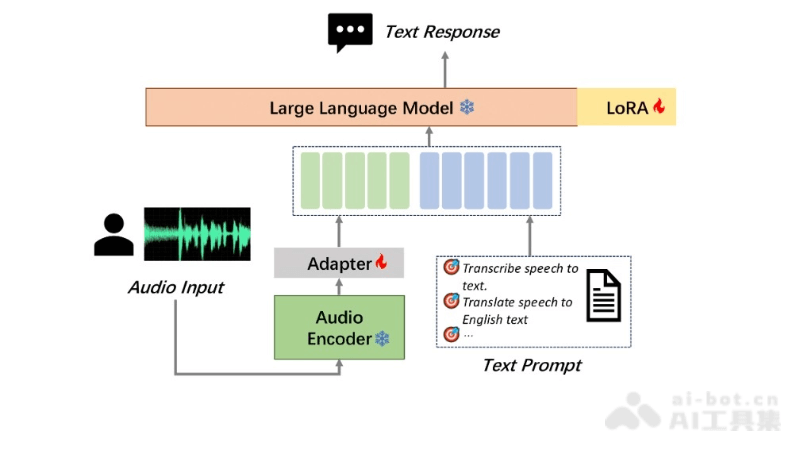
Main features of MooER
- Speech recognition: Supports speech-to-text conversion in Chinese and English.
- Speech translation: Has the ability to translate Chinese speech into English text.
- Efficient training: On Moore Threads' intelligent computing platform, training on large amounts of data can be completed quickly.
- Open-source models: The inference code and some training models have been open-sourced, facilitating community use and further research.
Technical principles of MooER
- Deep learning architecture: MooER adopts deep learning technology, especially neural networks, to process and understand speech signals.
- End-to-end training: The model goes directly from raw speech signals to text output, without the need for multiple independent modules in traditional speech recognition systems.
- Encoder-Adapter-Decoder structure:
- Encoder: Responsible for converting the input speech signal into a series of high-level feature representations.
- Adapter: Used to adjust and optimize the model's adaptability to specific tasks and improve the model's generalization ability.
- Decoder(Large Language Model, LLM): Generates the final text output based on these features.
- LoRA technology: Uses LoRA (Low-Rank Adaptation) technology, a parameter-efficient model fine-tuning method that improves training efficiency and effectiveness by updating only a small subset of parameters in the model.
- Pseudo-label training: Uses pseudo-labeling technology during training, that is, using the model's own predictions as training data to enhance the model's learning ability.
- Multilingual support: MooER supports speech recognition in Chinese and English, as well as Chinese-to-English speech translation, demonstrating its multilingual processing capability.
MooER project addresses
- GitHub repository:https://github.com/MooreThreads/MooER
- arXiv technical paper:https://arxiv.org/pdf/2408.05101
- Online experience address:https://mooer-speech.mthreads.com:10077/
How to use MooER
- Obtain the model: You can visitGithub repositoryto obtain the code and pre-trained weights of the MooER model.
- Environment configuration: Ensure that the necessary dependency libraries and tools are installed in the computing environment, such as Python, deep learning frameworks (such as TensorFlow or PyTorch), audio processing libraries, etc.
- Data preparation: Prepare audio data and, if needed, the corresponding text transcriptions. Ensure that the data format is consistent with the model input requirements.
- Model loading: Load the pre-trained MooER model into the computing environment.
- Data processing: Preprocess the audio data, such as normalization and framing, to match the model's input requirements.
- Model inference: Use the MooER model to perform inference on the preprocessed audio data to obtain speech recognition or translation results.
Application scenarios of MooER
- Real-time speech transcription: In meetings, lectures, classrooms, and other occasions, MooER can convert speech into text in real time, making it easy to record and review.
- Multilingual translation: It supports speech translation between Chinese and English, and is suitable for cross-border meetings, international exchanges, and other scenarios.
- Intelligent customer service: In the field of customer service, MooER can improve response efficiency and service quality through speech recognition and translation functions.
- Voice assistant: Integrated into devices such as smartphones and smart speakers to provide voice interaction services.
- Educational assistance: In language learning, MooER can help learners with pronunciation correction and language translation.