
What is MoMask
MoMask is an innovative 3D human motion generation tool that can generate high-quality 3D human motions based on text descriptions through generative masked modeling technology. MoMask adopts a hierarchical quantization scheme, representing human motion as multi-layer discrete motion tokens, and combines a masked Transformer and a residual Transformer to generate motion sequences. The model performs excellently on text-to-motion generation tasks, achieving an FID metric of 0.045 (HumanML3D dataset), significantly outperforming other methods. MoMask can be seamlessly applied to related tasks, such as text-guided temporal inpainting, without additional fine-tuning.
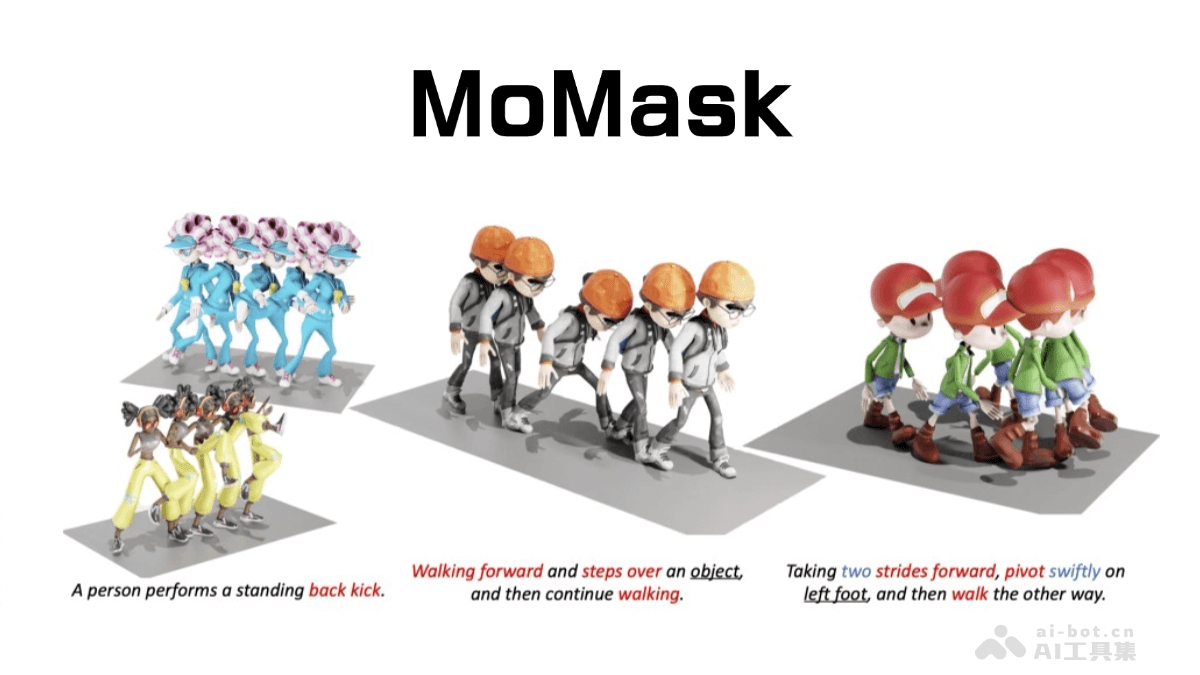
MoMask's main features
- Text-driven 3D motion generation: Users can generate corresponding 3D human motion animations by inputting simple text descriptions. For example, by inputting "a person running on a treadmill", MoMask can generate the corresponding motion.
- Motion editing and temporal control: MoMask supports complex temporal editing of generated motions, such as inserting, deleting, or replacing motion segments, and can change the duration or details of motions.
- High-precision motion generation: Using multi-layer quantization and masked modeling technology, MoMask can generate high-quality, high-precision, and coherent 3D motion sequences. On the HumanML3D dataset, the FID value for generation quality is only 0.045, significantly outperforming other methods.
- Multi-platform support and ease of use: MoMask supports local running, provides a Huggingface WebUI demo and a Colab online demo, and can be used as a Blender plugin, making it convenient for users to get started quickly.
- Motion evaluation and optimization: MoMask provides evaluation scripts that can be used to evaluate the quality and realism of generated motions, helping users optimize motion generation results.
MoMask's technical principles
- Hierarchical quantization scheme: MoMask adopts a hierarchical quantization scheme, representing 3D human motion as multi-layer discrete motion tokens. First, the motion sequence is encoded into base-layer motion tokens through vector quantization. Then, through iterative residual quantization, the quantization error is gradually reduced to generate higher-level residual tokens. This can capture high-fidelity details of motion.
- Masked Transformer: This is one of MoMask's core components. During the training phase, the base-layer motion tokens are randomly masked, and these masked tokens are predicted based on text input. During the generation phase, starting from a completely empty sequence, the masked Transformer iteratively fills in the missing tokens to gradually generate a complete motion sequence.
- Residual Transformer: This is used to process residual tokens in hierarchical quantization. After generating the base-layer tokens, the residual Transformer gradually predicts the residual tokens of the next layer based on the token sequence of the current layer. This can further optimize motion details and improve the quality of generated motions.
- Generation process: MoMask's generation process is divided into two stages:
- The masked Transformer generates base-layer tokens: Starting from an empty sequence, it iteratively predicts masked tokens until a complete base-layer token sequence is generated.
- The residual Transformer generates residual tokens: Based on the base-layer tokens, it predicts higher-level residual tokens layer by layer, ultimately generating high-quality 3D motion.
MoMask's project address
- Project official website:https://ericguo5513.github.io/momask/
- Github repository:https://github.com/EricGuo5513/momask
- arXiv technical paper:https://arxiv.org/pdf/2312.00063
Application Scenarios of MoMask
- Game Development: In game development, MoMask can quickly generate various character motions, reducing the workload of manually creating motions and improving development efficiency.
- Animation Production: Animators can use MoMask to quickly generate complex motion sequences and perform efficient dynamic scene editing, reducing manual labor.
- Virtual Reality (VR): In VR applications, MoMask can generate realistic virtual character motions based on natural language instructions, enhancing the user's sense of immersion.
- Sports Data Analysis: MoMask can be used to analyze athletes' motion trajectories, helping researchers better understand the patterns of human motion and provide training suggestions for athletes.
- Motion Editing and Repair: MoMask supports text-based editing functionality, allowing users to specify particular parts of a motion for editing, such as changing the duration or details of the motion.