
What is MOFA-Video
MOFA-Video is a controllable image-to-video generation model open-sourced by researchers from Tencent AI Lab and the University of Tokyo. This technology uses a generative motion field adapter to animate images and generate videos. Building on the pretrained Stable Video Diffusion model, MOFA-Video can achieve fine-grained control over motion during video generation through sparse control signals such as manual trajectories, facial landmark sequences, or audio. MOFA-Video can not only use these control signals individually but also combine them to create more complex animations in a zero-shot manner, providing a new, highly controllable image animation video solution.
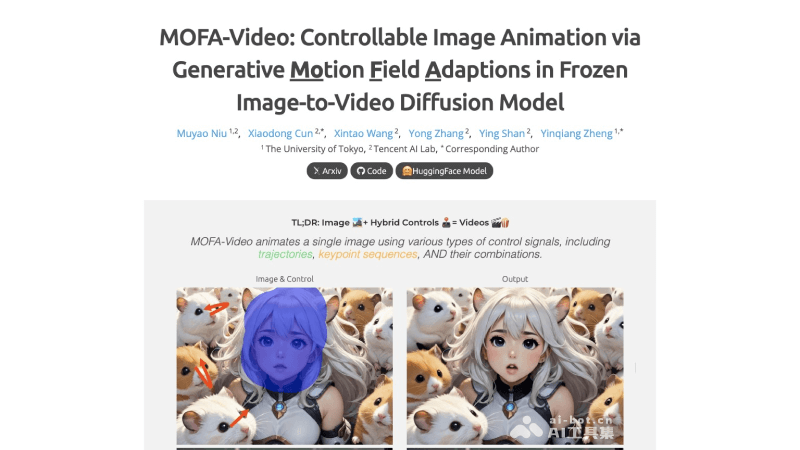
MOFA-Video's Features
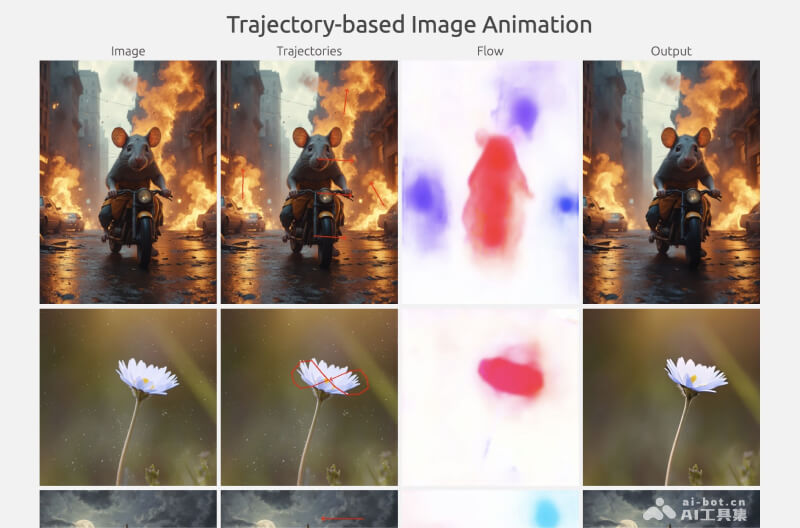
- Trajectory-Controlled Animation: Users guide MOFA-Video to generate corresponding video animations by manually drawing trajectories on images. This feature is particularly suitable for scenarios requiring precise control of object or camera movement.
- Facial Landmark Animation: The system uses facial landmark data, such as markers obtained through facial recognition technology, to generate realistic facial expressions and head movement animations.
- Hybrid Control Animation: MOFA-Video can combine trajectory control and facial landmark control to achieve synchronized animation of facial expressions and body movements, creating complex multi-part animation effects.
- Audio-Driven Facial Animation: By analyzing audio signals, MOFA-Video can generate facial animations synchronized with speech or music, such as lip-syncing.
- Video-Driven Facial Animation: Using a reference video, MOFA-Video can make facial movements in a static image mimic the movements in the video, achieving dynamic facial expression reproduction.
- Zero-Shot Multimodal Control: MOFA-Video supports zero-shot learning, meaning different control signals can be combined without additional training, greatly improving the flexibility and diversity of animation generation.
- Long Video Generation Capability: By adopting a periodic sampling strategy, MOFA-Video can generate longer video animations than traditional models, breaking through frame count limitations.
- User Interface Operation: MOFA-Video provides a simple and easy-to-use Gradio-based user interface, through which users can intuitively generate animations without professional programming skills.
MOFA-Video's Official Website Entry
- Official Project Homepage:https://myniuuu.github.io/MOFA_Video
- GitHub Code Repository:https://github.com/MyNiuuu/MOFA-Video
- Trajectory-Based Image Animation Gradio Demo and Model Checkpoints:https://huggingface.co/MyNiuuu/MOFA-Video-Traj
- Gradio Demo and Hybrid Control Image Animation Checkpoints:https://huggingface.co/MyNiuuu/MOFA-Video-Hybrid
How MOFA-Video Works
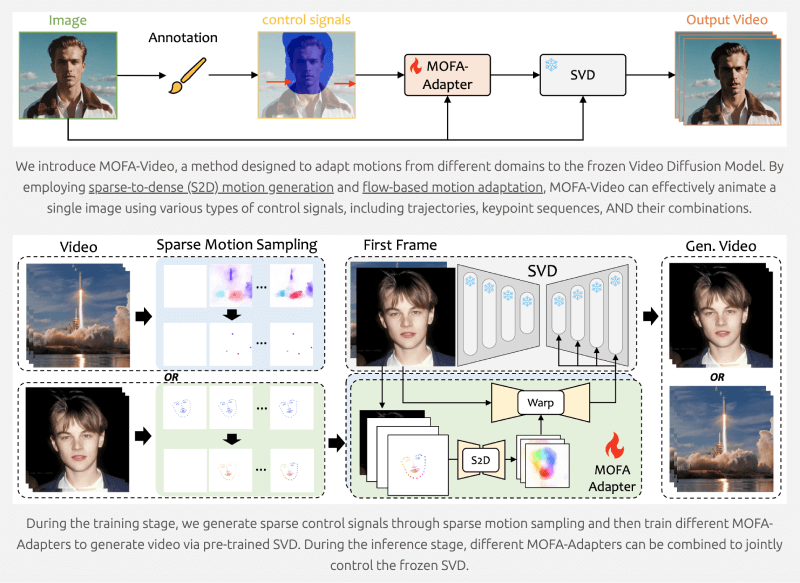
- Sparse Control Signal Generation: During the training phase, the system generates sparse control signals through sparse motion sampling techniques. These signals may be trajectory-based animation control points, facial landmark sequences, or other forms of motion instructions.
- MOFA-Adapter Design: MOFA-Adapter is the core of the system. It is a specially designed network structure used to convert sparse control signals into dense motion fields. This component includes:
- S2D Network: Converts sparse motion prompts into dense motion fields.
- Reference Image Encoder: Extract multi-scale features from the reference image for subsequent motion field generation.
- Feature Fusion Encoder: Combine the motion field generated by the S2D network with the features of the reference image encoder.
- Multi-Scale Feature Extraction: The reference image encoder processes the input reference image and extracts multi-scale feature representations, which will be used for guidance and deformation in the subsequent video frame generation process.
- Generation and Application of Motion Fields: The S2D network generates dense motion fields based on sparse control signals, and these motion fields are then used to spatially deform multi-scale features to simulate motion effects in the video.
- Pretrained SVD Model: MOFA-Adapter is combined with the pretrained Stable Video Diffusion model (SVD), using the conditional features obtained from MOFA-Adapter to guide the generation of video frames.
- Spatial Deformation: Using the generated motion fields, the system spatially deforms the multi-scale features of the reference image to ensure that objects and scene elements in the video frames move according to the predetermined motion trajectories.
- Video Frame Generation: The features deformed in the feature space are used to generate video frames. This process involves sampling from the latent space and gradually removing noise to reconstruct clear video frames.
- Multimodal Control Signal Integration: MOFA-Video can process control signals from different sources and fuse them into a unified generation process to achieve complex animation effects.
- Zero-Shot Learning: After MOFA-Adapter training is completed, it can work jointly across different control domains without additional training, achieving fine-grained control over video generation.
- Long Video Generation Strategy: To generate longer videos, MOFA-Video adopts a periodic sampling strategy, which addresses the issues of coherence and computational complexity in long video generation by grouping and overlapping sampling of frames in the latent space.