
What is MoE++
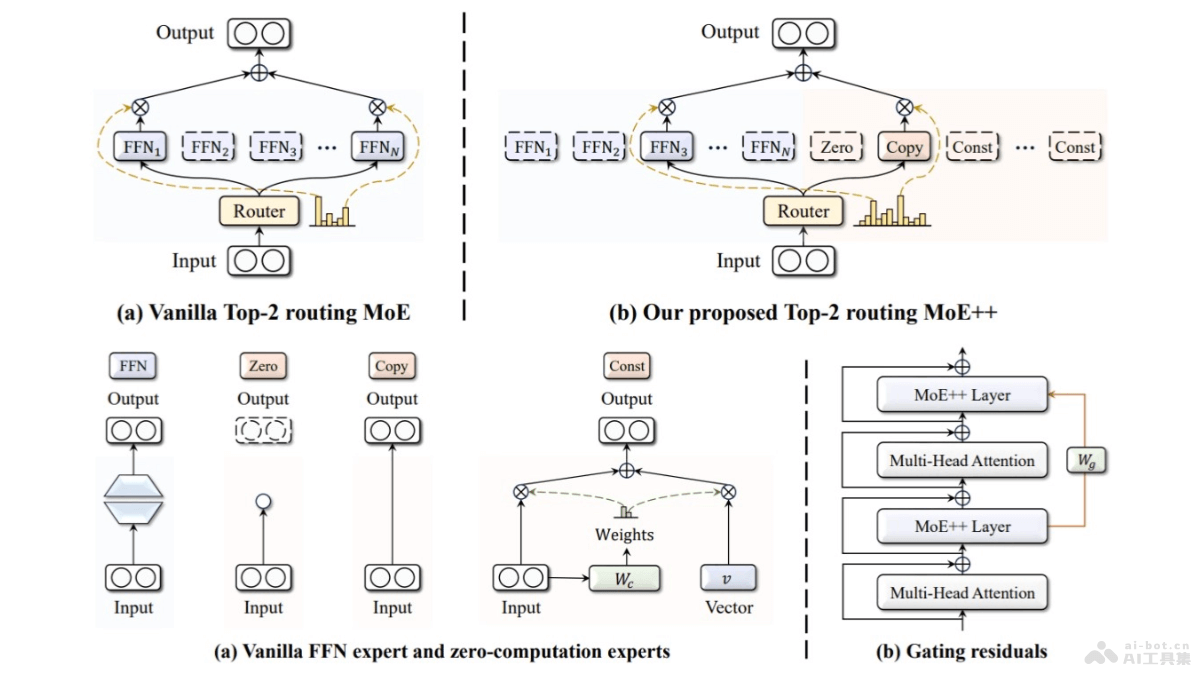
MoE++ is a new type of Mixture-of-Experts (MoE) architecture, jointly launched by the Kunlun Wanwei 2050 Research Institute and the Yuan Li team at Peking University. By introducing zero-computation experts, zero experts, copy experts, and constant experts, it reduces computational costs and improves model performance. MoE++ supports each token dynamically interacting with different numbers of feed-forward network experts, and even skipping certain layers, optimizing the allocation of computational resources. MoE++ uses gated residuals to help tokens consider the routing path of the previous layer when selecting experts, achieving more stable routing. Experiments show that MoE++ outperforms traditional MoE models at the same model size, improves expert throughput speed by 1.1 to 2.1 times, and is easy to deploy.
Main Features of MoE++
- Reduce Computational Costs: MoE++ introduces zero-computation experts, supporting each token in the model to dynamically interact with different numbers of feed-forward network (FFN) experts, and even skip certain layers, reducing unnecessary computation.
- Improve Model Performance: By reducing the number of FFN experts required for simple tokens, MoE++ frees up more expert resources to focus on processing complex tokens, improving the overall performance of the model.
- Optimize Resource Allocation: Through flexible computation allocation, MoE++ enables the model to concentrate computational resources on tokens that need them more, improving computational efficiency.
- Stable Routing: Based on the gating residuals mechanism, MoE++ allows tokens to refer to the routing path of the previous layer when selecting experts, achieving more stable expert selection.
- Easy to Deploy: Because the parameters of zero-computation experts are extremely small, MoE++ can deploy all such experts on the same GPU, avoiding the communication overhead and load imbalance issues caused by distributed FFN expert deployment.
Technical Principles of MoE++
- Zero-Computation Experts: MoE++ introduces three types of zero-computation experts, including zero experts (output an empty vector), copy experts (directly use the input as output), and constant experts (replace the input with a trainable vector).
- Dynamic Expert Selection: Unlike traditional MoE methods, MoE++ supports each token dynamically selecting different numbers of FFN experts for processing based on its complexity.
- Gated Residuals: MoE++ incorporates gated residuals into the expert selection process, allowing tokens to consider the routing path of the previous layer when selecting experts for the current layer, enhancing information flow between different layers of the model.
- Heterogeneous Expert Structure: The expert structure of MoE++ is heterogeneous, with different types of experts (FFN experts and zero-computation experts) working together in the same model, improving the model's adaptability and flexibility.
- Load Balancing: MoE++ uses load balancing loss and expert capacity allocation strategies to ensure balanced expert load during model training, avoiding the problem of some experts being overloaded while others are idle.
Project Address of MoE++
- GitHub Repository:https://github.com/SkyworkAI/MoE-plus-plus
- HuggingFace Model Library:https://huggingface.co/Chat-UniVi/MoE-Plus-Plus-7B
- arXiv Technical Paper:https://arxiv.org/pdf/2410.07348
Application Scenarios of MoE++
- Natural Language Processing (NLP) Researchers: Researchers build and train more efficient large language models for research in language understanding, text generation, machine translation, question-answering systems, etc.
- Enterprise Developers: Enterprise developers develop high-performance NLP applications, such as intelligent customer service, content recommendation systems, automatic summarization, sentiment analysis, etc., to improve the intelligence level of products.
- Cloud computing and AI service providers: Providers integrate the MoE++ architecture to offer customers more efficient and lower-cost AI services, especially in scenarios that require processing large amounts of language data.
- Academic institutions: Academic institutions conduct teaching and research on various NLP tasks, helping students and researchers understand advanced deep learning models and algorithms.