
What is ModernBERT
ModernBERT is a modern encoder-only Transformer model jointly launched by Answer.AI, LightOn, Johns Hopkins University, NVIDIA, and HuggingFace. It is a major upgrade to the classic BERT model. ModernBERT is trained on large-scale data of 2 trillion tokens and supports sequence lengths of up to 8192 tokens, significantly improving the ability to handle long contexts. ModernBERT surpasses SOTA on a variety of natural language processing tasks, while being twice as fast as DeBERTa, making it especially suitable for applications such as information retrieval, text classification, and entity recognition. The model is now open source for research and application by academia and industry.
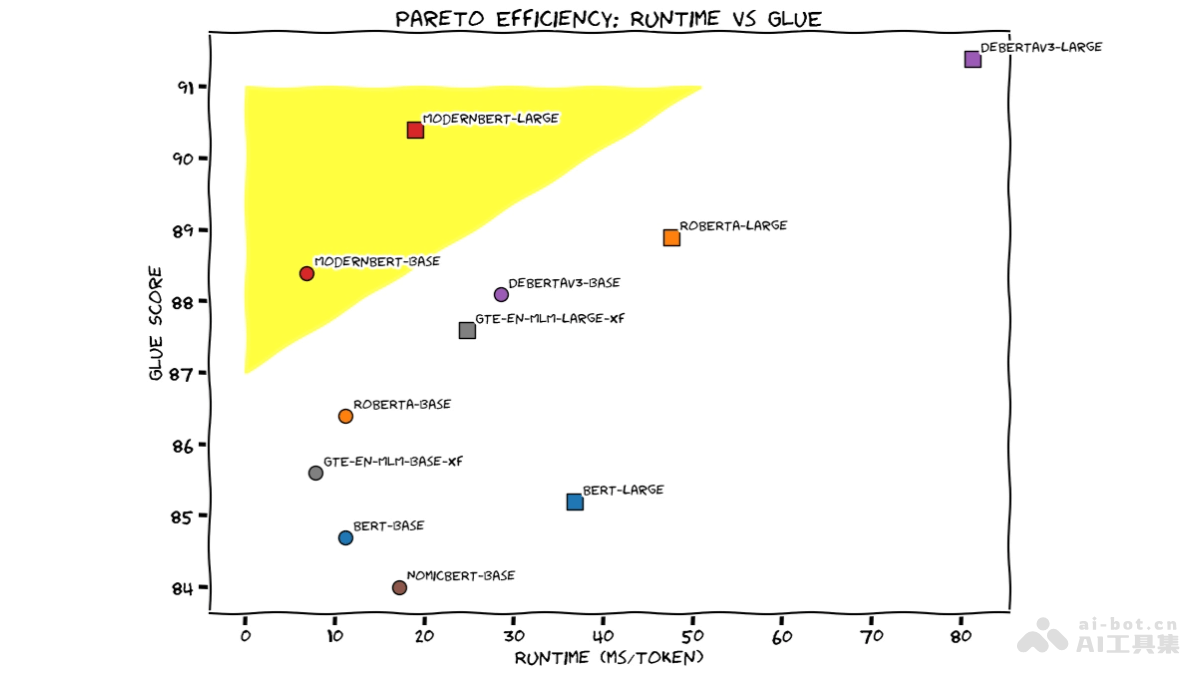
Main features of ModernBERT
- Long-context processing: Supports sequences of up to 8192 tokens, greatly improving the ability to process long texts compared with traditional models.
- Information retrieval: In semantic search and document retrieval tasks, ModernBERT can more effectively represent documents and queries, improving retrieval accuracy.
- Text classification: Including tasks such as sentiment analysis and content moderation, it can quickly perform text classification.
- Entity recognition: In named entity recognition (NER) tasks, it identifies specific entities in text.
- Code retrieval: It also performs excellently in programming language-related tasks, capable of processing and retrieving large amounts of code information.
- Efficiency improvement: While maintaining high performance, it is optimized for speed and memory usage, making the model more efficient.
Technical principles of ModernBERT
- Modernized Transformer architecture: Based on improvements to the Transformer architecture, including rotary position embeddings (RoPE) and the GeGLU activation function, helping the model better understand and process long-sequence data.
- Parameter optimization: Removes unnecessary bias terms, uses the parameter budget more effectively, and simplifies the model architecture.
- Attention mechanism: Introduces alternating global and local attention mechanisms to improve the model's efficiency in handling long texts.
- Unpadding and sequence packing: Unpadding and sequence packing reduce computational waste and improve the efficiency of training and inference.
- Hardware-aware model design: Hardware utilization is considered during design, maximizing GPU utilization based on an optimized model structure.
- Large-scale training data: Trained on a large-scale dataset of 2 trillion tokens, including web documents, programming code, and scientific articles, giving the model broader language understanding and application capabilities.
ModernBERT project address
- GitHub repository:https://github.com/AnswerDotAI/ModernBERT
- HuggingFace model library:https://huggingface.co/collections/answerdotai/modernbert
- arXiv technical paper:https://arxiv.org/pdf/2412.13663
Application scenarios of ModernBERT
- Semantic search and information retrieval: Build more precise search engines that understand the semantics of user queries and provide more relevant search results.
- Content recommendation systems: In recommendation systems, understand users' interests and the semantics of content, and recommend information that better matches user preferences.
- Natural language understanding (NLU) tasks: Including sentiment analysis, intent recognition, language inference, etc., providing deeper language understanding.
- Text classification: Categorize news articles, customer feedback, social media posts, etc., to facilitate content management and analysis.
- Question-answering systems: In question-answering systems, understand complex questions and retrieve the correct answers from a large number of documents.