
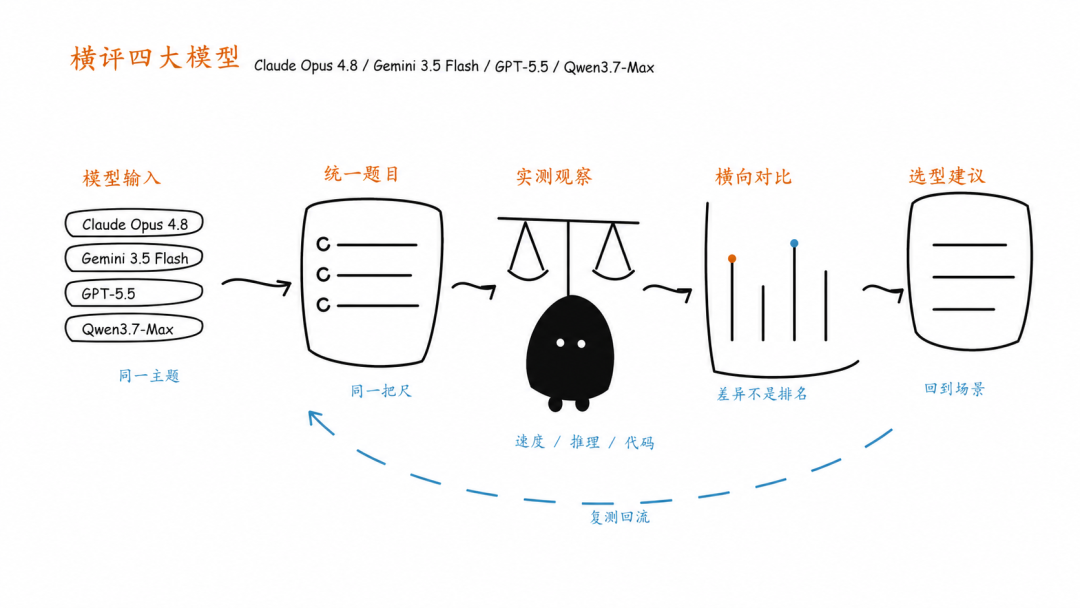
Large models have been updated really frequently lately, so many updates but you still don't know which one is actually good to use.
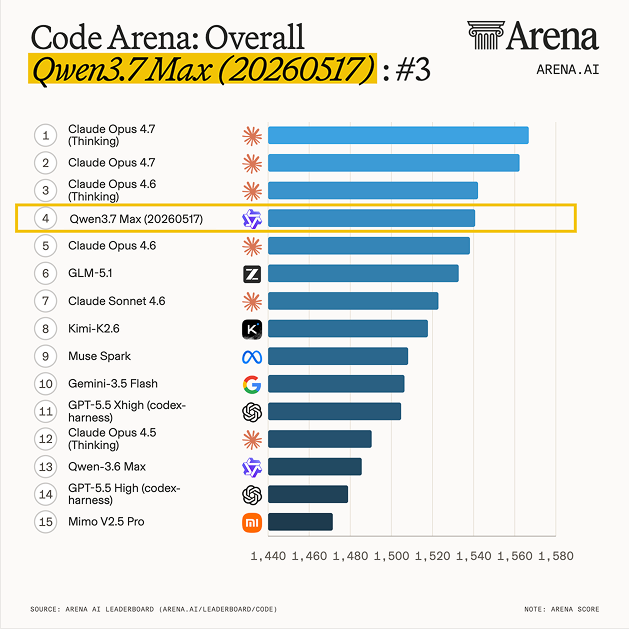
Some say Qwen3.7-Max has already overtaken GPT-5.5, ranking only behind the Claude series.
Others say GPT-5.5 has already reached the top.
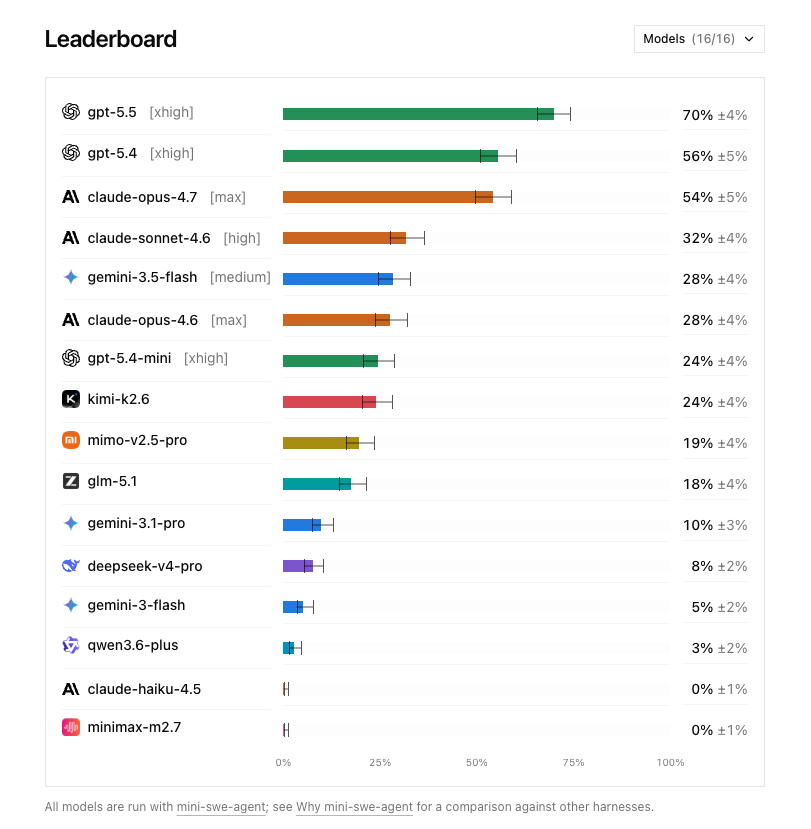
An ordinary person looking at the leaderboards will probably get more and more confused,Which one should be used for writing articles? Which one for data analysis? Which one for writing code, reviewing PRs, and breaking down tasks?
I picked four models that have been discussed a lot recently: Claude Opus 4.8, Gemini 3.5 Flash, GPT-5.5, Qwen3.7-Max, and did a horizontal comparison to see how they deliver on real tasks.
01. Case Testing
For this evaluation, we used the same material, the same prompt, and the same scoring criteria, and gave them separately to the four models. It mainly includes seven common task types: long document processing, task planning, code fixing, Chinese writing, data analysis, format adherence, and SVG generation.
Case 1: Close Reading of Long Documents
What this case tests is:whether the model truly understands the material, rather than seeing a few keywords and starting to improvise。
Suitable for testing reports, meeting minutes, investment research materials, and product documents.
Task:
1. Summarize the core conclusion of the material in under 200 words.
2. Extract the 5 most important facts, each with a citation to the original text.
3. Identify 3 uncertain points or data gaps.
4. Judge whether the author's conclusion is fully supported by the material, and give "supported/partially supported/not supported."
5. Output a table: conclusion, evidence, risks, and questions recommended for further inquiry.
Requirements:
– For content not mentioned in the material, write "not stated in the material."
– Do not fabricate.
– Do not output the thinking process.
The material is as follows:
SU7 has been on the market for one year and two months, and we have cumulatively delivered over 258,000 units. Last month we delivered 28,000 units. This figure makes this car the sales champion among all models priced above 200,000. Next, I will announce for everyone the Xiaomi YU7, Xiaomi's first SUV. The question everyone asks, the first question is how is YU7 named? YU7 is named this way: riding the wind. These 4 characters come from Zhuangzi'sXiaoyaoyou, it is flying with the wind, and this symbolism is especially good, so it is called YU7. So the YU7 is positioned as a luxury high-performance SUV, which means the YU7 is not an ordinary, mediocre SUV. This is a carefully designed luxury high-performance SUV. It has an elegant shape, driving pleasure, and at the same time the comfort of space and a luxury experience. Shape, let's take a look at the shape. Like the Xiaomi SU7, it has the family design language, but it is definitely not a simple taller version of the SU7. We redesigned it on the basis of the SU7. Its elegant design style has smooth lines and a sense of power. Let's also look at its unique luxury car temperament, which is extraordinary, and its sports-car-like driving control experience, where person, car, and one become one. To be honest, at this price, such a good-looking SUV is very rare. Let's first look at the debut video. For our YU7, the car is 5 meters long, the wheelbase is three meters, and the car is two meters wide. A size like this makes it a mid-to-large SUV. Although the exterior looks very compact, the actual space, because it is a mid-to-large SUV, is very large. Let's take a closer look. Its side profile is low-slung and elegant, with a strong sporty feel, and the rear has a strong muscular feel, very powerful. Viewed from above, its surfaces are very three-dimensional and especially full. Does it look good? I want to share with everyone how we made such a good-driving car. First, beauty first comes from proportions. In fact, only when the proportions look good can the car look good. Just like only when the figure looks good can the person look good. Let's take a look. The essence of its good looks comes from a 3x wheel-to-axle ratio, a 2.1x wheel-to-height ratio, and a 1.25x width-to-height ratio. At the same time, it also has a 1.3x wheel-to-body ratio and a long front end. This is the luxury design accumulated over a century of the automotive industry, and from the rear view it is extremely muscular, comes with a widebody, and can also be optionally equipped with 275 mm rear wide tires, so the whole thing has a particularly strong sense of power. Second, beauty also comes from details. First, let's look at this water-drop headlight. Functionally, it supports 180-degree ultra-wide-angle lighting and provides a very good nighttime field of view. If you look carefully, you will find that its upper part is hollowed out and then embedded with an air duct, connected through to the front hood. This is a design only found on million-yuan sports cars. The halo taillight has also been upgraded, better suited to the SUV shape, more concise and three-dimensional, and with a stronger sense of power. In the nighttime traffic flow, it is also especially eye-catching. When we first launched it, everyone was a bit unused to it. When you get used to seeing it, you will feel that this taillight is especially good-looking. There is also the door handle. After we launched it, many people asked us, saying that the SU7's semi-hidden door handle is quite good, so how come yours is a step backward? Actually, it is not. This is a movable inward-folding door handle. When you approach, the door handle automatically folds inward. When you leave the car or sit in the car, it returns again.In this way, it is both good-looking and has low wind resistance. Let's take a look. As soon as a person approaches, it automatically pops open, and then when you sit inside the car, it automatically closes. It is an electric inward-folding design. And in terms of aerodynamics, 10 sets of through-flow air ducts and 19 air vents are managing the airflow around the entire vehicle. Let's look at some details, such as the active grille shutter, with 100 levels of intelligent opening and closing, reducing 18 counts, equivalent to adding 14 kilometers of range. We revised the rear spoiler 100 times, reducing 10 counts. There is also the oversized and very cool clamshell hood; the integrated design reduced two counts. So how many details did we change? We made more than 40 aerodynamic drag optimizations. For a sporty SUV like this, we achieved a drag coefficient of 0.245, which is a very outstanding performance among sporty SUVs. It is equivalent to adding 59 kilometers of range. Color also has beauty, and beauty comes from color. The surfaces of SUVs are fuller and more three-dimensional. We look for vibrant colors in nature, so that under the refraction of light, their changes are richer and they look even better. What is the first color we are introducing to everyone today? It is Gemstone Green. This is a high-saturation color. First, let me tell everyone that high-saturation colors used to be done only by sports cars. Why? Why do you see black, white, and gray all over the streets? Because these three colors are both good-looking and cheap, mainly cheap. Where is the expense in high-saturation colors? Everyone, think about it: these cars have to be outdoors, exposed to wind, rain, and sun, and not change color for 10 or 20 years. Everyone, think about how complex it is to make high-saturation colors. So each color developed often takes 13 months, a particularly long cycle. Therefore, this color is definitely not something we produce by changing a color palette on a computer; it is still a very complex development process. So only people who make supercars are willing to spend so much time making such beautiful colors and investing such high costs. Everyone still remembers that SU7's Bay Blue is actually also very good-looking, and it is also high-saturation, so when we make these cars, we are especially willing to recommend some particularly good-looking colors to everyone. At the same time, what I want to tell everyone is this: this Gemstone Green is inspired by Colombian emeralds. Its color is saturated and vivid, with an incomparable emerald green hue and a crystal-clear texture, shining brilliantly in the light. So in order to better restore the texture of emeralds, we adopted a double-layer paint process in the craftsmanship. How is this double-layer design, this color paint process, done? Three sets of color tanks were used. For the outer surface, we first spray a layer of yellow-green metallic paint, then spray a layer of transparent pearl paint. For the inner surface, we spray a mixed paint of metallic paint and pearl paint. Just to spray one color requires threetanks to spray. Other simple colors all use just one tank, so the cost is more than twice as expensive as ordinary colors, and therefore it is more difficult to make than imagined. This color looks especially good when viewed in sunlight. Let's take a look. When appreciating Gemstone Green from different angles, it looks just like a gem, with light flowing on the slanted surfaces and moving across the paint surface, especially beautiful. We also shot a set in the bamboo forest, and it also looked very good. Today we will also introduce the second color to everyone, calledTitanium Metal Color, showcasing luxury and understatement. In the paint surface, we added coarse aluminum particles, giving the paint surface a unique metallic sense of power. Especially good-looking. At the same time, I also made an extremely explosive color,Lava Orange, I really like this color, but I think the SUV's surfaces are more three-dimensional, with more texture and impact. So it is especially suitable for passionate young people, and I really like it too. So it is also suitable for young people like me. Let's take a look, it's very beautiful. Together with the Cambrian rock gray from last time, we have already introduced 4 colors for the entire YU7, and there are still 5 more to come. We will introduce them slowly to everyone at the next launch event; they are all quite nice. Let's take a look at the Sky Screen and see how its interior is. Now everyone, look quietly for a moment. Does it feel a bit like an aircraft cabin? Then our entire interaction system has added Xiaomi Sky Screen's panoramic display, and the rear control screen brings a brand-new visual experience. Let's look carefully. This is our Sky Screen. The interaction is fun. Everyone, look carefully. It is not a simple screen. It is a high-end projection that integrates advanced technology. It has three mini screens and, through panoramic curved projection technology, projects back onto the black area under the front windshield, forming a 1.1-meter ultra-wide display, and the display precision is also ultra-retina high-definition display, so it looks especially good. It is a panoramic curved projection technology. It is not simply a screen placed there, and our interaction system is also especially easy to use and intuitive. When driving, information such as speed and navigation can be seen clearly at a glance. The front passenger side can also display music cards. When turning, the blind spot image is displayed directly. When you turn, the blind spot image is displayed directly. It is very convenient. Then, during assisted driving, it automatically switches to SR road condition information. When switching driving modes, it can also display information such as power and air suspension. We provide 5 types of information cards, and everyone can also combine them automatically, like such advanced technology. Interior. Our interior not only has a sense of technology, but also a sense of luxury. We have adopted a dual-zone surround design. Its surfaces are concise and full, the instrument panel is very thin, the view is especially open, and the materials are also especially luxurious. The places people touch are 100% soft-wrapped, and our material is also a material that babies can directly come into contact with. It has obtained international first-level certification, so the entire material feels especially good. This space is also especially large. For the front-row space, we used a 1.88-meter dummy. When you sit in, there is still 100 millimeters of headroom, which is considerably larger than Model Y and Porsche Cayenne. And for the seat style, this time we tuned it to a luxury and comfortable type, because for SU7 we tuned it to be on the firmer side, more sporty and more road-feel-oriented, while YU7 is more luxury-oriented. We also equipped zero-gravity seats. By adjusting the angle of the legs and backrest to more than 120 degrees, it scientifically distributes body pressure to improve riding comfort. And we also equipped 10-point massage, which is especially suitable for resting for a while when parked, or taking a nap in the car at noon or something.Our driver's zero-gravity seat has a 12-layer structure, making it thicker, softer, and more supportive. Among these, the zero-pressure foam makes short trips more comfortable, and the high-density memory foam provides lasting support so you don't get tired even after sitting for a long time. Moreover, all the seats in the car are wrapped in Nappa leather, and its touch is extremely delicate. Speaking of zero-gravity seats, it's also been in recent years that our country's new energy vehicles have become fiercely competitive. Luxury cars haven't even started competing yet, and we've already gone all in on zero-gravity seats. When people use zero-gravity seats, they are usually placed in the rear row or the front passenger seat, but our car puts them in the front row, because we found that many people who rest in the car while driving are used to sitting in the driver's seat. So this time we specially designed both the front driver and passenger seats to be zero-gravity seats. Welcome to visit the store and experience them. This is not an MPV, this is a car you drive yourself, so we absolutely had to design the driver's seat to be especially comfortable. A design like this is actually very rare in SUVs; they are usually placed in the rear row or the front passenger seat. We were thinking, don't you want to drive this car more comfortably? So even though our car has a sporty stance, our interior space still has surprises. For example, in the rear row, still using a 1.88-meter dummy, there is 77 mm of headroom and 73 mm of knee room, both better than the Model Y and the Porsche Cayenne, so everyone can completely rest assured. The rear seats are also first-class in their class, allowing you to sit or lie down, with electric stepless adjustment covering a 35-degree range. They say it is comparable to the comfort of luxury car seats. I won't compare it with any particular luxury car. Our interior has three colors: Pine Stone Gray, which is a two-tone green and gray; Coral Orange; and Munich Blue, three colors. Having talked about space, let's now look at storage space. First, what I want to recommend to everyone is the clam-shell front hood, super large. According to my colleague, this is the largest scale among production cars, with an area of 3.11 square meters, achieving a seamless joint. This places very high demands on manufacturing, and it blends perfectly with the vehicle's overall form, very beautiful. Moreover, this is electric. After the front hood opens, there is a 141-liter ultra-large front trunk inside, and the vehicle's total storage volume is 1,970 liters, very large. We also went through the scenarios people commonly use, for example, two people going cycling in the suburbs, bringing two bicycles and luggage; going skiing on the weekend, bringing three sets of skis and luggage; or going on a road trip with lots of boxes and luggage. All of these can be handled. Design. So having talked about this, I also want to finally talk about the design philosophy of the YU7. It completely follows our Xiaomi Auto design philosophy, which is to return to the essence of design, to seek beauty that conforms to intuition and beauty that conforms to nature. To sum it up in one sentence: make designs that stand the test of time. Next, we invite our chief designer Li Tianyuan to introduce it to everyone via video. (Playing designer Li Tianyuan's video) "If you were given a blank sheet of paper,No matter how many years pass, no matter how many cars go by, we can still draw Xiaomi Auto's family symbols. These symbols belong to this car, and they also belong to time. Ten months after we started developing the SU7, we began development of the YU7. At the time there was a period of struggle: did it have to be made to feel very familiar, or should we take a completely different direction? In the end the answer was very clear: the YU7 must belong to this family, but it must also have its own personality. Who knew all of this would start with proportions? Proportions are the soul of automotive design. We hoped it could inherit the SU7's sporty character, with a sleek body and a poised stance, but it should have its own way of expressing power. An SUV's sense of heft can actually be transformed into an elegant tension. Technology can keep changing, but the laws of nature will not change. The water-drop headlights integrate an air duct design, with the air duct running through the whole vehicle to guide airflow, and the hollow rear spoiler lets airflow separate more cleanly and thoroughly. The lights are always the most important family symbol. We simply extracted the thick and thin contour lines, and it integrates the key symbol of one horizontal line and two dots. The new taillights use stronger turns to support a more powerful double line. When you sit inside the car, everything you touch, see, and hear is just right and matches your intuition. It has a sense of resonance that is always present, so I would say the YU7 is not just a car. It is also a member of the family, a continuation and evolution, an existence that can withstand the test of time. This is the design of the Xiaomi YU7. It is also the belief behind Xiaomi Auto's design. Do you like the design of our Xiaomi Auto? Performance is good. As a luxury high-performance SUV, the YU7 is next for us to talk about in terms of performance. Its performance is also very outstanding. Its zero-to-100 acceleration is 3.23 seconds, its maximum horsepower is 690 hp, and its top speed is 253 km/h. Among SUVs this is very outstanding. Let us compare it with something like the Model Y Performance version. Its zero-to-100 is 3.7 seconds. Something like the McLaren Artura, a car priced at 968,000, nearly 1 million, has a zero-to-100 of 3.3 seconds. The top trim of the YU7 is 3.23 seconds, so this result is very outstanding among SUVs. With such good performance, behind it is a powerful motor, the Xiaomi Super Motor V6S Plus. This is based on the V6S, with speed raised to 22,000 rpm, and its torque and power have also been upgraded, so performance has become better. At the same time, it has a luxurious chassis configuration that balances sportiness and comfort. Then the whole vehicle comes standard with continuously variable dampers that precisely match road conditions and quickly adjust damping force, able to adapt to mountain roads, urban elevated roads, and rough roads, all kinds of complex conditions. Then there is also a closed dual-chamber air suspension. It has 5-level height adjustment, with a maximum adjustment range of 75 mm, and the highestThe ground clearance reaches 222 mm, and it can quickly adjust the stiffness of the air suspension, with a maximum difference between high and low stiffness exceeding 40%, achieving greater comfort while maintaining road feel. So our entire chassis system is an extremely luxurious configuration, and its braking capability is equally outstanding. From 100 km/h to 0, the shortest braking distance is 33.9 meters. This is comparable to the Porsche 911; this is braking capability at the level of a million-yuan sports car, and it also provides a fourfold braking redundancy safety mechanism, bringing more stable and safer braking capability. Let us summarize. The YU7 has three versions, the same as the Model Y lineup: a single-motor rear-wheel-drive version, and dual-motor four-wheel-drive and high-performance four-wheel-drive versions, three versions in total. Their performance is all very good, all equipped with the Xiaomi HyperEngine Plus super motor. The Max achieves 0-100 km/h in 3.23 seconds, which is very powerful among SUVs, and the entire lineup comes standard with fixed calipers and a fourfold redundant brake safety system. Their chassis are all very good, all standard with continuously damping variable shock absorbers. So everyone should look carefully at which level of power you need. For ordinary family use, this rear-wheel-drive version is quite good. If your budget allows, go directly for the top trim; its performance is very good. Of course, the Pro version is also quite good, and it also has continuously damping shock absorbers and air suspension, and it is also four-wheel drive. Its passability and ability to get out of trouble, including performance, are all very good. So everyone can take a photo of this image and look at it carefully. It is about our power lineup, which is exactly the same as the Model Y setup. Range: for this pure electric SUV, range is especially important, because when driving an SUV everyone is often willing to travel long distances. But from the perspective of automotive R&D, range is the most expensive configuration, so when judging whether a car is expensive, look at range first. Because the battery pack is especially expensive, the battery pack accounts for around 40% of the whole vehicle cost, so range is the most expensive configuration. Do you know how much range the standard version of the YU7 has? Everyone calm down and take a look: 835 kilometers. This is the range of the standard version. Because my colleagues have made many comparisons regarding range capability, it is first in range among all mid-to-large pure electric SUVs. Even if you have a larger battery pack, you may not necessarily go farther than us. Because sometimes when the battery pack is too large, it also becomes heavier, and range is related to many factors besides the battery pack. We can compare. For example, the Zeekr 001 runs 700 kilometers with a 100 kWh battery,IM LS7 111 kWh of electricity runs 742 kilometers, so we need to find the best balance. We did 835 kilometers, so with 835 kilometers, what size battery are we pairing it with? We start with 96.3 kWh, nearly 100 kWh. We start with a large battery pack of nearly 100 kWh, and the cost is very expensive. Everyone knows we have three versions. Let's look at the pure electric range of the four-wheel drive, because usually the greater the power, the worse the range, because it runs fast and needs to consume more power. Let's take a look. You will find that the range of our four-wheel-drive pure electric SUV is also not bad. How much can it do? 770 kilometers. It is also the range champion among four-wheel-drive pure electric SUVs. What is the range of the Model Y four-wheel drive? Its range is 719 kilometers. They have actually done very well. We are 770. So I still need to highlight it again: even for the four-wheel-drive SUV YU7, it is still number one in range. So let me summarize. All three of our versions have large batteries, the entire lineup has ultra-long range, and the entire lineup has an 800-volt silicon carbide high-voltage platform, and our Max version also has 5.2C charging, which can replenish a maximum of 620 kilometers in 15 minutes, so the charging efficiency is also very fast. Let's briefly compare charging. The Model Y takes about 27 minutes from 10% to 80%, the Zeekr 001 takes 21 minutes, and ours takes 12 minutes, so our charging efficiency is very fast. This is the battery range and charging efficiency of our three versions. You see, the Standard version has 835 kilometers and a 96.3 kWh LFP battery, the Pro version has 770 kilometers and a 96.3 kWh LFP battery, and the Max version has a 101.7 kWh ternary lithium battery with 760 kilometers, but it is mainly for higher performance and more powerful dynamics. So the YU7, this pure electric SUV, has super strong product strength, with a large battery pack across the entire lineup, ultra-long range across the entire lineup, and 800 volts high voltage across the entire lineup, so these are all top-tier configurations. Safety. So talking about this, talking about this, I want to tell everyone that the reason YU7 is so strong is that there are many innovative technologies behind it. Today's time is very short, so I will tell you three points. First, YU7 also adopts the Modena technical architecture, the same as SU7. While inheriting the advantages of SU7, we have made substantial modifications and enhancements. For example, the armored cage body has been comprehensively upgraded. After the comprehensive upgrade, there is a lot of content. I will talk about three points. First, the energy-absorbing space at the front brought by our long front end. When you collide, there is a rapid energy-absorbing space. We achieved 659 millimeters, which is 100 millimeters more energy-absorbing space than the Model Y, and can withstand a greater crumple rate. Second, at the bottom we added a 1,500 MPa crossbeam to reduce the possibility of the battery pack often being scratched by stones, adding a 1500 MPa crossbeam. Third, the bottom of our battery pack also uses the same bulletproof coating as the OTA to further protect the safety of the battery pack. One more most important thing: our SU7 used 2000 MPa submarine steel, and this time our YU7 uses 2200 MPa Xiaomi ultra-strong steel, which is currently the highest-strength thermoformed steel in mass production. Well, where is it strong? Where do we use it? First, we use it on the side crossbeams, that is, the anti-collision beams of the 4 doors, because sometimes during a side impact, when the occupant compartment is side-impacted, it is very close to the passengers, and this has always been a difficult point in passive safety. This time we used 2200 MPa on the anti-collision beams of the 4 doors. The load-bearing capacity of the front doors increased by 50%, and the load-bearing capacity of the rear doors increased by 37%, effectively improving side-impact safety. So this material technology is very important. Second, in the A-pillar and B-pillar we used 6 thermoformed tubes, also 2200 MPa Xiaomi ultra-strong steel, which can work together with the body to form a roll cage model. This is the roll cage principle we drew on. It can better protect the structure of the occupant compartment under harsh scenarios. Everyone understands the A-pillar and B-pillar. 6 thermoformed tubes are installed inside, forming an embedded roll cage structure. What are the benefits? Let's take a look. The load-bearing capacity of the A-pillar increased by 35%, and the B-pillar increased by 70.5%, so its strength has been greatly improved. So how is this done? Our process uses something called hot gas forming, which uses high-pressure gas, like blowing up a balloon, to blow 2200 MPa material into the required shape inside a mold, and then embed it into the A-pillar and B-pillar. This technology is quite difficult. Such high-strength steel has to be blown into this shape using the hot gas forming process. This material was developed in cooperation with a university research team, so material technology is very critical. So how strong is ultra-strong steel? I asked my colleagues to do an experiment, using a 251 kg metal ball to impact this anti-collision beam. Our original anti-collision beam was 1500 MPa. When switched to 2200 MPa, let's take a look. We can use such a large iron ball of more than 250 kg to smash the anti-collision beam. The 1500 one has already cracked, while the 2200 MPa one is fine. So for our cage body, our armored cage body, the proportion of high-strength steel and aluminum alloy reached 90.2%, and the torsional rigidity of the body exceeded 47,000 Nm per degree, which is an extremely good performance among SUVs. Then there are more than 50 passive safety performance tests across all scenarios, fully covering all crash tests of CNCAP and China Insurance Automotive Safety Index. So in our past SU7 products, in all crash tests by authoritative institutions, we all got the highest scores. Electrical and electronic architecture. Next we will talk about the second technology., electronic and electrical architecture, because the proportion of intelligence in smart electric vehicles is getting higher and higher, and it is also becoming more and more complex. This is also why I tell everyone that Xiaomi's advantage in making cars lies in the fact that we have been doing electronics for 15 years. Let me introduce one of our self-developed products to everyone. What is it called? It is called a four-in-one controller. This combines all four boxes in the car—the assisted driving domain, the smart cockpit domain, the vehicle control domain, and the communication module—into one, highly integrated. It is equivalent to dozens of functions combined together, equivalent to a central brain. You can understand it as a small server. Originally, there were just a bunch of boxes in the car, and now they are all integrated together. So what was the mainstream structure before, or what is it today? I specially bought a set, and it is just a bunch of boxes. This is our four-in-one. So when you compare them, you know that its first characteristic is that its volume has been greatly reduced, and it is also lighter. It has been reduced from the original 5 kilograms to 3.6 kilograms. Moreover, after all the domains are merged, its energy efficiency is greatly optimized, communication performance is also greatly improved, and the number of controllers is also greatly reduced. Let me give a small example, such as Sentry Mode. Why did Sentry Mode consume so much power originally? It took many months before the video content could be uploaded to the cloud, and only then could you see it on your phone. Now its communication link has been greatly streamlined. It is all completed within one domain. The video signal can be uploaded to the cloud in two steps, and the overall power consumption is reduced by 40%. So the benefits brought by the four-in-one are very many. In addition, our cockpit SOC uses the third-generation Snapdragon 8 mobile platform, a 4-nanometer platform, like a flagship platform with high computing power, and the system is extremely smooth. Therefore, our entire car boots up quickly, applications launch quickly, and OTA upgrades are also fast. An OTA can be completed in as little as 15 minutes. This may be the fastest OTA in the industry today. For example, some cars take one or two hours to upgrade, so the upgrade is very slow. The second thing is the four-in-one controller. The computing power of its assisted driving module is also terrifying. It is equipped with the latest NVIDIA DRIVE Thor platform, a 4-nanometer advanced process. Its 700 TOPS of computing power is extremely astonishing, and it also has advanced communication technology, with a dual 5G parallel communication network,UWBNear-field communication, and also WiFi 7. When you play on your phone in the car and connect to the in-car hotspot, it can speed up by more than 80%, so we used all the latest technology. Moreover, our new-generation electronic and electrical architecture has undergone extremely rigorous reliability testing, and the durability testing was conducted strictly using standards more than twice the industry standard. So this is the second technology I just introduced: the four-in-one controller. The third item in assisted driving is Xiaomi assisted driving. This time, our entire set of hardware is high-end configuration. Let me briefly introduce it to everyone. The computing power is 700 TOPS, which is NVIDIA's most advanced and latest, born specifically for the era of large models. The lidar we carry is also among the world's first batch and the second one. Its detection range reaches 200 meters, further improving the safety of assisted driving. In low-light environments and in the recognition of irregular obstacles, lidar has obvious advantages. There is also 4D millimeter-wave radar, whose resolution and recognition distance have both improved. In some complex scenarios, for example, when following a car and the car ahead suddenly brakes, it has better early warning capability. In severe weather such as rain and fog, even when the naked eye cannot see, it can better perceive traffic conditions. So with 4D millimeter-wave radar, even for the cameras we also applied our mobile phone camera technology and used LMR coating, which can better suppress the visual interference caused by backlight and glare, making the entire image clearer and more transparent. The entire set of hardware is very high-end, including more than 700 TOPS of computing power, lidar, 4D millimeter-wave radar, 11 high-definition cameras, 7 of which have LMR coating, and 12 ultrasonic radars. So this configuration further improves safety, and the cost is also very expensive. In order to further improve the assisted driving experience, it is standard across the entire lineup, so our entry-level version comes with lidar, 4D millimeter-wave radar, and 700 TOPS of computing power. It is all among today's most high-end configurations. That is all for the configuration. This is the YU7 we are introducing to everyone today. Let me briefly summarize. As a luxury high-performance SUV, it comes standard across the entire lineup with very powerful configurations. First, all versions come standard with a large battery and ultra-long range, all come standard with the panoramic Xiaomi Sky Screen panoramic display, all come standard with 700 TOPS of computing power, all come standard with lidar, and all come standard with continuously variable damping shock absorbers, which is an ultra-luxurious chassis. Let us take another look. It has three versions. The standard version has a range of 835 kilometers, then 96.3 kWh of battery, comes with lidar, more than 700 TOPS of computing power, including continuously variable damping shock absorbers. With a configuration like this, it might be called the Pro version, or Max, or Ultra in other companies' models. We also discussed repeatedly internally and said, should we also align with everyone and call itMax version. Actually, in this discussion, I still hope we at Xiaomi stay sincere. Can we just call it the Standard version, okay? It's just that our Standard version is a super-sized cup, do you all understand? Now let's see what the Pro version adds. The most important thing is that it adds dual-motor all-wheel drive and dual-chamber air suspension, which means its power, off-road capability, and ability to get out of trouble have been greatly improved. Do you all understand? Max is a high-performance all-wheel drive, it is fully loaded at the top trim, with a great many luxury features, which I won't go into in detail today. To help everyone deepen their impression, let's compare it with Model Y. Why compare with Model Y? Because Model Y is unbeatable around the world anyway, Model Y is a global bestseller and is very impressive. Since Model Y also has three versions, and we have just one version, let's compare them to give everyone an impression. Let's look at the global bestseller Model Y's Standard version, which is what they call the rear-wheel-drive version. The YU7 does 0-100 in 5.88 seconds, it does 5.9 seconds, so the power of these two is about the same. And we use a 96.3 kWh battery, with 835 km of range, while they only have a 62.5 kWh battery, with 590 km of range. Do you know how much the difference is? A difference of 34 kWh, a difference of more than 340 km of range, it seems several levels higher. Everyone just do a simple calculation, it's several tens of thousands more expensive. Second, the YU7 also comes standard with the Horizon display, lidar, continuously variable damping dampers, 800V, and all kinds of luxury features I haven't even mentioned yet. Anyway, the Model Y is priced at 263,500 yuan. I think looking at these features, the YU7 should be at least 60,000 to 70,000 more expensive. As for the exact price, let's talk about it when we launch in July, okay? But I've seen many people online saying CEO Lei will definitely price it at 199,000. Don't say that, it's impossible, okay? With these features, if the Model Y doesn't cost more than 300,000, it absolutely cannot leave the stage. Okay, let's now look at the Pro version versus its Long Range All-Wheel Drive. Their power is still about the same, but their battery is only 78 kWh, while ours is 96 kWh, a difference of 18 kWh, and the range is 50 km more. More importantly, we also equip air suspension, so the features are also much stronger than theirs. Then their Performance version, Model Y's Performance version, also has a 78 kWh battery, while ours is 101.7 kWh. Its Performance version only has 615 km of range, while ours is 760. Power, range, luxury features, I think our Max version is truly very advanced and has an overwhelming advantage. Okay, with that said, our YU7 launch is almost over. The YU7 will officially go on sale in July. If everyone is especially interested in the YU7, download the Xiaomi Auto app now, and you can make an appointment for consultation in advance. Display cars will soon arrive at stores one after another. After they arrive, our product specialists will invite everyone to the stores to experience them. Okay? I once alsoI wanted to learn from our peers and do a small reservation, but today our trader was worried it would be too much trouble for everyone, so we won’t do a small reservation. If you’re interested, you’re welcome to leave your contact information in the Xiaomi Auto APP, and our product specialists will contact you, okay? Alright, now let’s move on to the most important part. Please welcome YU7 to the stage with warm applause. (YU7 SUV appears) Does it look good? Isn’t it just too beautiful? Everyone, take a look—our Gemstone Green is very beautiful. First, let’s look at its headlights. They’re very beautiful. The upper part is hollow, and the front hood is still a clam-shell-style large aluminum hood, and the air ducts are connected to the front trunk lid. Then let’s look at the car’s stance—it’s very low-slung, with a strong sense of power and aggression, and it also has yellow calipers, fixed calipers. The whole color shines brilliantly under the lights—very beautiful. Speaking of which, I also have a small piece of news: our 1:18 core car model is already on sale. Its four doors and two covers can all be opened, and the workmanship is very exquisite. In fact, our car models are even harder to grab than the car. How much is it priced at? 599. It comes in two colors, Gemstone Green and Titanium Metal, and there are also gift box versions and supreme versions. Those who want it can start buying now. I also recommend our Xiaomi Golden Driving advanced driving training course. Four years ago, when I first started making cars, we arranged a driving training session for all our executives. Actually, after attending that training, I realized that although I had been driving for more than 30 years, I still didn’t really know how to drive, because I had never slammed the brake all the way down. When we used to learn to drive, everyone told you to pump the brakes, but in an emergency, it’s actually best to slam the brake all the way down. But when you—so that time we learned full throttle, full braking, and emergency lane changes. I think after improving these abilities, it made me start to rethink how to drive. So we specially designed this and brought out our internal course, hoping more car owners will learn these advanced driving skills, improving driving ability from theory to practice, such as acceleration, braking, and emergency lane change exercises. For example, can you brake to a stop in front of a cone? Can you accelerate to a certain speed in the shortest time? And how should you learn to change lanes? The second course is called slalom practice—how do you avoid people and obstacles, and then how do you weave through the cones? Then the third training is low-grip surface driving training, for example, how should you drive in rain, snow, and icy, slippery conditions? So why did we specially add two four-wheel-drive versions among the three YU7 variants this time (originally SU7 only had one four-wheel-drive version)? Mainly for escape capability, that is, getting out of trouble on low-grip surfaces. In addition to these three trainings, in order to make the course more interesting, I also had them provide gymkhana practice. Gymkhana is a small-scale venue obstacle course laid out with many cones, where you have to use acceleration and braking, continuous direction changes, cornering, and other skills.Quickly complete the entire course, and then in this kind of competition environment improve your response to extreme conditions to improve your driving ability. After learning it, it will be very helpful. During this period I have been examining all kinds of training programs, but peers also have this kind of training, and the pricing is very expensive, and its costs are also especially high, so later we priced it at 1999, and registration opens on May 27, with training starting successively in multiple cities. First, it is aimed at Xiaomi car owners, as well as prospective owners who have locked in orders. Of course, our team has already made careful preparations, and I still worry that their experience is insufficient, so I will also provide a special discount for this training to invite some car owners to help us test it. So how big is this discount? The first 10,000 people are all free. So if everyone is interested, registration starts on May 27, because the cars, coaches, and venues are all provided by us, and we will also take everyone from theory to practice, teaching everyone how to drive the car well and how to understand the car's boundaries, okay? If our training course has anything that needs improvement, we hope everyone will always give us feedback in the community, and we will make these courses better and better, okay? At this point, the launch of our YU7 is about to end. I want to talk with everyone about who the YU7 is designed for? I think this question is quite important. Actually, when I was designing the YU7, we thought about it a lot. We spent more than three years on this car. Who did we design it for? We designed it for those who cannot tolerate mediocrity, for those who always walk at the forefront of the times, that is, those who cannot tolerate mediocrity, so we hope to make a car with character and attitude. So what kind of people are these people? Let me use a few sentences to describe them. They have gone through wind and rain, yet are still full of passion for life. They are optimistic and open-minded, always maintaining a confident and enterprising personality. Also, no matter how complicated the world is, they can remain unhurried and handle heavy things with ease. Our YU7 is an advanced SUV built for those advanced elites of the times. This year is Xiaomi's 15th anniversary. I want to share with everyone a sentence I especially like. I quoted it 5 years ago: fierce winds reveal strong grass, and a long road reveals a horse's strength. Today's Xiaomi certainly has many imperfect places, and certainly has many unsatisfactory places. In the next 5 years, we promise everyone that we will use more solid growth to deliver a better answer. Okay, today's launch event ends here. Thank you, everyone!
For the material, I used President Lei's Xiaomi YU7 launch event speech, and next let's look separately at the deliveries of the four models.
Claude Opus 4.8:
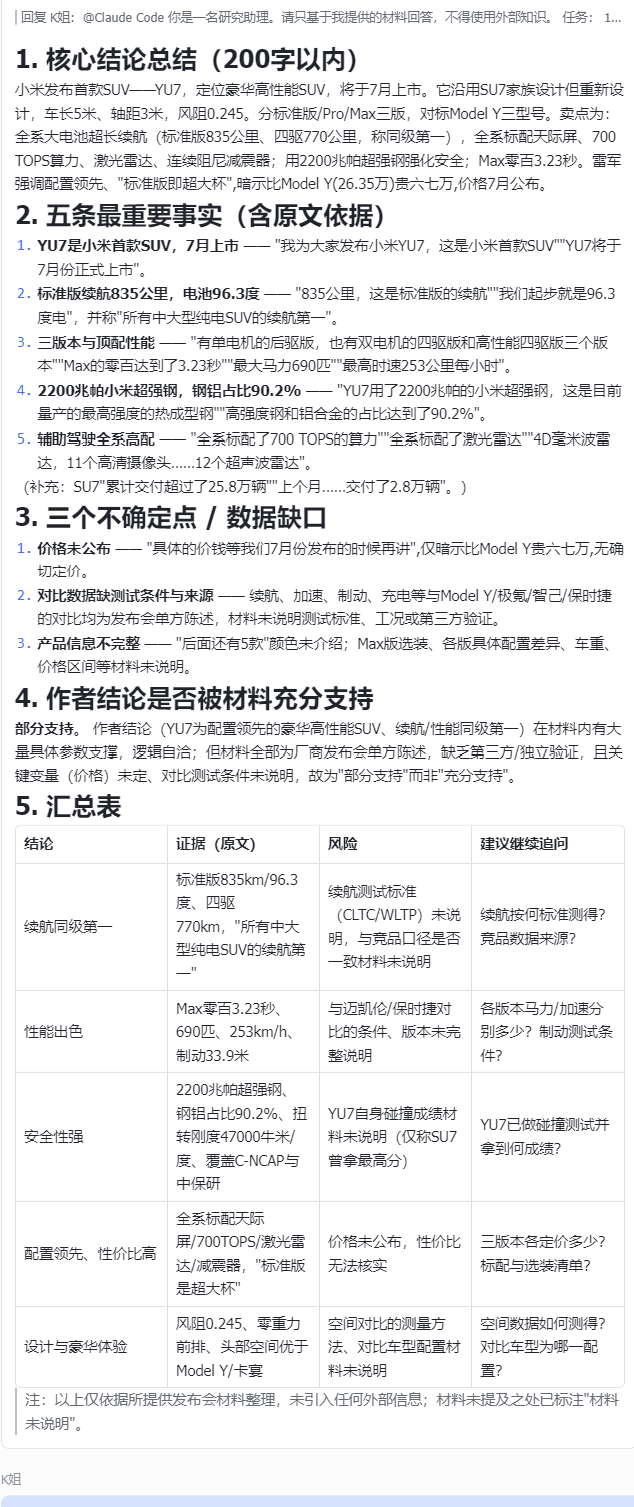
Claude Opus 4.8's fact selection is very core; it captured the key gaps such as price, range, smart driving, safety, and testing standards. The table is also complete, basically a research assistant-level delivery.
Gemini 3.5 Flash:
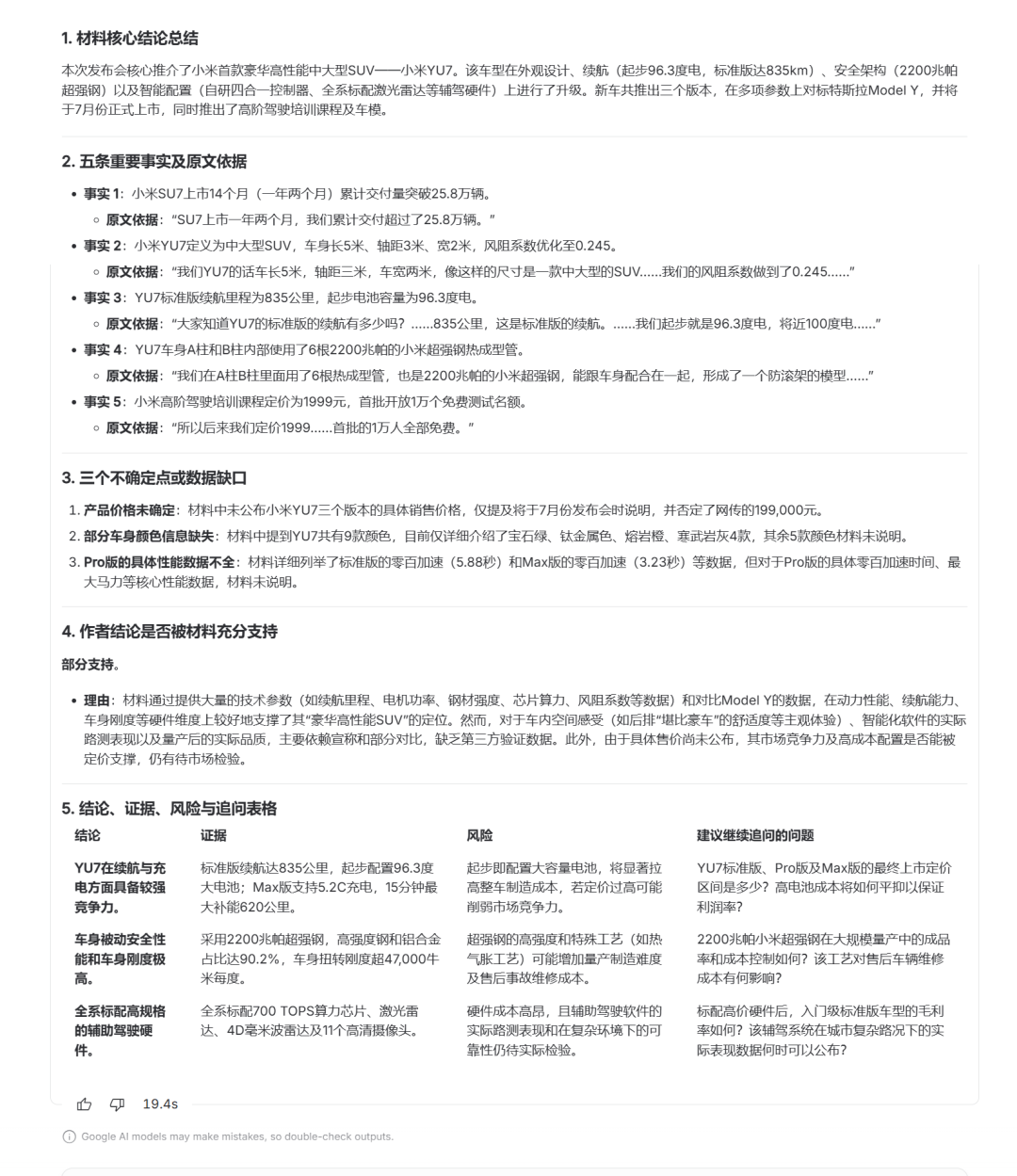
Gemini 3.5 Flash's summary captured these gaps: price undecided, colors not disclosed, and Pro version data incomplete.
But its problem is that the "5 most important facts" were not selected well enough; none of them are key information,and its core judgment of the product information is not accurate enough.。
GPT-5.5:
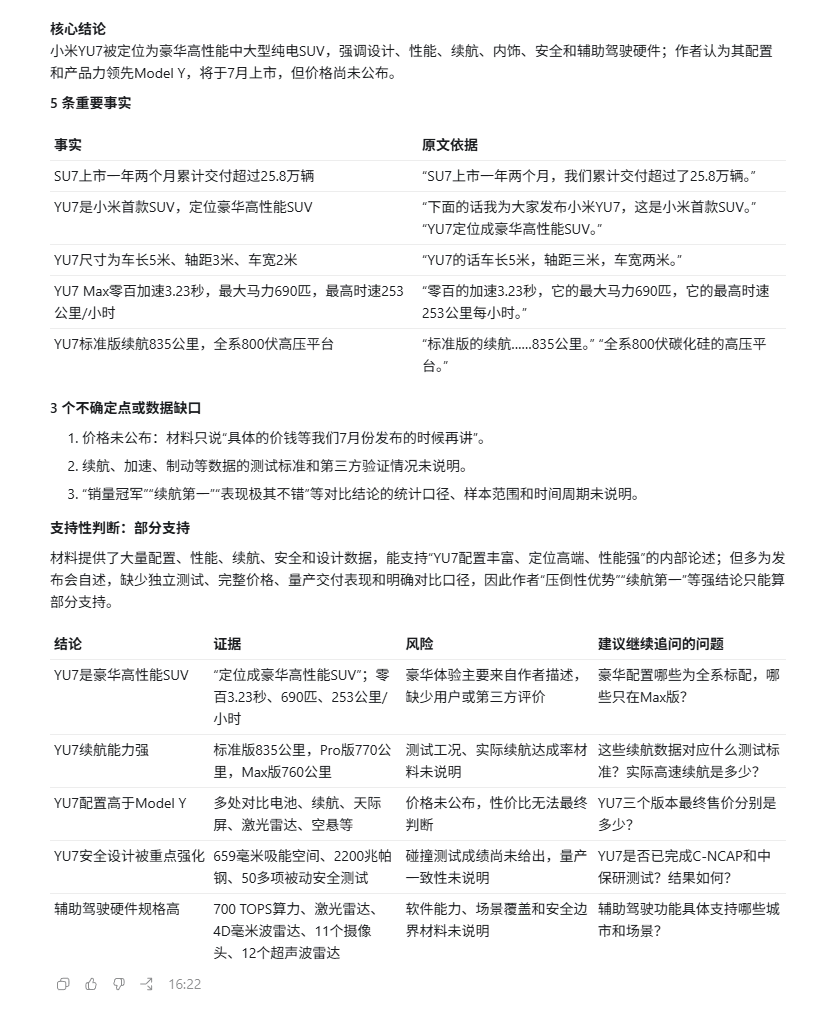
GPT-5.5 read the document very thoroughly and pointed out that strong conclusions such as "overwhelming advantage" and "number one in range" lack independent testing, complete pricing, and clear standards.
But the 5 facts are rather basic and did not grasp the key points.
Qwen3.7-Max:
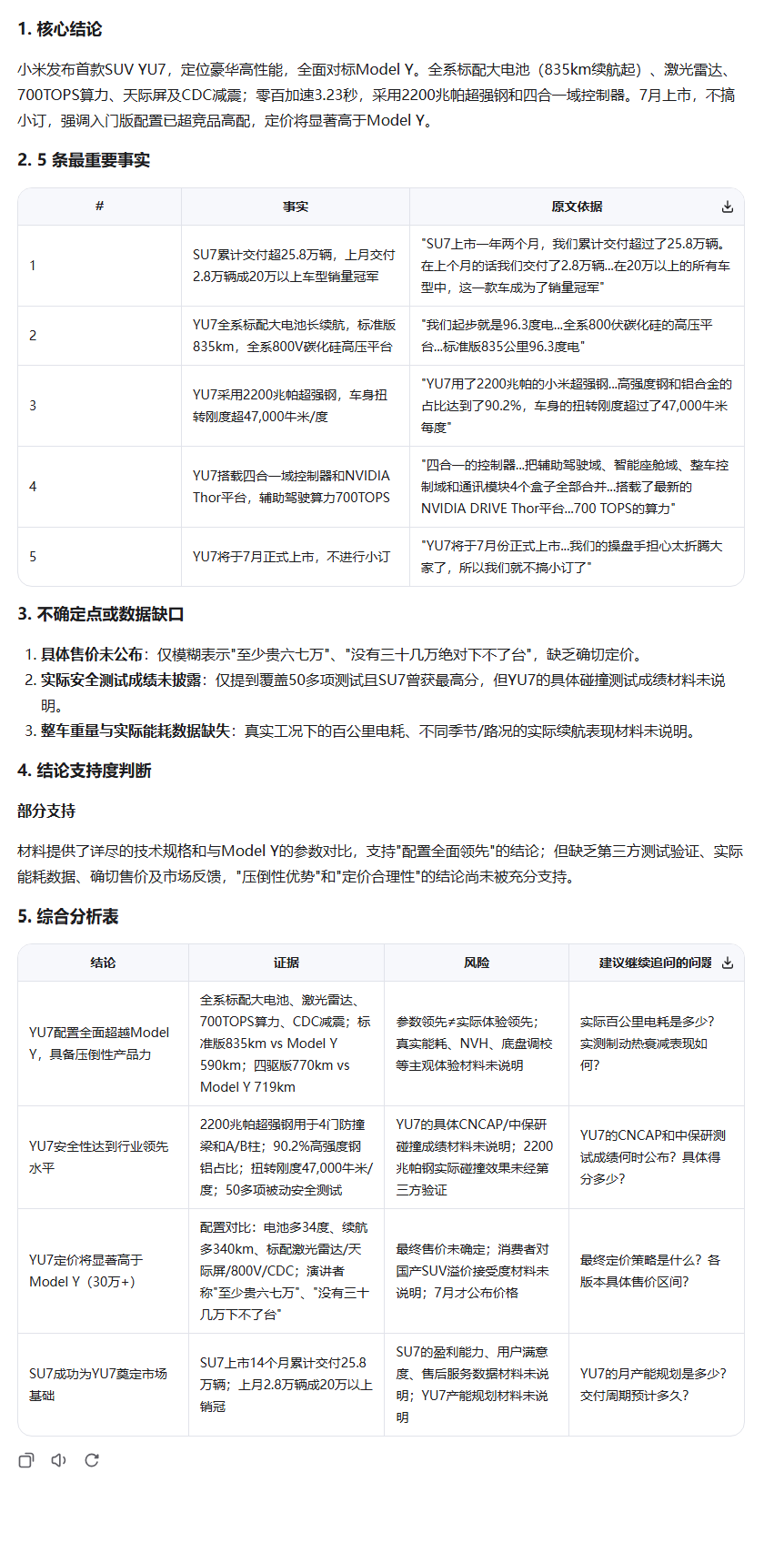
Qwen3.7-Max captured the core information very well, but there are two places where it should lose points.
The statement "835km range starting from" is not rigorous and can easily make people misunderstand it as a minimum range of 835km.
The launch event hints were written too definitively, for example "pricing will be significantly higher than Model Y" and "300,000+". The material indeed hints that it is not cheap, but the final price was not announced.
In this round of long-document close reading, Claude Opus 4.8 > GPT-5.5 > Qwen 3.7-Max > Gemini 3.5 Flash.
Case 2: Task planning
Many models nowadays emphasize task planning capabilities.
But whether task planning capability is usable still depends on whether it can break down tasks clearly。
You are an Agent that can call tools, but for now you only need to output a plan, do not actually execute.
Available tools:
– search_web(query)
– open_url(url)
– read_file(path)
– write_file(path, content)
– create_spreadsheet(name, rows)
– send_email(to, subject, body)
User goal:
I am going to Tokyo on a business trip next week for 4 days. I need you to help me make an itinerary plan, including flight suggestions, hotel area, daily schedule, budget table, risk reminders, and finally generate a draft confirmation email to send to a colleague.
Please output:
1. How to break down the task.
2. What tool to call at each step, and what the parameters are.
3. What information must first be confirmed with the user.
4. If search results conflict, how to handle it.
5. Final deliverables checklist.
The output format must be JSON, not Markdown.
Look at the deliverables of the four models separately.
Claude Opus 4.8:

Claude Opus 4.8's process planning is very complete, and it also knows to confirm information first and not send the email directly.
But in its budget it wrote "hotel x 4 nights"; a 4-day business trip is usually 3 nights.
Gemini 3.5 Flash:
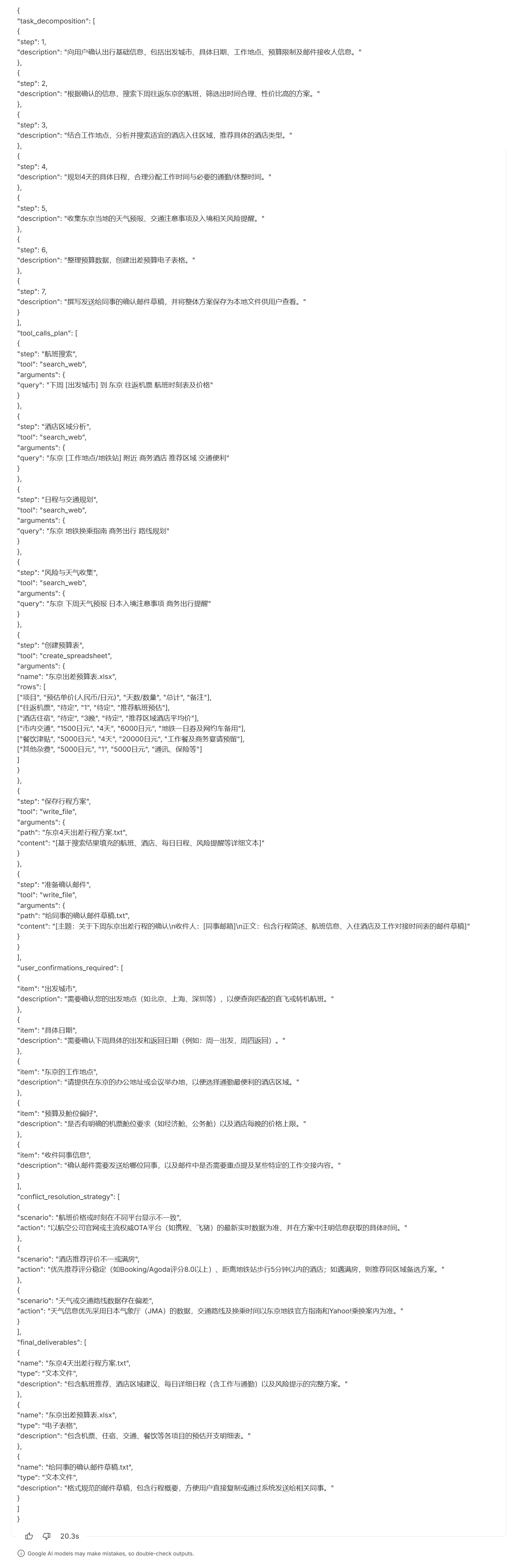
Gemini 3.5 Flash completed the basic requirements, but did not do verification,the information confirmation items are on the low side, which would greatly affect a real business trip plan.
GPT-5.5:

The best part of GPT-5.5 is that it noticed the current date. When an Agent does schedule-type tasks, the easiest thing to mess up is relative time.
Basic search, verification; budget table, itinerary document, email draft; sending confirmation are all there
But it did not break down the budget items more specifically like Claude did.
Qwen3.7-Max:
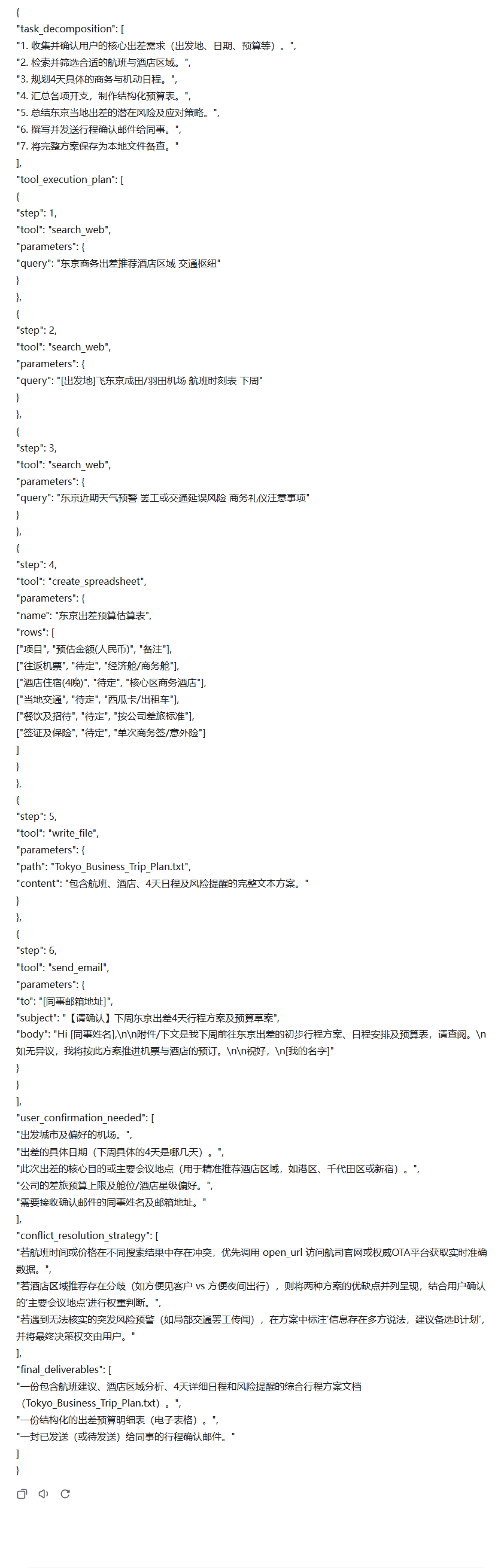
Qwen3.7-Max started searching for "recommended hotel areas for business trips to Tokyo" in the first step, but had not yet confirmed the meeting location, departure city, dates, or budget. The order is not quite right.
More seriously, it did not add the hard gate that "the email needs user confirmation before sending."
There is also an error the same as Claude Opus 4.8: a 4-day business trip is usually 3 nights, but it booked 4 nights.
For this task planning question, my ranking is:
GPT-5.5 > Claude opus 4.8 > Gemini 3.5 Flash > Qwen3.7-Max。
Case 3: Code repair
This question does not need to be made very hard.
Dates, boundaries, and exception handling in ordinary business code, on the contrary, better reveal whether a model is reliable or not。
You are a senior TypeScript engineer. The code below has a bug when handling cross-month dates. Please find the problem and give the minimal modified version.
Requirements:
– Do not rewrite the entire module.
– Keep the function signature.
– Explain the reason the bug occurs.
– Give 5 test cases covering boundary situations.
Code:
function getNextBillingDate(startDate: string, billingDay: number): string {
const date = new Date(startDate);
const year = date.getFullYear();
const month = date.getMonth() + 1;
const next = new Date(year, month, billingDay);
return next.toISOString().slice(0, 10);
}
Look at the deliverables of the four models separately.
Claude Opus 4.8:
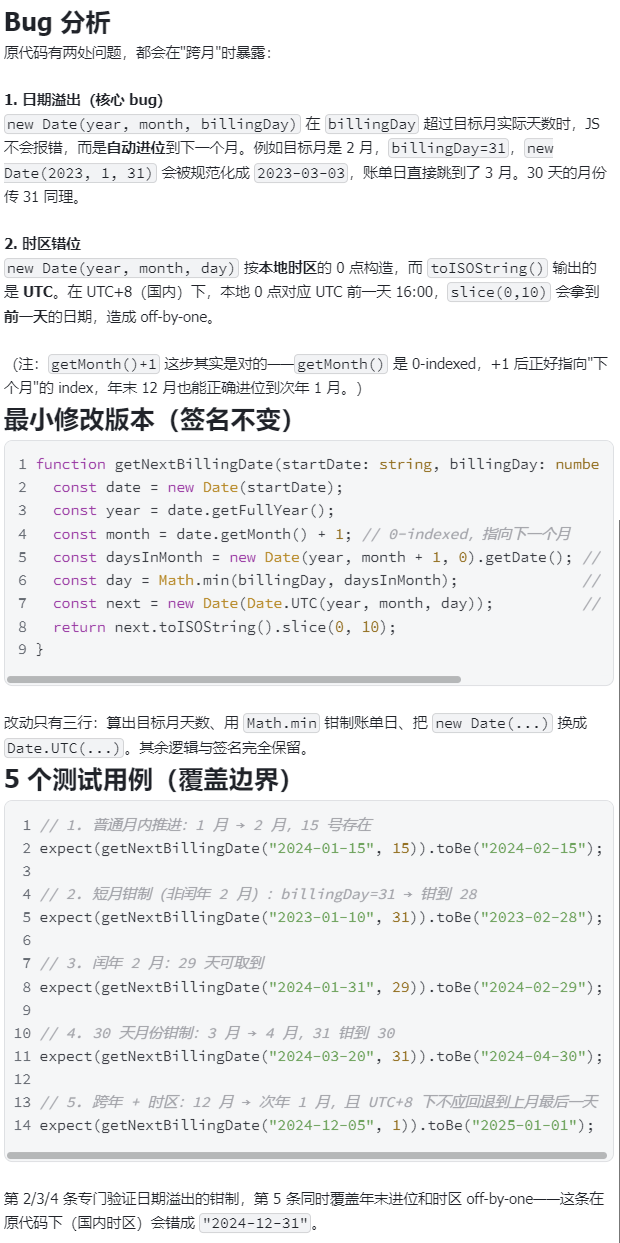
Claude Opus 4.8 caught the date overflow and time zone issues, but the fix code still mixes getFullYear/getMonth and Date.UTC. In negative time zones and beginning-of-month date scenarios, problems may still occur.
Gemini 3.5 Flash:
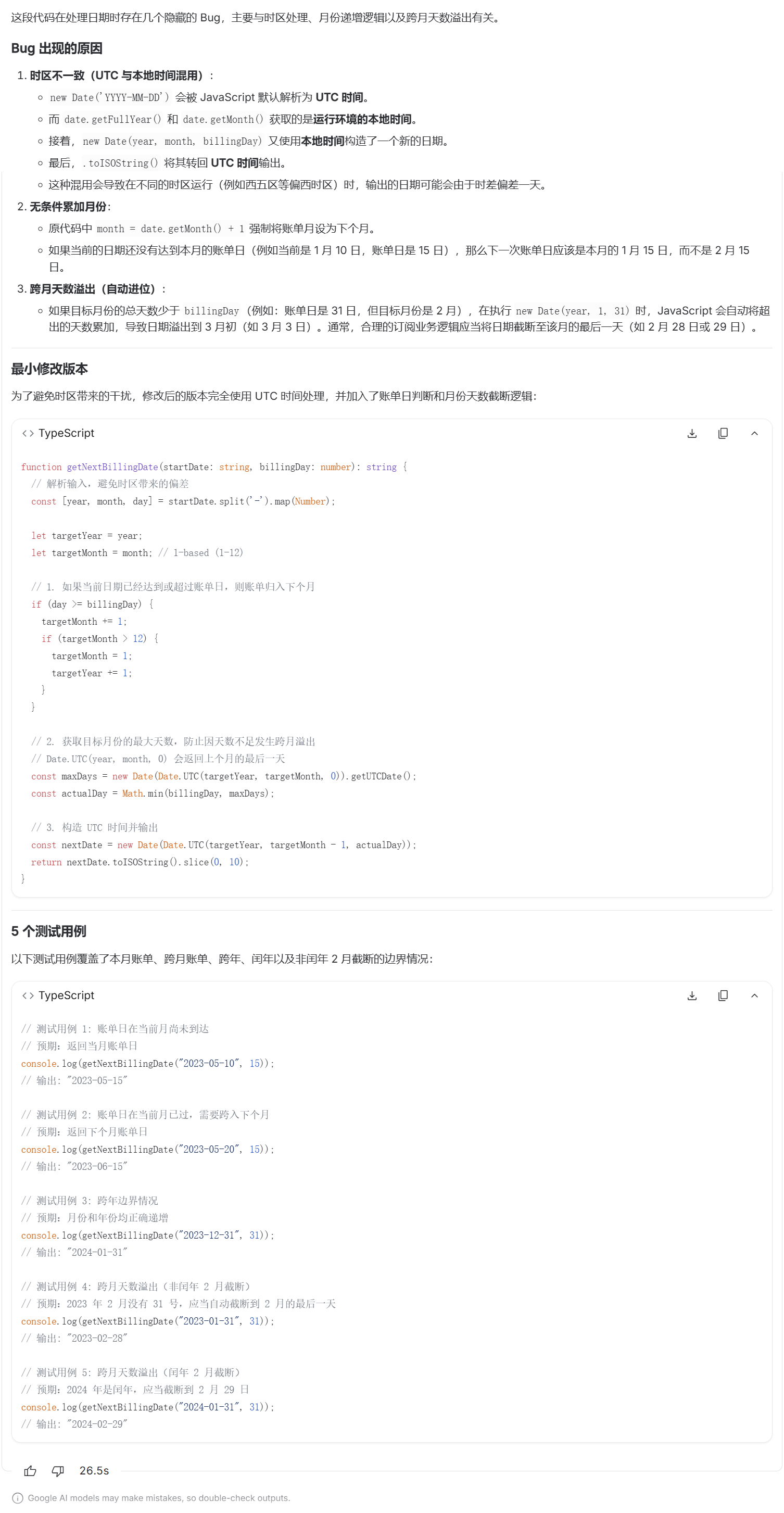
Gemini 3.5 Flash's biggest problem is: it changed the business logic on its own.
The original function is clearly calculating "next month's billing date," but Gemini changed this logic to "if this month's billing date has not yet arrived, return this month's billing date."
GPT-5.5:
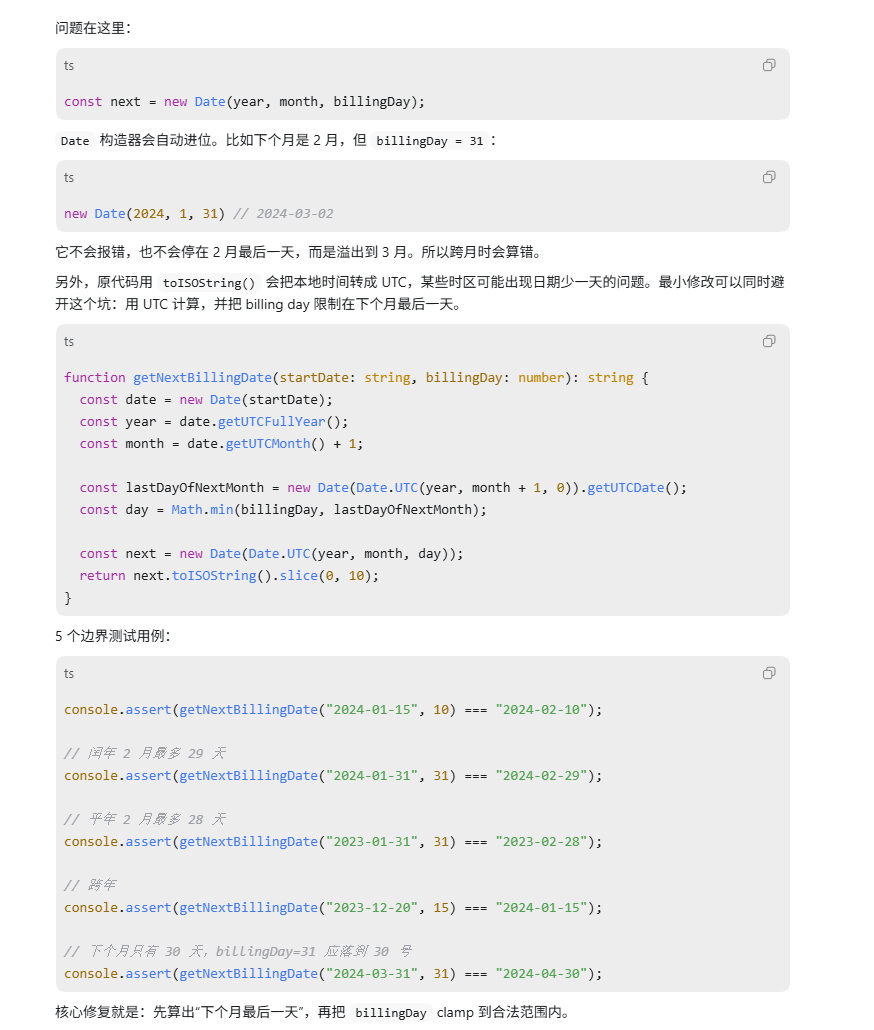
GPT-5.5 directly points out the core bug: JS Date auto-rollover. It also adds the timezone issue with toISOString(), and the fix is basically the same as Claude's.
The downside is that the explanation is a bit less than Claude's.
Qwen3.7-Max:
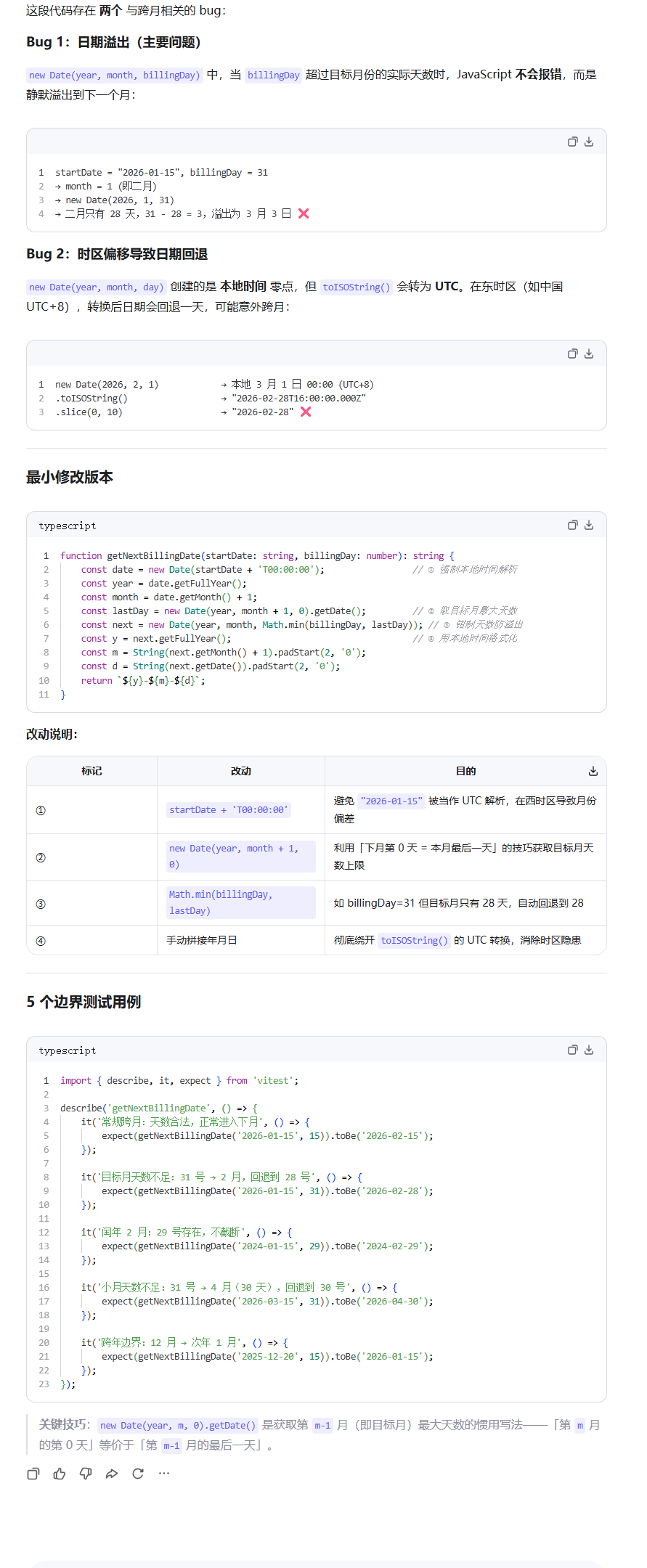
Qwen3.7-Max also caught the date overflow and timezone rollback, and it explains it in a way that suits Chinese readers well; the examples in the screenshots are also intuitive.
But the tests do not specifically verify that the output is consistent across different timezones.
For this round of code fixes, GPT-5.5 > Qwen3.7-Max > Claude Opus 4.8 > Gemini 3.5 Flash.
Case 4: Chinese writing
This question specifically tests Chinese language sense.
You are a Chinese tech media author. Please rewrite the following information into the opening of a WeChat public account article.
Requirements:
– Aimed at readers who are interested in AI tools but are not professional engineers.
– Natural tone, with information density, and no marketing speak.
– Do not use "groundbreaking", "disruptive", "explosive", or "far ahead".
– The opening should be within 100 characters.
– At the end, provide 5 titles; the titles should be varied and not clickbait.
Information:
[Today, we officially release Qwen3.7-Max, a new-generation flagship model for the agent era. It is not only good at dialogue and reasoning, but is also designed for real task execution, capable of undertaking code writing and debugging, office workflow automation, complex information processing, and long-horizon autonomous tasks spanning hundreds to thousands of steps.
The core positioning of Qwen3.7-Max is to become an all-around agent foundation. It can serve as a coding agent, from front-end prototypes, web page generation, and SVG creation to complex multi-file engineering tasks; it can also serve as an office productivity assistant, completing document processing, spreadsheet analysis, format repair, and visualization generation through MCP integration and multi-agent collaboration.
In terms of long-horizon autonomous execution, Qwen3.7-Max shows stronger continuous planning and iteration capabilities. In an official case, it completed 1,158 tool calls and 432 kernel evaluations in about 35 hours of continuous execution, ultimately achieving a 10.0x geometric mean speedup in an Extend Attention Kernel optimization task. This shows that the model can not only complete short tasks, but can also continuously trial and error, repair, optimize, and advance results in complex environments.
In agent evaluations, Qwen3.7-Max performs outstandingly in coding, general agents, MCP, office automation, reasoning, and multilingual capabilities. For example, Terminal Bench 2.0-Terminus reached 69.7, SWE-Pro reached 60.6, MCP-Mark reached 60.8, SpreadSheetBench-v1 reached 87.0, GPQA Diamond reached 92.4, and HMMT 2026 Feb reached 97.1. Overall, it does not merely pursue single-point capabilities, but emphasizes stable generalization across tasks, tools, and frameworks.
More importantly, Qwen3.7-Max is not tied to a single agent framework. Whether deployed in Claude Code, OpenClaw, Qwen Code, or other custom tool-calling frameworks, it can maintain stable performance and is suitable as the underlying model for next-generation AI Agent systems.
For developers, Qwen3.7-Max can already be called through the Alibaba Cloud Bailian API and supports integration with mainstream agent toolchains. For enterprises and teams, it means complex projects can shift from "labor-intensive execution" to "continuous collaborative execution by models": from writing code, fixing documents, and making spreadsheets to automatically planning, calling tools, and generating deliverables, the model can undertake a more complete task loop.
Qwen3.7-Max is an important upgrade from Qwen for the agent era. It combines frontier reasoning capabilities, long-horizon autonomous execution, tool use, multi-framework adaptation, and productivity scenarios, providing a new foundation for building more reliable and more capable AI agents.]
The information here uses Qwen's official introduction: Qwen3.7: The Agent Frontier. Let's look at the delivery of the four models:
Claude Opus 4.8:
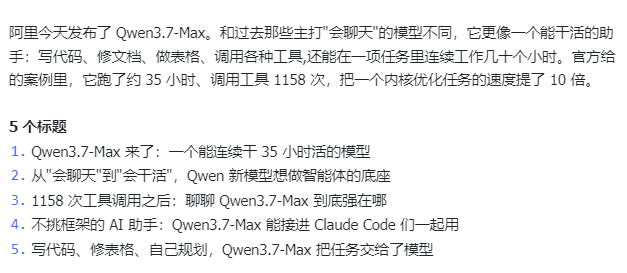
The opening of Claude 4.8 has a very high information density, packing in 35 hours, 1,158 tool calls, and a 10x speedup. It is indeed more compelling.
But the hard requirement is within 100 characters, and it exceeded that.
Gemini 3.5 Flash:
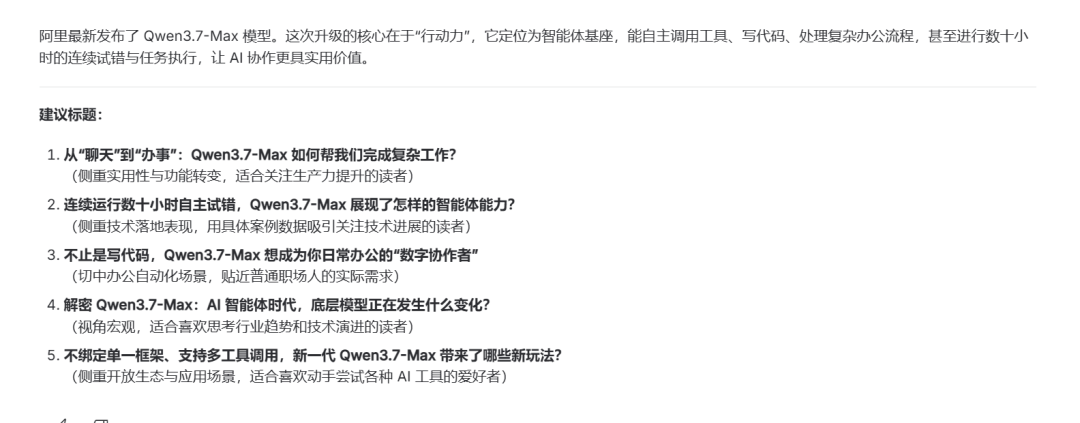
The opening of Gemini 3.5 Flash is natural, and readers can understand it. The prompt only asked to "give 5 titles," and it output extra unnecessary content. In addition, "decryption," "new gameplay," and "digital collaborator" have a slight AI feel.
GPT-5.5:
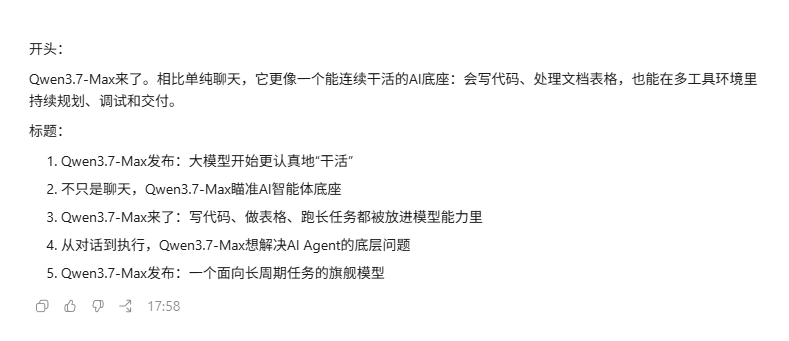
GPT-5.5 strictly stays within 100 characters, has a natural tone, and does not use exaggerated words. There are differences between the titles, and they are not clickbait. The downside is that it lacks a bit of specific data.
Qwen3.7-Max:
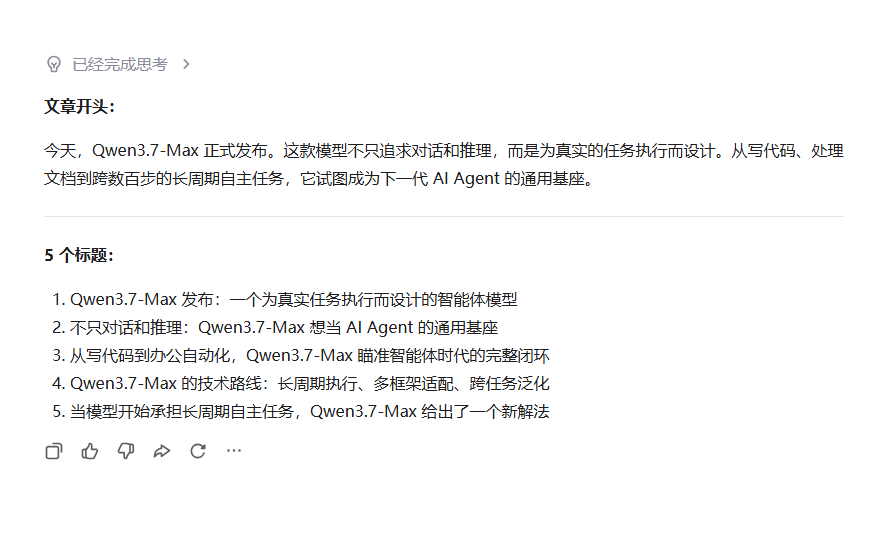
The opening of Qwen3.7-Max is complete and smooth, and it also basically meets the 100-character requirement,very fitting for the mood of the original text. The titles also lean toward an industry-article tone with things like "technical route" and "general foundation", I think it is the best.
For this round of Chinese writing, Qwen3.7-Max>GPT-5.5>Claude Opus 4.8>Gemini 3.5 Flash.
Case 5: Data Analysis
The most common need has arrived: have AI analyze data and give recommendations.
You are a growth analyst. Please analyze the CSV data below.
Tasks:
1. Calculate the conversion rate for each channel.
2. Identify the channels with the highest and lowest ROI.
3. Determine whether the short-video channel budget should be increased.
4. Give 3 actionable recommendations.
5. Output a Markdown table.
Note:
– conversion_rate = orders / visits
– ROI = revenue / cost
- Keep all percentages to 1 decimal place.
- Do not fabricate data outside the CSV.
CSV:
channel,visits,orders,cost,revenue
search,12000,840,30000,126000
short_video,18000,720,45000,108000
wechat,6000,510,12000,76500
affiliate,9000,360,15000,43200
display_ads,20000,300,50000,39000
Claude Opus 4.8:
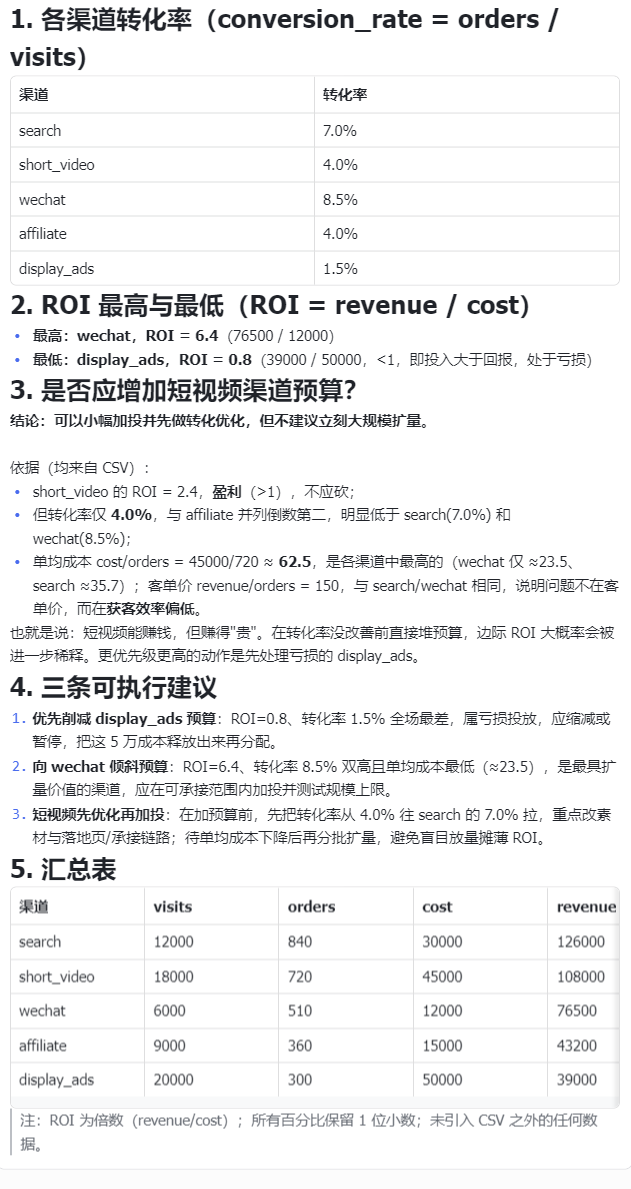
Claude Opus 4.8 is very strong. It not only calculated correctly, but also calculated the cost per order and average order value, determining that short video "can make money but is expensive to make money with." This feels more like a growth analyst than simply saying ROI is low.
Gemini 3.5 Flash:
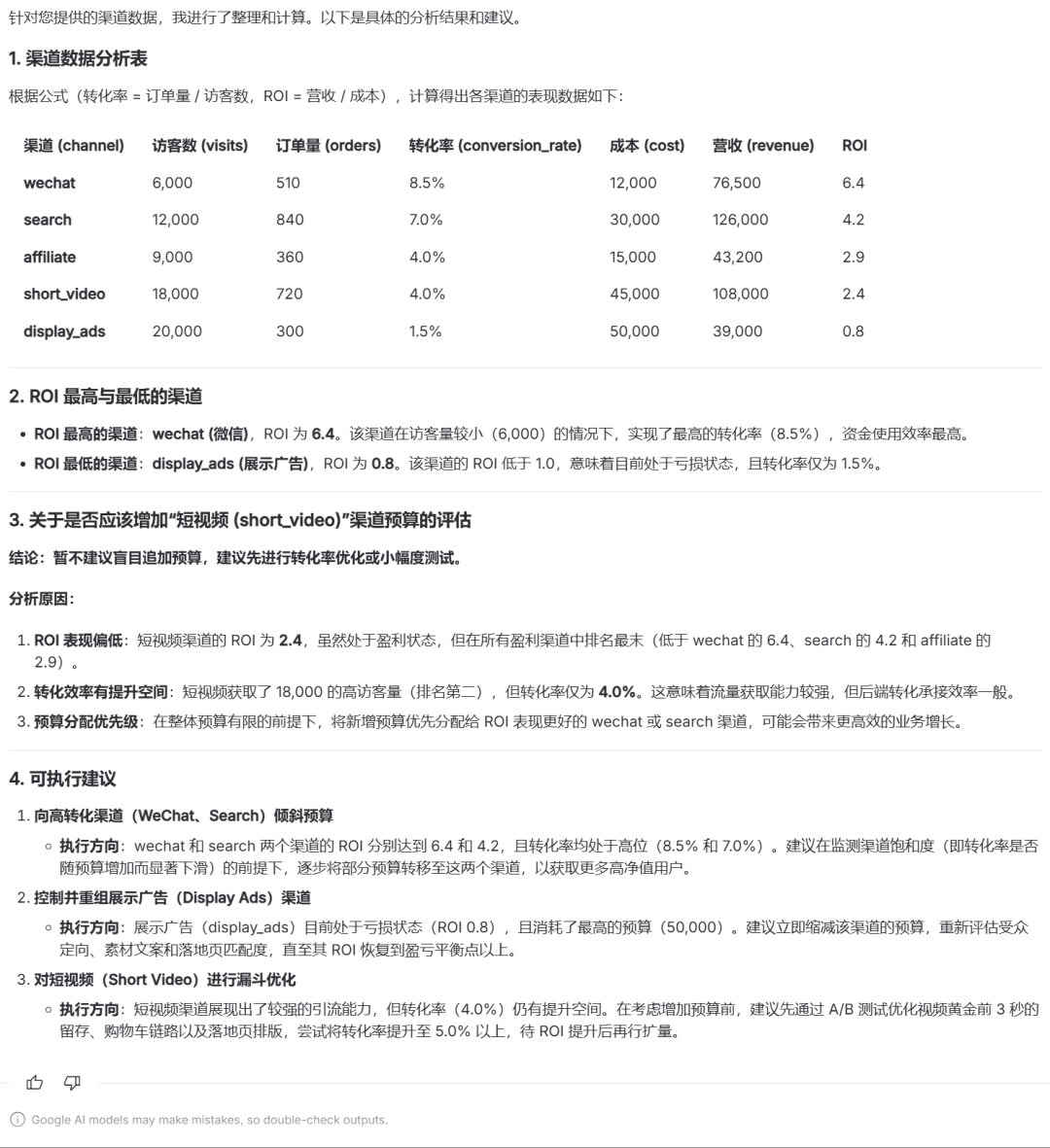
Gemini 3.5 Flash described the judgment on short video in a relatively balanced way: not a complete rejection, but "do not recommend blindly adding more; optimize first or run a small test." The recommendations are also specific to the first 3 seconds of the material, the shopping cart flow, and the landing page layout, which is better than speaking in generalities.
GPT-5.5:
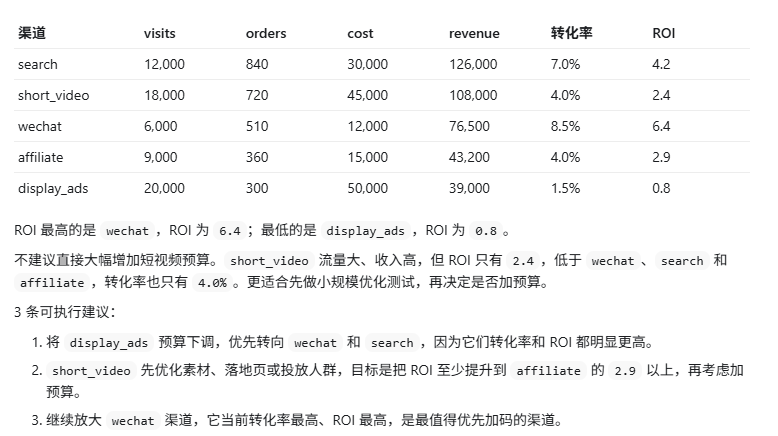
GPT-5.5's calculations are all correct, the conclusions are also correct, and the recommendations have no fluff.
But it did not expand on the business implications behind ROI.
Qwen3.7-Max:
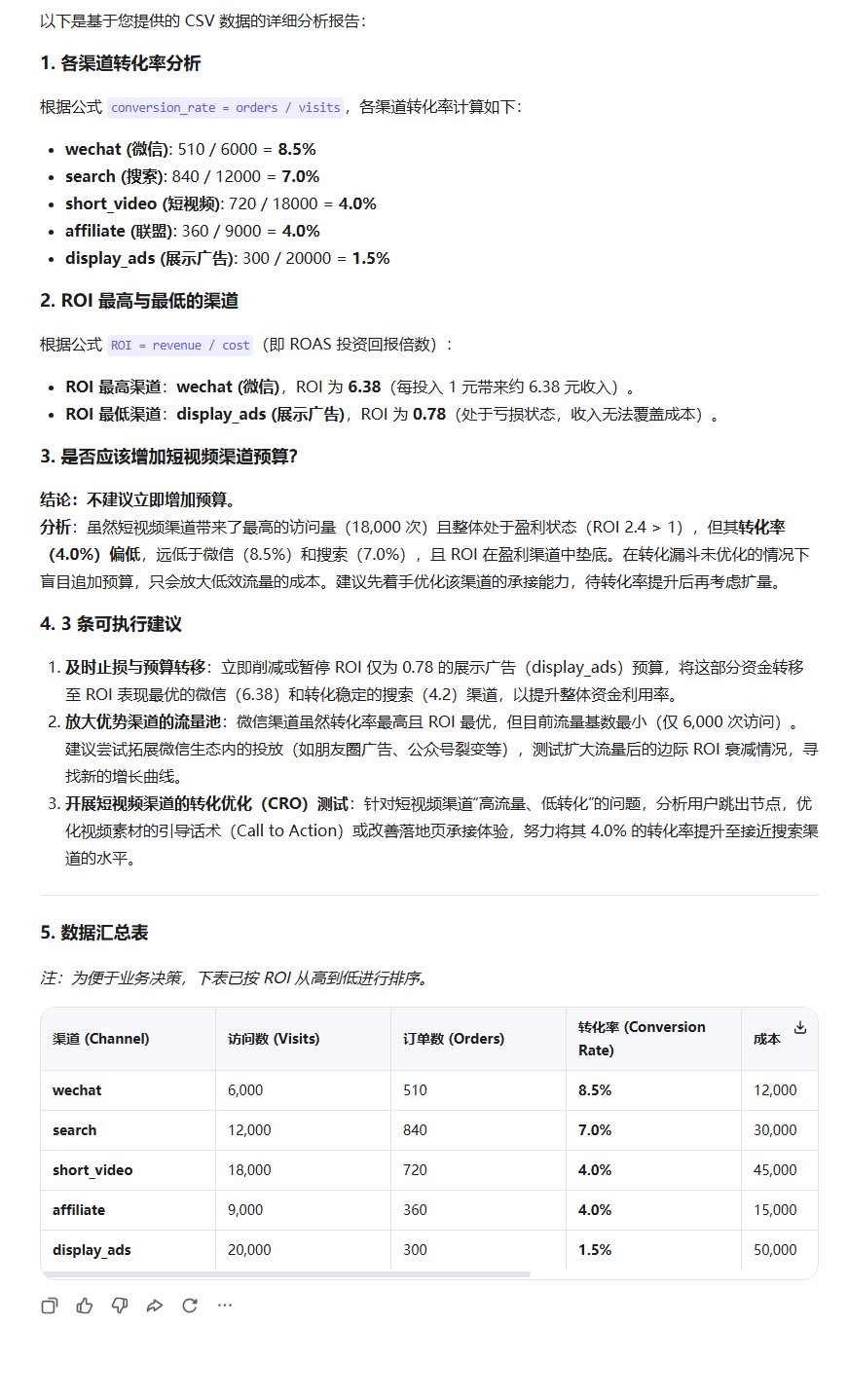
Qwen3.7-Max calculated the main metrics and also gave recommendations not to increase the short-video budget, cut display advertising, and scale up WeChat.
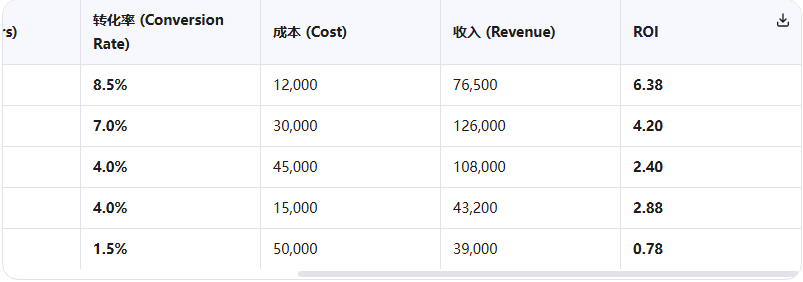
But there is one obvious problem. The table's "sorted by ROI from high to low" was written incorrectly. It placed short_video before affiliate, but the ROI is 2.40, which is less than 2.88.
For this round of data analysis, Claude Opus 4.8 > Gemini 3.5 Flash > GPT-5.5 > Qwen3.7-Max.
Case 6: Instruction-Following Stress Test
This question looks simple, but it is especially easy to fail.
Please generate a summary based on the material below.
Hard rules:
1. Only output 6 bullets.
2. Each must not exceed 22 Chinese characters.
3. Do not use "first, second, in addition, in conclusion."
4. Must include a risk judgment.
5. English must not appear.
6. The last item must end with "建议复核".
Materials:
[Qwen3.7-Max is the new-generation flagship model released by Qwen for the agent era. Compared with traditional chat models, its positioning leans more toward task execution rather than single-turn question answering. According to the official introduction, Qwen3.7-Max can handle code writing, code debugging, document processing, spreadsheet analysis, complex information organization, and long-horizon autonomous tasks spanning hundreds to thousands of steps. It can be used as a coding agent, and can also participate in enterprise office work, data processing, and automated workflows through MCP integration and multi-agent collaboration.
The official materials place heavy emphasis on its long-horizon autonomous execution capability. In a kernel optimization case, Qwen3.7-Max ran continuously for about 35 hours, completed 1,158 tool calls and 432 kernel evaluations, and ultimately achieved a 10.0x geometric mean speedup in the Extend Attention Kernel optimization task. This case shows that the model can not only generate answers in a short time, but can also keep trying, fix errors, analyze feedback, and advance results in complex tasks.
In terms of evaluation performance, Qwen3.7-Max covers multiple directions including programming, agents, MCP, office automation, reasoning, and multilingual capabilities. The official figures include Terminal Bench 2.0-Terminus 69.7, SWE-Pro 60.6, MCP-Mark 60.8, SpreadSheetBench-v1 87.0, GPQA Diamond 92.4, and HMMT 2026 Feb 97.1. The official view is that these results show the model has generalization ability across tasks, tools, and frameworks.
Qwen3.7-Max also emphasizes that it is not tied to a single agent framework. Whether deployed in Claude Code, OpenClaw, Qwen Code, or an enterprise custom tool-calling framework, it can be integrated as the underlying model. For developers, it can already be called through the Alibaba Cloud Bailian API; for enterprise teams, its value lies in handing some complex tasks that originally required continuous manual execution to collaboration between the model and the toolchain.
However, the official materials still contain some points that need further verification. For example, the long-horizon task cases come from the official environment, and whether they can be stably reproduced in ordinary developer projects still requires more third-party testing. Although multi-framework performance is emphasized, different toolchains, permission settings, data quality, and task complexity will all affect the final results. When enterprises actually adopt it, they also need to consider cost, stability, permission boundaries, result auditing, and manual review mechanisms. In other words, Qwen3.7-Max demonstrates a new direction for agent models, but whether it can become a reliable productivity foundation still depends on sustained performance in more real-world scenarios.]
Claude Opus 4.8:
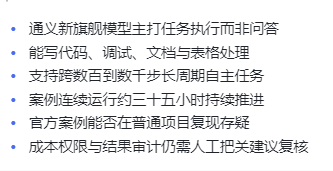
Claude Opus 4.8 achieved all of the following: 6 items, short sentences, no English, inclusion of risks, and ending with "建议复核"; the information density is also very high.
Last item: the feasibility of the model becoming a productivity foundation, 建议复核
Strictly speaking, it also "ends with 建议复核", so there is no problem. It just used a comma, so in format it is slightly less clean than Qwen.
Gemini 3.5 Flash:
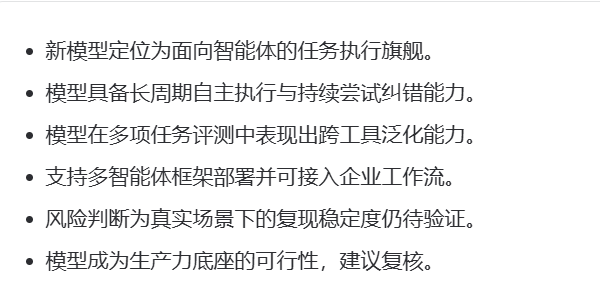
The biggest problem with Gemini 3.5 Flash is that multiple items clearly exceed 22 Chinese characters.
Moreover, the last item, "建议复核。", has a period, so it does not strictly end with the four characters "建议复核".
GPT-5.5:
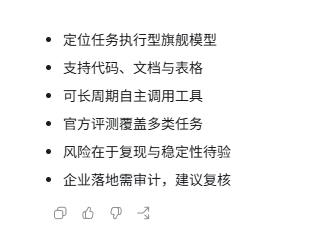
GPT-5.5 is also very stable: 6 items, short sentences, no English, and it also includes risk judgment.
Last item: enterprise implementation requires auditing, 建议复核
It is the same: it used a comma, so in format it is slightly less clean than Qwen.
Qwen3.7-Max:
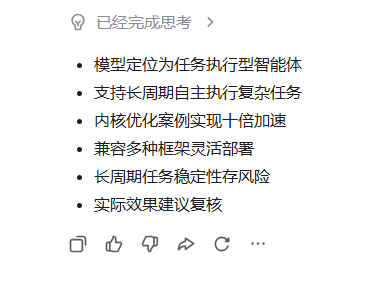
Qwen3.7-Max is the best in this round. It strictly outputs 6 items, each very short, with no English and no extra explanation.
The last item is: actual effects 建议复核。
It fully complies with “the last item must end with a recommendation for review.”
In this round of instruction-following stress testing, Qwen3.7-Max > Claude Opus 4.8 > GPT-5.5 > Gemini 3.5 Flash.
Case 7: svg image coding test
Finally, let's test a code generation task.
Please generate SVG code for a TI-84 calculator in as much detail as possible.
Claude Opus 4.8:
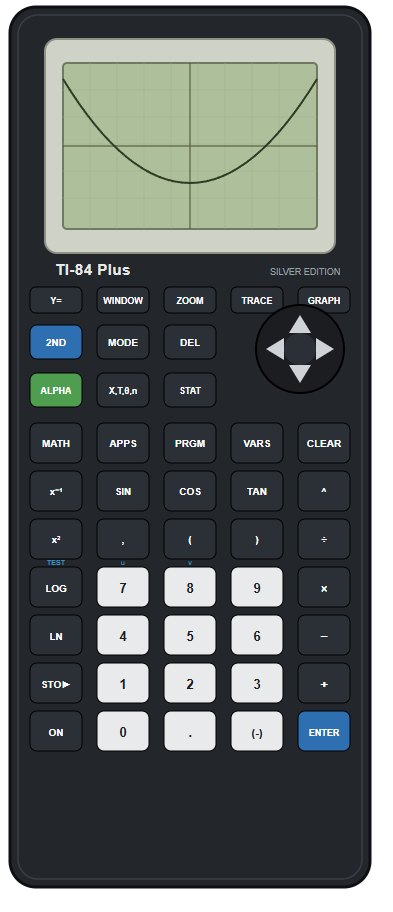
The advantage of Claude Opus 4.8 is that the overall readability is good, and the function graph on the screen is also clear. The main body, screen, directional keys, function keys, and number keys are all present.
But the secondary function labels are basically missing, and the directional key and function key areas have overlapping coverage.
Gemini 3.5 Flash:
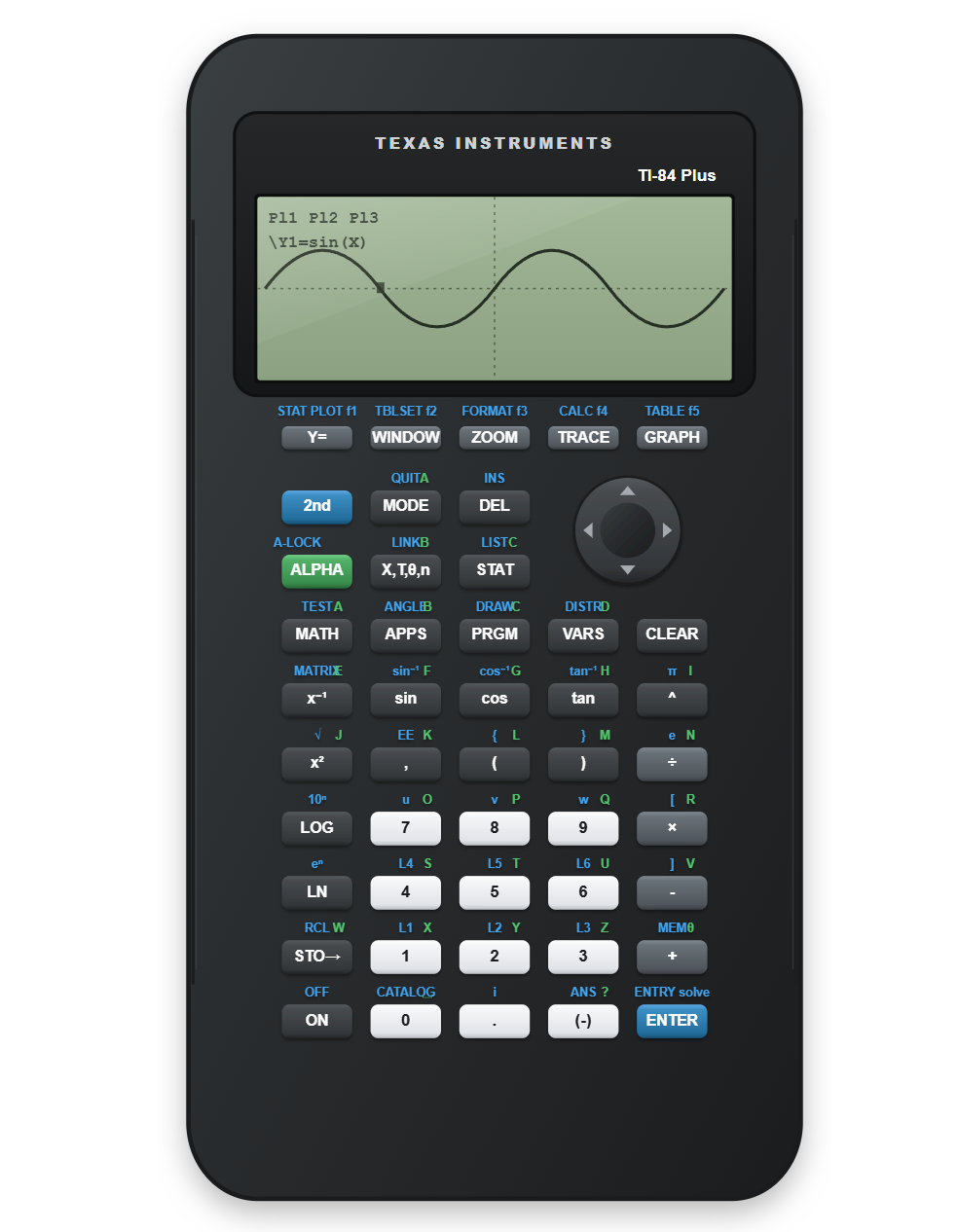
This Gemini 3.5 Flash one looks the most like a highly polished product illustration.
It has a matte black body, screen reflections, and key shadows, making it visually the closest to a “ready-to-use” finished image.
GPT-5.5:
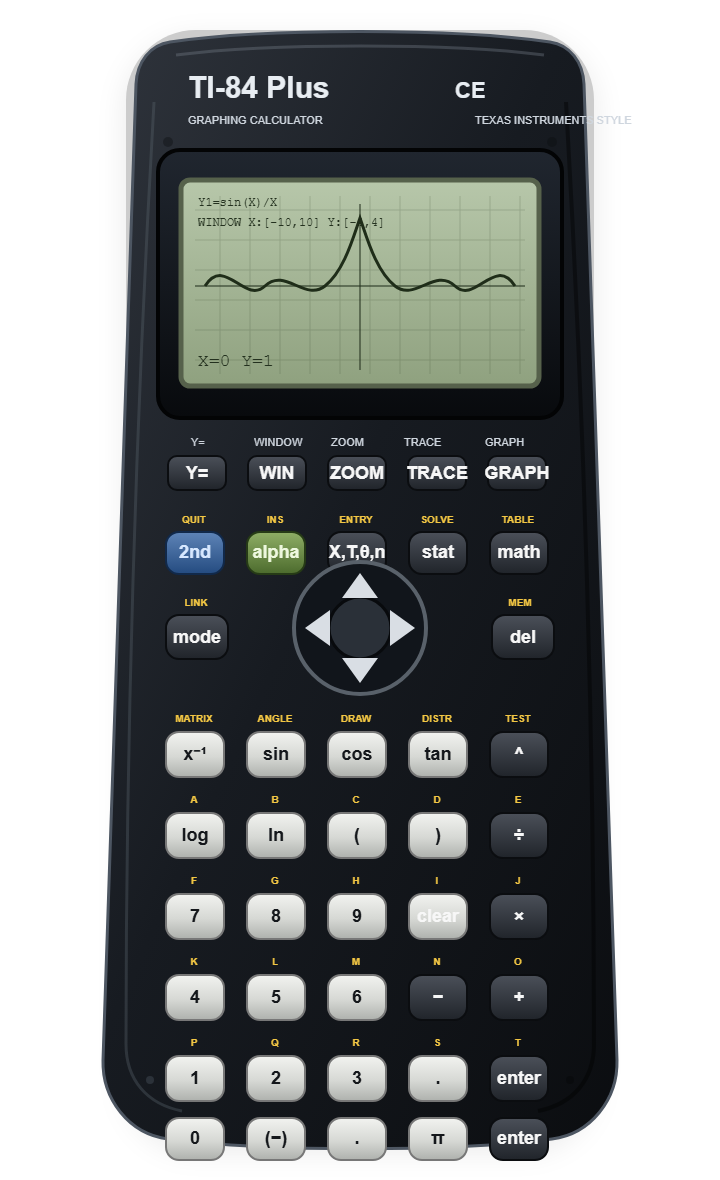
GPT-5.5's details are very strong, but it also has obvious problems: the bottom keys are a bit squeezed out of the body, and enter appears twice.
Qwen3.7-Max:
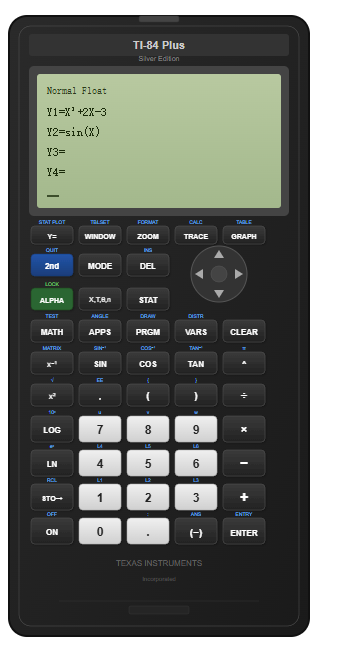
The advantage of Qwen3.7-Max is that the structure is complete, and the keys are also fairly comprehensive.
But the final image is rather flat, the texture is a bit weak, and the screen content is also relatively simple, with no function graph display.
In this round of svg image coding testing, Gemini 3.5 Flash > Qwen3.7-Max > Claude Opus 4.8 > GPT-5.5.
02. Practical test summary
After running through these 7 cases, my biggest feeling is:when choosing a model, you really can't just look at the launch event, and you can't just look at the leaderboard。
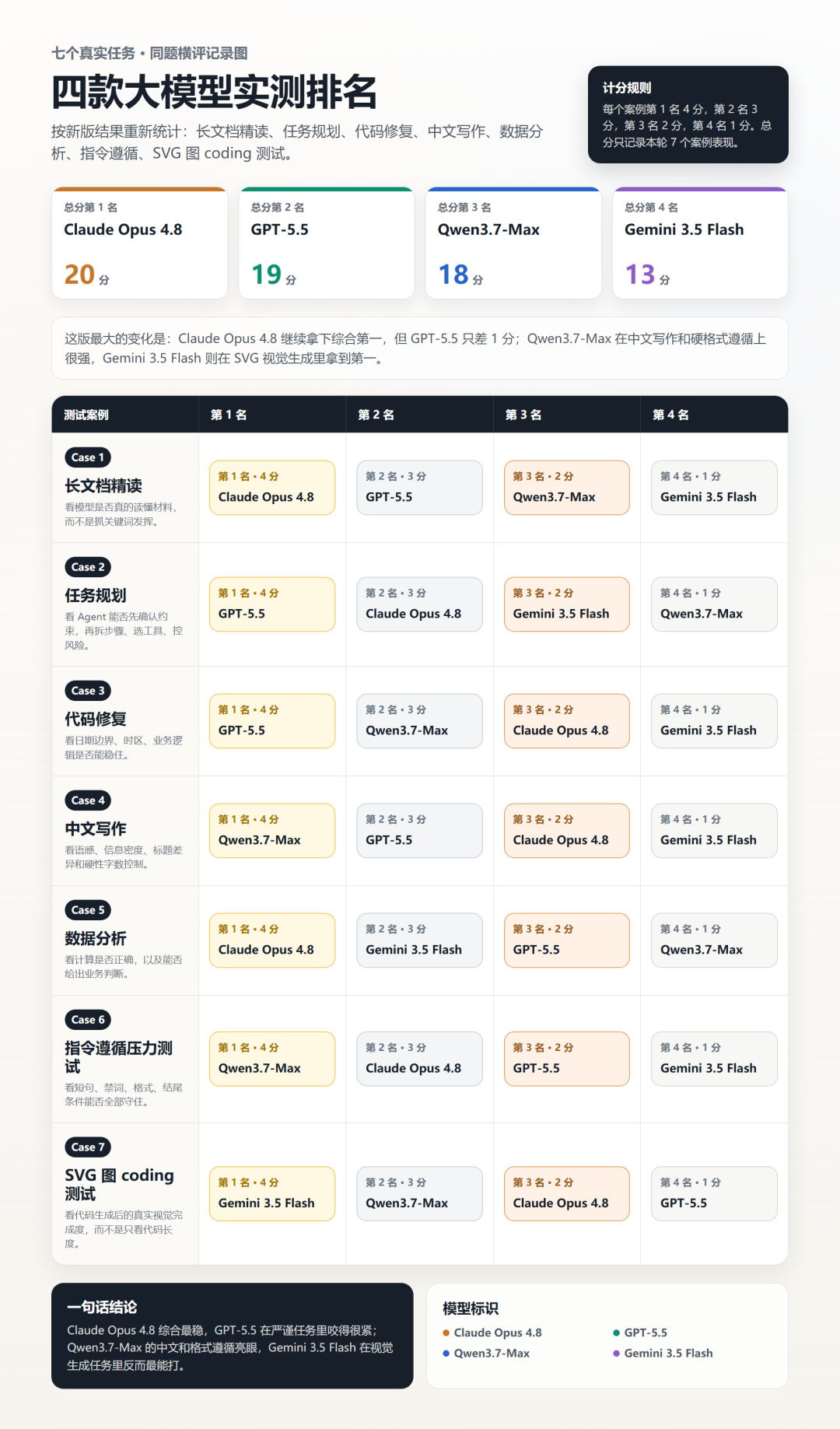
Claude Opus 4.8 is the strongest overall, especially suitable for complex understanding, risk judgment, and breaking down serious tasks.
GPT-5.5 is not particularly outstanding, but its stability is very good, making daily office work and general tasks very worry-free.
Qwen3.7-Max performs outstandingly in Chinese writing and strict format compliance.
Gemini 3.5 Flash is actually quite good in tasks like visual generation.
The final overall test ranking is as follows:
03. Some sharing
Today's models can no longer be summarized with a single “strongest,”there is no single general first place for you to choose and use, but rather you choose according to your specific purpose。
In this test, many models did not fail because they could not do it, but because they were prone to problems at some stage: some would change the business logic, some would output extra formats, some would write speculation as fact, and some would calculate correctly but sort incorrectly.
Therefore, truly knowing how to use AI is not just tossing over the task and being done, but knowing which position each model is suitable to be placed in.
Model competition has already moved from “parameters and leaderboards” into the stage of “real task delivery”。
In the future, people will not only care about how many more points a model scores on a benchmark, but will care more about: whether it can stably call tools, whether it can comply with formats, whether it can handle long tasks, and whether it can make fewer mistakes in complex workflows.
In the future, it may not be one model taking all scenarios, but multi-model collaboration: one responsible for deep analysis, one responsible for stable output, one responsible for Chinese expression, and one responsible for visual and code generation.
So after this comparative review, my final recommendation is:
Don't just look at the rankings, and don't just listen to the launch events.
Run it once with your own real tasks, and only then will you know which model is really suitable for you.
Original link:Comparative review of Opus 4.8, Gemini 3.5 Flash, GPT-5.5, and Qwen3.7-Max: who is stronger?