
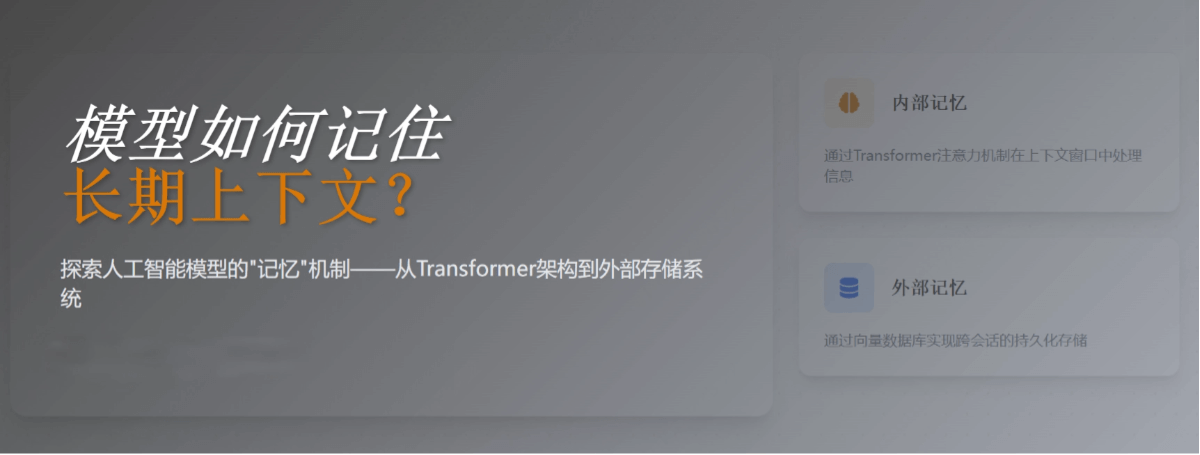
AI models "remember" long-term context in two main ways:Internal memoryandexternal memory。
Internal memory relies on the model architecture (such as the Transformer'sattention mechanism) to process a limited length of information within a single conversation, known as the "context window."
External memory stores information in databases outside the model (such asvector databases) and retrieves it when needed, achieving persistent memory across multiple conversations. Users can help the model better "remember" key information through explicit instructions, structured input, and other means, and control the model's "forgetting" through memory management features.
Core concept: What exactly is AI's "memory"?
Before discussing how artificial intelligence (AI) models "remember" long-term context, we must first understand a core concept: AI's "memory" is fundamentally different from human memory. It does not store and replay specific, discrete events or facts like the human brain. Instead, an AI model's "memory" is a more abstract and dynamic process, arising from learning from massive amounts of data and adjusting internal parameters.
How models "learn" rather than "memorize"
The core capability of AI models lies in learning from data, not simply memorizing data. This learning process is a complex optimization problem, with the goal of enabling the model to generalize and make accurate predictions or generate reasonable responses for data it has never seen before.
- Training process: The model "learns" by adjusting its internal parameters, which number in the hundreds of millions, and these parameters jointly define how the model processes and interprets input information.
- Nature of memory: Learned associations and patterns, rather than specific stored entries. The model learns statistical associations between concepts.
The model's "internal memory" mechanism
In addition to the "memory" learned through training, many modern AI models, especially those that process sequence data (such as text), also have an "internal memory" mechanism. This mechanism is part of the model architecture itself, allowing the model to dynamically use and refer to previously processed information when processing current information.
Distinguishing short-term memory from long-term memory
| Feature | Short-term memory (context window) | Long-term memory (external storage) |
|---|---|---|
| Function | Maintain the coherence of the current conversation and handle immediate tasks | Achieve cross-session memory, provide personalized services, and store persistent knowledge |
| Storage location | Inside the model, as part of the input | External systems, such as vector databases and knowledge graphs |
| Capacity | Limited, constrained by the size of the context window | Theoretically unlimited, depending on the capacity of external storage |
| Persistence | Temporary, disappearing after the session ends | Persistent, can be saved and updated over the long term |
| Implementation method | Processed directly as input to the model | Dynamically retrieved and integrated through technologies such as retrieval-augmented generation (RAG) |
| Analogy | Working memory, temporary notepad | Archive, diary |
The "memory" of AI models is not permanent. Even the "long-term memory" learned through training may change over time or with the introduction of new data.
AI's "memory" is a dynamic, malleable process influenced by multiple factors, not a static, permanent database.
Technical Principles: The "Memory" Methods of Different Models
Attention Mechanism: Focusing on Key Information Like a Spotlight
The attention mechanism can be vividly compared to a spotlight. When the model processes a word in a piece of text, it does not view that word in isolation; instead, it "illuminates" all other words in the text, assigning different "brightness" or "weights" based on their relevance to the current word.
Analogy: An Encyclopedia-Like Scholar
A Transformer-based model is like a scholar with encyclopedic knowledge. It does not recall specific passages from a book word by word; instead, it rapidly mobilizes and integrates relevant concepts, facts, and logic from a vast knowledge system.
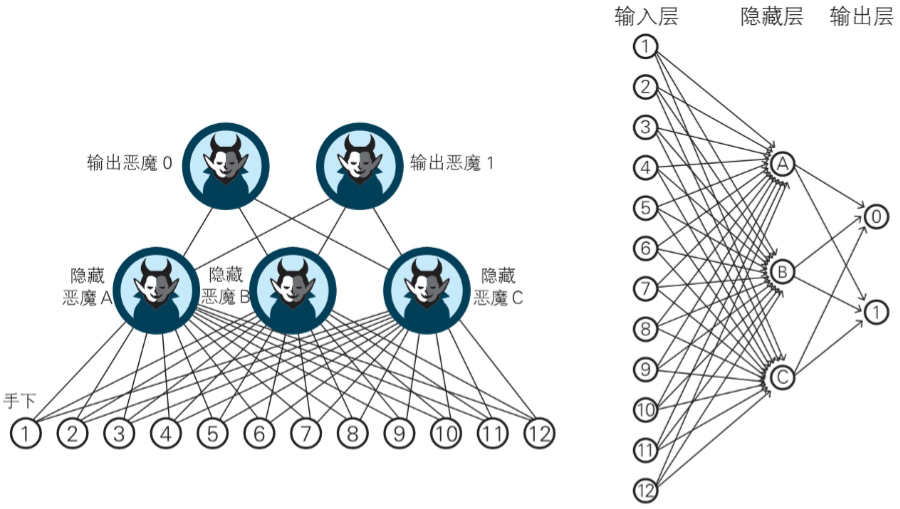
The "Memory" of Traditional Models: RNN and LSTM
Before the advent of Transformers, recurrent neural networks (RNNs) and their variants, such as long short-term memory networks (LSTMs), were the mainstream models for processing sequence data.
Analogy: A Running-Account Recorder and an Intelligent Archive Manager
RNN: Passing information like a running account. A traditional RNN can be seen as a "running-account recorder." It processes text in order, one word at a time, combines the information of the current word with previously accumulated information, and passes it to the next step.
LSTM: Selectively "remembering" and "forgetting." LSTM introduces an elaborate "gating mechanism" that can, like an "intelligent archive manager," selectively "remember" or "forget" information. The internal structure of LSTM contains three key "gates": the forget gate, the input gate, and the output gate.
Model Comparison: The Pros and Cons of Different Memory Mechanisms
| Feature | Transformer (Attention Mechanism) | LSTM (Gating Mechanism) | Traditional RNN |
|---|---|---|---|
| Memory Method | Dynamic, global attention, parallel processing | Selective memory, sequential processing | Sequential transmission, information easily decays |
| Long-Term Dependency | Excellent, can directly capture relationships between words at any distance | Good, mitigates vanishing gradients through gating mechanisms | Poor, susceptible to vanishing/exploding gradients |
| Parallel Computation | Efficient, can process the entire sequence simultaneously | Inefficient, must process sequentially | Inefficient, must process sequentially |
| Computational Complexity | Proportional to the square of the sequence length | Proportional to the sequence length | Proportional to the sequence length |
| Analogy | An encyclopedia-like scholar, with a global perspective | An intelligent archive manager, selectively archiving | A running-account recorder, information easily lost |
- Transformer: Thanks to its attention mechanism, it has an overwhelming advantage in "remembering" long-term context. It can process information in parallel and directly compute the associations between any two words, making it both efficient and accurate when handling long texts. Its computational complexity is relatively high, and it may face challenges when processing extremely long sequences.
- LSTM:By introducing a gating mechanism, it significantly improves the long-term dependency problem of traditional RNNs. It can selectively remember and forget information, and performs well when processing medium-length sequences. The characteristic of sequential processing limits its parallel computing capability.
- Traditional RNN:Due to its simple recurrent structure, it suffers from a severe vanishing gradient problem when processing long sequences, resulting in very limited "memory" capability, and it has now basically been replaced by LSTM and Transformer.
Practical applications: How models use "memory"
Conversational coherence
In dialogue systems, maintaining contextual coherence is one of the key indicators of their level of intelligence. A model with good "memory" capability can understand the history of a conversation and generate relevant and consistent replies based on previous exchanges.
- Understand the topic and history of the conversation, and handle referential relationships
- Generate personalized replies based on prior information
Personalized experience
Some advanced AI systems have cross-session "memory" capabilities, can remember users' long-term preferences and habits, and provide more personalized services.
- Remember user information across sessions
- Provide customized services and suggestions
Knowledge updating: combine new and old information
- Learn new facts provided by users: During interactions with AI, users may provide some new information that the model did not learn during training. A model with good "memory" capability can integrate this new information into its own knowledge system.
Example:If the model previously knew that a certain phone only came in black and white, and the user tells it "this phone has newly released a blue version," the model should be able to "remember" this new fact.
- Correct or supplement existing knowledge: In addition to learning new facts, the model can also correct or supplement its existing "memory" based on user feedback, which is crucial for improving the model's accuracy and reliability.
Example:If the model mistakenly believes that a certain historical event occurred in a certain year, and the user points out the correct year, the model should be able to "remember" this correction.
User experience: How to interact with the model's "memory"
Help the model "remember" better
🪄Explicit instructions: The most direct and effective method is to directly issue explicit instructions to the model, requiring it to remember key information. For example, in a conversation we can clearly say: "Please remember, I like coffee without sugar." Or "My birthday is October 11, please write it down." Such explicit instructions can help the model quickly identify the information that needs to be remembered and store it in long-term memory.
🪄Repeated emphasis: The model's memory can be reinforced by mentioning key information multiple times. When a certain piece of information appears repeatedly in a conversation, the model tends to regard this information as important and store it in long-term memory. For example, we can mention information such as our profession and hobbies multiple times in different conversations.
🪄Structured input: Providing information in a clear format can help the model better understand and remember it. For example, we can provide information in the form of lists, tables, or key-value pairs. "My personal information is as follows: Name: Zhang San; Occupation: Engineer; Hobbies: Reading, Traveling." This structured input method can reduce the difficulty for the model to parse the information and improve the accuracy of memory.
Managing the Model's "Memory"
🪄Viewing and Editing Memory: Some advanced AI models (such as ChatGPT) provide the ability to view and edit memory. Users can view at any time what information the model remembers about them and modify or supplement it. For example, if the model incorrectly remembers our birthday, we can manually correct it.
🪄Asking the Model to "Forget" Specific Information: If we do not want the model to remember certain sensitive or outdated information, we can directly ask the model to "forget" this information. For example, we can say: "Please forget my home address that I mentioned earlier." Or "I no longer like rock music, please update my preferences."
🪄Turning Memory Function On or Off: In some cases, we may not want the model to remember any information about ourselves. You can choose to turn off the model's memory function.
User Interaction Best Practices
✅Provide clear background information at the beginning of the conversation
✅Use consistent terminology and expressions
✅Regularly confirm whether the model understands key information
✅Proactively manage memory content and regularly clean up outdated information
Long-Term Memory Systems: "Memory" Beyond the Model Itself
By extending the model's memory capability to external storage, more persistent and flexible knowledge management is achieved. Retrieval-Augmented Generation (RAG) and vector databases are currently the two most widely used technologies.
Retrieval-Augmented Generation (RAG)
Retrieval-Augmented Generation (RAG) is a framework that combines LLMs with external knowledge bases to solve the problems of static LLM knowledge and hallucinations.
- Chunk the external knowledge base and convert it into vectors
- Also convert the user's question into a vector and perform similarity search
- Combine the retrieved information to generate the final answer
How RAG Works
- Data Preparation (Offline) : Chunk the external knowledge base (such as documents, web pages, databases, etc.), then use an embedding model (Embedding Model) to convert each text chunk into a high-dimensional vector (Vector). These vectors are stored in a dedicated vector database.
- Online Retrieval: When a user asks a question, the system first converts this question into a vector as well.
- Similarity Search: In the vector database, by calculating the similarity between the question vector and all stored vectors, find the few text chunks most relevant to the question.
- Augmented Generation: Package the original question together with the retrieved text chunks into a new, more content-rich prompt (Prompt), then send it to the LLM so that it generates the final answer based on this information.

Vector Databases
Vector databases are databases specifically designed for storing and retrieving high-dimensional vectors. In RAG systems, all text information is converted into vector form and stored in the vector database.
Major vector database products, such as Pinecone, Weaviate, Milvus, etc., provide strong support for building efficient RAG systems.
Slot-based Memory
Slot-based Memory is a more structured way of organizing memory. Information is stored in predefined "slots" or "fields," with each slot corresponding to a specific attribute.
Memory types: memory fragments (MemoryNode);memory variables (key-value pairs)
Summary
The "memory" of AI models is not a replica of human memory, but a complex capability based on data learning and pattern recognition. Its core mechanisms can be summarized as follows:
- Learning rather than memorizing: Through the training process, the model learns statistical patterns and associations from massive amounts of data, and encodes this knowledge into its internal parameters.
- Short-term memory (context window) : In a single conversation, the model uses its internal architecture (such as the Transformer's attention mechanism) to process and maintain a limited-length context, ensuring the coherence of the conversation.
- Long-term memory (external systems) : To achieve persistent memory across sessions, the model relies on external systems, such as retrieval-augmented generation (RAG) and vector databases, to store, retrieve, and update information.
- User interaction: Users can guide and optimize the model's memory performance through explicit instructions, structured input, and proactive memory management, thereby obtaining a more personalized experience.

Future development trends: smarter and more persistent memory
The "memory" capabilities of AI models will develop in a smarter, more persistent, and more humanized direction.
- Dynamic memory management: Future memory systems will not merely be static repositories; like humans, they will be able to dynamically forget, reinforce, and reflect based on the importance, timeliness, and frequency of use of information.
- Multimodal memory: The model's memory will no longer be limited to text; it will be able to integrate information from multiple modalities such as images, sound, and video, forming richer and more three-dimensional memories.
- Personalized memory models: Future AI may build an exclusive, dynamically evolving memory model for each user, able to deeply understand the user's personal history, emotional state, and cognitive patterns, and provide unprecedented personalized services.
- Explainable memory: Researchers will work to improve the explainability of the model's memory process, allowing users to more clearly understand how the model "remembers" and "forgets" information, and building deeper trust.
With the continuous advancement of these technologies, AI will gradually evolve from a passive tool into an intelligent partner that can grow with us and build long-term relationships.