
What is MobileLLM
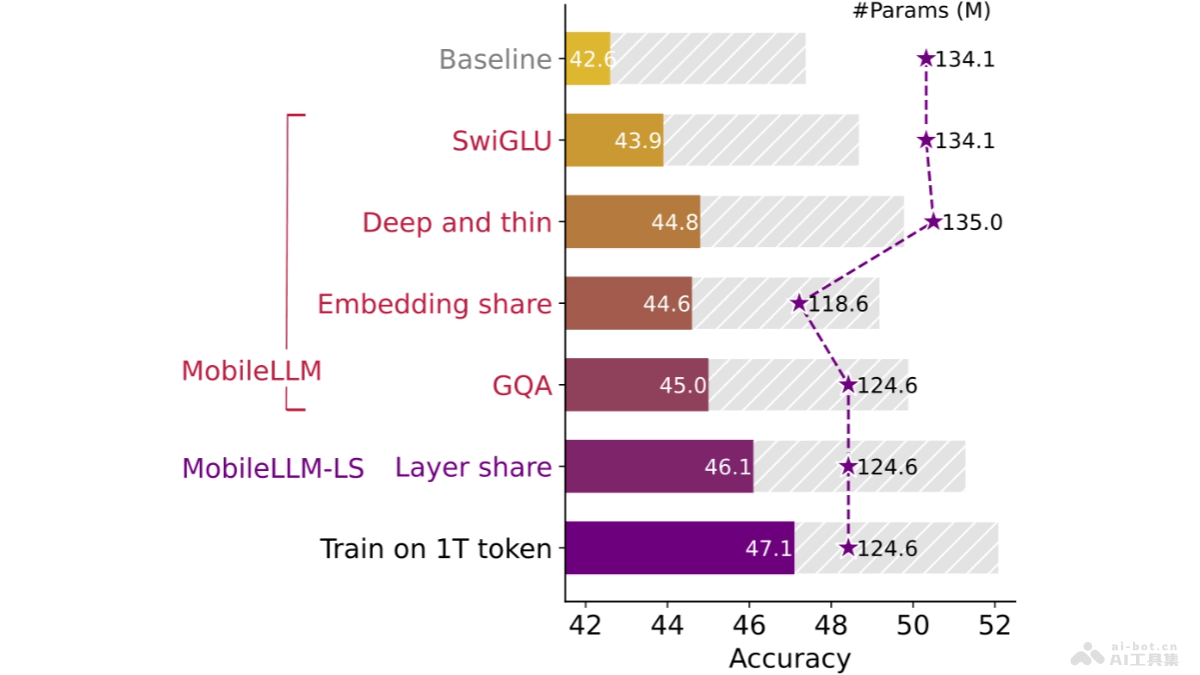
MobileLLM is a large language model with fewer than one billion parameters, optimized and designed by Meta for mobile device use cases, capable of addressing rising cloud costs and latency issues. MobileLLM is based on designs such as deep and thin architecture, embedding sharing, and grouped query attention mechanisms, achieving high-quality language models with fewer than one billion parameters. MobileLLM-125M/350M significantly improves accuracy on zero-shot commonsense reasoning tasks compared to previous models, and the MobileLLM family shows significant improvements over small models in chat benchmark tests, demonstrating accuracy comparable to LLaMA-v2 7B in API calling tasks, highlighting the potential of small models in common device use cases.
Main features of MobileLLM
- Language understanding and generation: Capable of understanding and generating natural language, supporting various language-related tasks.
- Zero-shot commonsense reasoning: Solving problems that require commonsense reasoning without specific training.
- Chat interaction: Providing a smooth interactive experience in dialogue systems, capable of understanding and responding to user questions.
- API calling: Converting natural language instructions into API calls to interact with backend services.
- Text rewriting and summarization: Supporting text content rewriting and summary generation, improving information processing efficiency.
- Mathematical problem solving: Possessing the ability to solve mathematical problems, capable of understanding and performing mathematical calculations.
Technical principles of MobileLLM
- Deep and thin architecture: MobileLLM is based on a deep and thin model architecture, i.e., more layers and fewer parameters, which helps the model learn more abstract concepts.
- SwiGLU activation function: Replacing the traditional ReLU activation function with the SwiGLU activation function, improving the model's nonlinear expression capability.
- Embedding sharing: The input and output embedding layers share weights, reducing the number of model parameters while maintaining or improving model performance.
- Grouped query attention mechanism: Reducing the number of key-value heads and reusing them, optimizing the attention mechanism and improving model efficiency.
- Block-level layer sharing: Sharing weights between adjacent model blocks, avoiding frequent movement of weights between memory layers and reducing latency.
- Quantization compatibility: The model supports quantization techniques, such as W8A8 (8-bit weights and 8-bit activations), allowing the model to run on resource-constrained devices while maintaining performance.
MobileLLM project addresses
- GitHub repository:https://github.com/facebookresearch/MobileLLM
- HuggingFace model library:https://huggingface.co/collections/facebook/mobilellm-6722be18cb86c20ebe113e95
- arXiv technical paper:https://arxiv.org/pdf/2402.14905
Application scenarios of MobileLLM
- Mobile chat applications: In mobile chat applications, MobileLLM provides instant language understanding and generation capabilities, supporting smooth conversations between users and chatbots.
- Voice assistants: Integrated into voice assistants on smartphones and other mobile devices, helping users perform tasks based on natural language commands, such as setting reminders and searching for information.
- Content filtering and recommendation: In content recommendation systems, MobileLLM can understand users' interests and preferences, providing personalized content recommendations.
- Educational applications: In educational software, MobileLLM serves as a language learning assistant, helping users learn new languages and providing grammar correction and pronunciation guidance.
- Mobile Search: In mobile search applications, MobileLLM provides smarter search suggestions and result explanations, helping users quickly find the information they need.