
What is MobileCLIP2
MobileCLIP2 is an efficient on-device multimodal model launched by Apple researchers, and is an upgraded version of MobileCLIP. It has been optimized in multimodal reinforcement training, further improving model performance by training a better-performing CLIP teacher model ensemble on the DFN dataset and an improved image-text generator teacher model. MobileCLIP2 performs excellently on zero-shot classification tasks. For example, on the ImageNet-1k zero-shot classification task, its accuracy is 2.2% higher than MobileCLIP-B. MobileCLIP2-S4 maintains performance comparable to SigLIP-SO400M/14 while having a smaller model size and lower inference latency. It also demonstrates good performance in various downstream tasks, including vision-language model evaluation and dense prediction tasks. MobileCLIP2 is suitable for various application scenarios such as image retrieval, content moderation, and smart photo albums. It can retrieve relevant images based on text descriptions, perform image-text consistency checks, and automatically classify images.
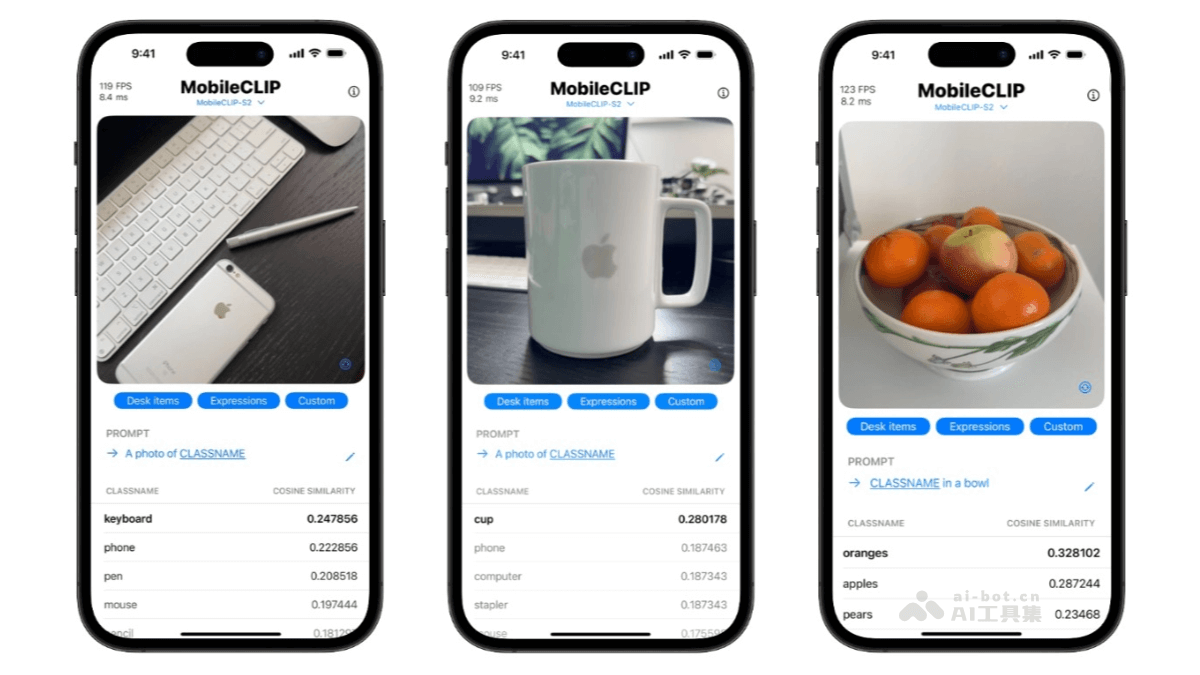
Main Features of MobileCLIP2
-
Zero-Shot Image Classification: Uses pretrained multimodal features to directly classify images without additional training data, enabling quick adaptation to new tasks.
-
Text-to-Image Retrieval: Retrieves the most relevant images from an image library based on input text descriptions, enabling precise image search.
-
Image-to-Text Generation: Generates descriptive text based on input images, adding appropriate titles or descriptions to images, assisting content understanding and creation.
-
Image-Text Consistency Judgment: Evaluates the match between images and text descriptions, and can be used in scenarios such as content moderation and smart photo album classification to ensure image-text consistency.
-
Multimodal Feature Extraction: Extracts high-quality multimodal features for images and text, supporting downstream tasks such as image classification, object detection, and semantic segmentation, and improving model performance.
Technical Principles of MobileCLIP2
-
Multimodal Reinforcement Training: By optimizing the training of the CLIP teacher model ensemble and the image-text generator teacher model, it improves the model's joint understanding of images and text and enhances the representation of multimodal features.
-
Contrastive Knowledge Distillation: Uses contrastive knowledge distillation technology to extract key information from large teacher models and pass it to small student models, achieving a balance between model performance and efficiency.
-
Temperature Adjustment Optimization: Introduces a temperature adjustment mechanism in contrastive knowledge distillation, optimizing the model training process and improving the model's adaptability and generalization ability to data of different modalities.
-
Synthetic Text Generation: Uses an improved image-text generator to generate high-quality synthetic text, enriching training data and improving the model's understanding and generation ability for text diversity.
-
Efficient Model Architecture: Designs lightweight model architectures, such as MobileCLIP2-B and MobileCLIP2-S4, which significantly reduce model computational complexity and inference latency while maintaining high performance, making them suitable for on-device deployment.
-
Fine-Tuning and Optimization: Fine-tunes on diverse and high-quality image-text datasets, further improving the model's performance on specific tasks and enhancing its practicality and adaptability.
MobileCLIP2 Project Address
- Github Repository:https://github.com/apple/ml-mobileclip
- HuggingFace Model Library:https://huggingface.co/collections/apple/mobileclip2-68ac947dcb035c54bcd20c47
Application Scenarios of MobileCLIP2
-
Mobile Applications: Can be used for augmented reality applications, personal assistants, real-time photo classification, etc., enabling phones to complete data processing locally without sending data to the cloud.
-
Edge computing: Suitable for edge computing environments with limited bandwidth and processing power, such as drones, robots, and remote sensors, which can use the model to perform visual recognition tasks and enable real-time decision-making.
-
IoT devices: Can be integrated into Internet of Things (IoT) devices, such as security cameras or smart home assistants, enabling these systems to perform local visual recognition, with the advantages of privacy protection, low latency, and operation in environments with unstable internet connections.
-
Image classification: As a lightweight zero-shot image classification solution, even if the model has not seen a certain type of image, as long as text category labels are provided, it can determine which category the image belongs to.
-
Feature extraction: As a feature extractor, it extracts high-quality multimodal features for images and text, which can serve as input for downstream tasks, such as diffusion models (e.g., Stable Diffusion) and multimodal large language models (e.g., LLaVA).