
What is Mobile-Agent
Mobile-Agent is a mobile intelligent agent software entity that can move between various nodes of a network, working on behalf of users or other agents. It can interrupt its current execution according to specific circumstances, move to another device to resume running, and return results in a timely manner. The purpose of this mobility is to bring program execution as close as possible to the data source, reduce network communication overhead, save bandwidth, balance load, accelerate task execution, and improve the processing efficiency of distributed systems.
Mobile-Agent applications are developing rapidly in the field of mobile device operation. For example, Mobile-Agent-v2, jointly proposed by Alibaba and Beijing Jiaotong University, is a mobile device operation assistant that achieves effective navigation through multi-agent collaboration. Based on a multimodal large language model (MLLM), it can autonomously complete complex mobile device operation tasks. Mobile-Agent-v2 includes three specialized roles: the planning agent, the decision agent, and the reflection agent, and can generate tasks based on historical operations, performing self-reflection and adjustment during the operation process. Mobile-Agent also supports a pure vision solution, which does not need to rely on the system's UI files, and instead understands and operates the phone by analyzing images. This enables it to be flexibly applied in different mobile operating system environments.
The third-generation GUI agent framework Mobile-Agent-v3, based on the visual multimodal model GUI-Owl, achieves a major breakthrough in GUI automation technology, covering PC, Web, and mobile phone systems, and can accurately identify interface elements and execute operations on multiple platforms.
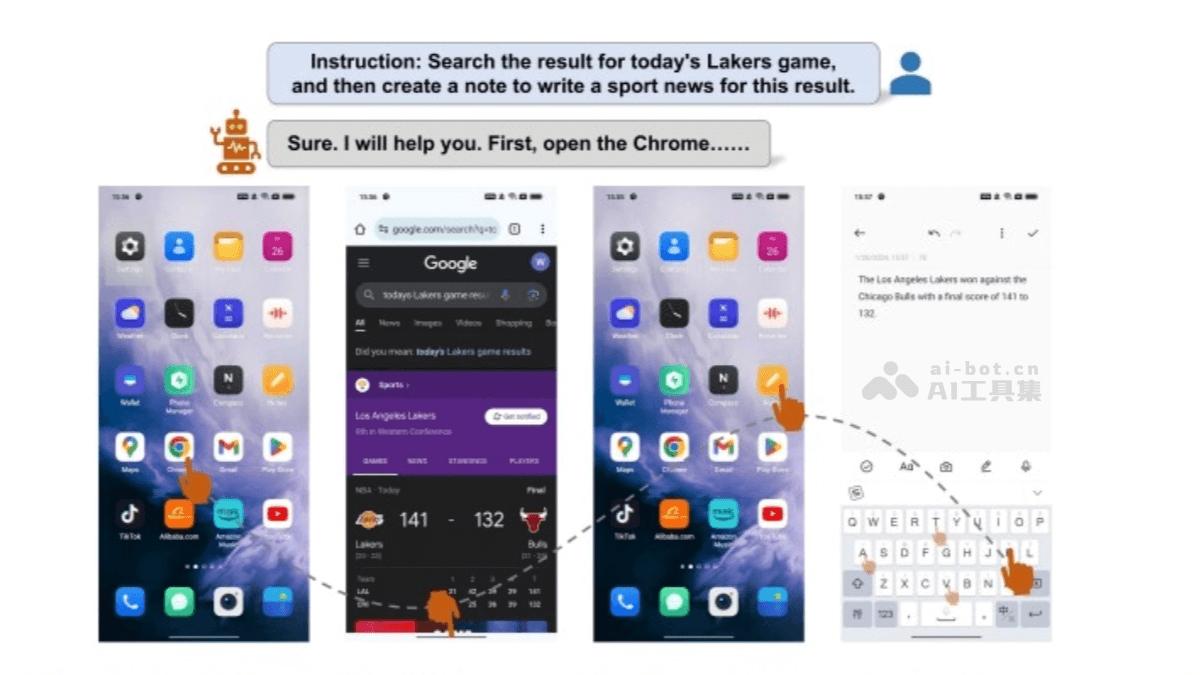
Mobile-Agent's main features
- Operation localization: Mobile-Agent can accurately identify and click specific icons and text on the screen. It determines operation positions through detection models and visual perception tools, for example, using OCR tools to locate text or identifying icons through icon detection tools.
- Self-planning: It can automatically plan and execute a series of operation steps according to the user's instructions and the current screen state until the task is completed. Mobile-Agent obtains screenshots iteratively and decides the next operation by combining operation history and system prompts.
- Self-reflection: During the operation process, if errors or invalid operations occur, Mobile-Agent can promptly detect them and take remedial measures. For example, when the screen does not change after an operation or an error page is displayed, it will try other operations or adjust parameters.
- Multi-application operation: Mobile-Agent supports automated operations across multiple applications, for example, switching between different applications and collaboratively completing tasks.
- Pure vision solution: It does not depend on the system's XML files or other metadata, and instead understands and operates the phone by analyzing images, so that its operation scope is not limited.
Mobile-Agent's technical principles
- Multimodal large language model: Mobile-Agent combines large-scale language models (such as GPT-4V) to understand and execute the user's natural language instructions. The model can generate corresponding operation steps by reading screen screenshots and user instructions.
- Visual perception technology
- Text and icon detection: The system uses optical character recognition (OCR) tools to locate text on the screen, and identifies the accurate positions of icons through icon detection tools and the CLIP model. This enables Mobile-Agent to accurately identify and locate elements on the screen and execute precise operations.
- Screenshot analysis: Mobile-Agent obtains the visual information required for operations by analyzing the current screen screenshot. Using the screenshot as input, combined with the operation history and user instructions, it determines the next operation.
- Multi-Agent Collaboration Mechanism: Mobile-Agent adopts a multi-agent architecture, including multiple specialized agents, such as the visual perception agent, decision-making agent, execution agent, and reflection agent. These agents each perform their own duties and collaborate to complete complex mobile device operation tasks.
- Autonomous Task Planning and Execution
- Self-Planning: Mobile-Agent can automatically plan and execute a series of operation steps based on the user's instructions and the current screen state. It iteratively captures screenshots repeatedly, processes prompts and operation history, and generates the next operation.
- Self-Reflection: During the operation process, if errors or invalid operations occur, Mobile-Agent can promptly detect them and take corrective measures. For example, when the screen does not change after an operation or an error page is displayed, it will try other operations or adjust parameters.
- Prompt Format: Mobile-Agent adopts the prompt format in ReAct, requiring the agent to output three parts: Observation, Thought, and Action. This helps the agent better understand and execute tasks.
Mobile-Agent's project address
- Github repository:https://github.com/X-PLUG/MobileAgent
- arXiv technical paper:https://arxiv.org/pdf/2401.16158
- Online experience Demo:https://huggingface.co/spaces/junyangwang0410/Mobile-Agent
Mobile-Agent's application scenarios
- Mobile device operation assistant: Mobile-Agent can complete various operations on mobile devices according to user instructions, such as opening apps, clicking buttons, entering text, etc., improving ease of use.
- Multi-app collaborative operation: Supports switching between different apps and collaborating to complete tasks, for example, copying information from one app and pasting it into another app.
- Automated testing: Used to simulate user operation behavior and conduct automated testing of mobile applications, improving testing efficiency and accuracy.
- Intelligent navigation and task planning: Automatically plans and executes a series of operations according to user goals and the current state until the task is completed, such as finding and executing specific functions in a complex application environment.
- Vision perception-driven operation: Through a pure vision solution, it understands and operates the phone by analyzing images only, and can be flexibly applied across different operating systems without being limited by system data structures.