
What is Mobile-Agent-v3.5
Mobile-Agent-v3.5 is a new-generation multi-platform GUI Agent framework open-sourced by Alibaba Tongyi Lab, marking the transition of open-source GUI agents from "demo-level" to "engineering-ready level." The framework natively supports three major platforms—desktop, mobile, and browser—and can achieve automated operations across Android, Ubuntu, macOS, and Windows. The accompanying GUI-Owl-1.5 model family offers multiple parameter scales from 2B to 235B, and decouples two variants: Instruct (lightweight and low-latency) and Thinking (strong planning and reflection), supporting full-chain deployment from edge devices to the cloud. Mobile-Agent-v3.5 has achieved SOTA results in the open-source field on more than 20 mainstream GUI Benchmarks, including OSWorld-Verified, AndroidWorld, and VisualWebArena. Through three core technologies—the hybrid data flywheel, unified chain-of-thought synthesis, and the MRPO multi-platform reinforcement learning algorithm—it solves challenges such as cross-platform action space differences and unstable long-horizon task training, providing the community with a complete open-source technical reference from underlying foundation models to the Agent framework.
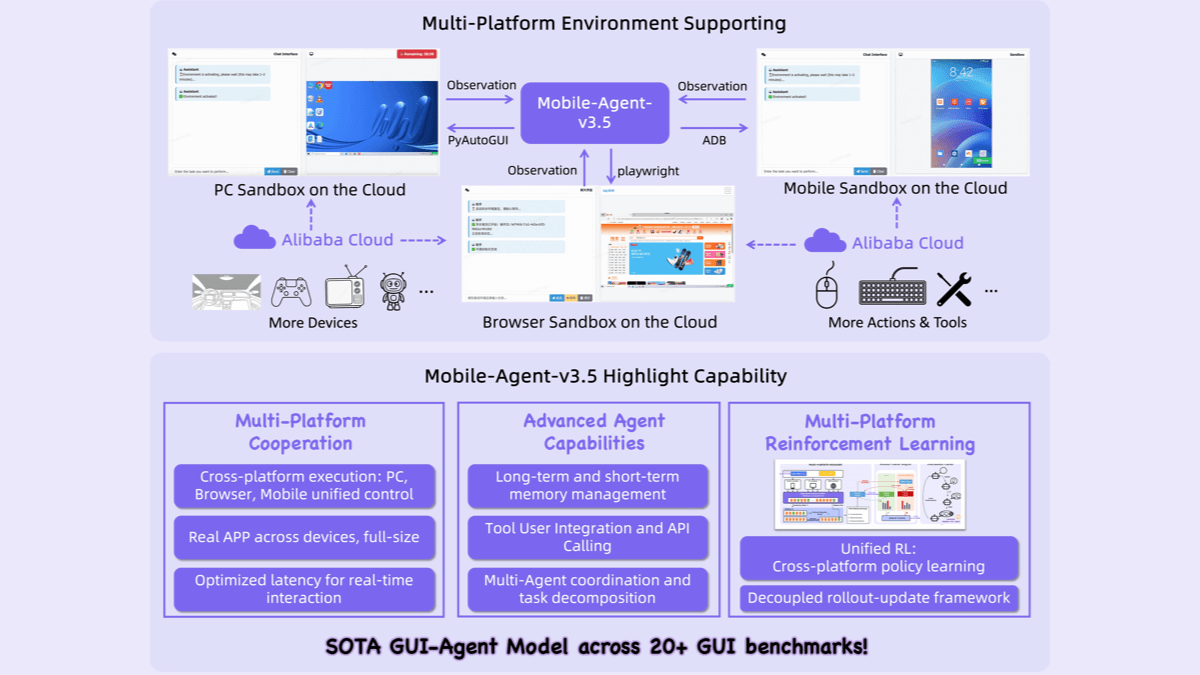
Main Features of Mobile-Agent-v3.5
-
Cross-Platform GUI Automation: Native support for the three major platforms—desktop, mobile, and browser—enabling unified control and automated operations across Android, Ubuntu, macOS, and Windows.
-
Multi-Parameter Model Coverage: The accompanying GUI-Owl-1.5 model family provides multiple parameter scales including 2B/4B/8B/32B/235B, supporting full-chain deployment solutions from edge devices to the cloud.
-
Dual-Mode Reasoning Architecture: Decouples two variants, Instruct (lightweight and low-latency) and Thinking (strong planning and reflection), balancing real-time response with deep reasoning for complex tasks.
-
Long-Horizon Task Planning: Through unified chain-of-thought synthesis technology, it systematically injects capabilities such as tool/MCP invocation, memory management, knowledge querying, and multi-Agent collaboration, supporting the execution of complex long-horizon tasks.
-
High-Performance Benchmark Results: Achieves SOTA results in the open-source field on more than 20 mainstream GUI Benchmarks, including OSWorld-Verified (56.5), AndroidWorld (71.6), and VisualWebArena (46.6).
-
Multimodal Perception and Understanding: Possesses visual perception and semantic understanding capabilities, can recognize interface elements, understand operational intent, and achieve precise GUI interactions such as clicking, input, and swiping.
-
Reinforcement Learning Optimization: Adopts the MRPO multi-platform reinforcement learning algorithm to resolve gradient conflicts caused by cross-platform action space differences and improve the training stability of long-horizon tasks.
Technical Principles of Mobile-Agent-v3.5
-
Hybird Data Flywheel: Combines simulation environments with cloud sandboxes to generate high-quality grounding data and long-horizon trajectories at scale, solving the challenges of high cost and limited scale in real-environment data collection.
-
Unified Chain-of-Thought Synthesis: Systematically injects advanced capabilities such as tool/MCP invocation, memory management, knowledge querying, and multi-Agent collaboration, enabling the model to perform long-horizon planning, reflection, and self-correction.
-
MRPO Multi-Platform Reinforcement Learning Algorithm: Addresses the gradient conflict problem caused by cross-platform action space differences, as well as challenges such as unstable long-horizon task training and difficult credit assignment, achieving unified multi-platform training and optimization.
-
GUI-Owl-1.5 Foundation Model: As a native multimodal understanding model, it provides a complete parameter spectrum from 2B to 235B, supporting end-to-end GUI interaction with visual perception and semantic reasoning。
-
Dual-Variant Architecture Design: The Instruct variant is optimized for low-latency scenarios, while the Thinking variant strengthens planning and reflection capabilities. Their decoupled design meets the needs of different application scenarios.
-
End-to-End Training Framework: It forms a closed loop from data generation and model training to reinforcement learning optimization, supporting unified learning and transfer across platforms and tasks.
-
Open Source Ecosystem Compatibility: Optimized based on the Qwen3 series architecture, it is compatible with the mainstream AI development ecosystem and supports one-click deployment from ModelScope and HuggingFace model repositories.
Mobile-Agent-v3.5 Project Address
- Github Repository:https://github.com/X-PLUG/MobileAgent
Mobile-Agent-v3.5 Application Scenarios
-
Smart Device Automation: Automatically operate mobile phones to complete tasks such as using apps, querying information, and adjusting settings, such as automatically ordering takeout, checking the weather, and managing schedules.
-
Cross-Platform Office Assistance: Automatically execute repetitive office tasks such as document processing, email sending, meeting scheduling, and data entry on Windows, macOS, and Ubuntu desktops.
-
Web Automation Testing: Supports browser-side automated operations, suitable for scenarios such as Web application testing, form filling, data collection, and e-commerce price comparison.
-
On-Device AI Assistant Deployment: With the help of 2B/4B lightweight models, it enables low-latency local GUI automation assistants on mobile phones, IoT devices, and other edge devices.
-
Enterprise Process Automation: Combined with RPA needs, it automates interface operations in enterprise systems such as ERP and CRM to improve business process efficiency.
-
Accessibility Assistance Tools: Helps visually impaired users or users with limited operation capabilities automatically complete complex interface interactions, lowering the threshold for using digital devices.