
What is MMRole
MMRole is a Multimodal Role-Playing Agent (MRPA) framework launched by the research team at the Gaoling School of Artificial Intelligence at Renmin University of China. By combining images and text, it enables agents to engage in more natural and immersive conversations as specific characters. MMRole includes a large-scale, high-quality multimodal dataset and a comprehensive evaluation method for developing and evaluating the performance of MRPAs. The launch of the framework provides new possibilities for creating agents that can understand and generate image-related dialogue content, expanding application prospects in fields such as education and entertainment.
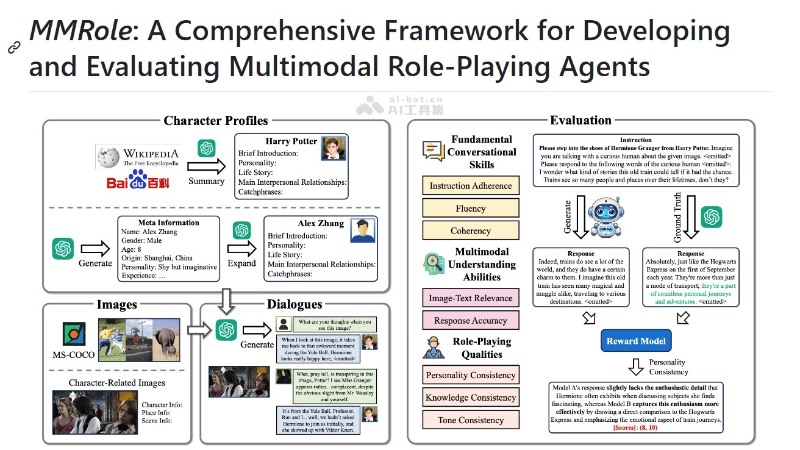
MMRole Main Features
- Multimodal Role-Playing Dataset (MMRole-Data): Provides a large-scale dataset containing multiple characters, images, and dialogues, used to train MRPAs to understand and generate image-related dialogues.
- Multimodal Role-Playing Evaluation Method (MMRole-Eval): Eight detailed evaluation metrics that comprehensively assess MRPAs' dialogue skills, multimodal understanding capabilities, and role-playing quality.
- Reward Model: Develops a reward model for quantitatively evaluating the performance of MRPAs, scoring by comparing with constructed standard answers.
- MRPA Development: Supports the development of specialized multimodal role-playing agents, such as MMRole-Agent, which performs excellently in multimodal information understanding and role-playing.
- Open-Source Resources: Provides open-source access to data, code, and models, promoting further research and development in the research community.
Technical Principles of MMRole
- MMRole-Data: A large-scale, high-quality multimodal role-playing dataset containing 85 different characters, over 11,000 images, and 14,000 dialogue segments. Dialogues can be single-turn or multi-turn, centered around images, and are designed to train MRPAs for multimodal dialogue.
- MMRole-Eval: A comprehensive evaluation method comprising eight evaluation metrics under three dimensions, used to assess the performance of MRPAs. The metrics cover basic dialogue skills, multimodal understanding capabilities, and role-playing quality. To quantitatively evaluate MRPAs, the research team developed a specialized reward model that scores by comparing the relative performance between the MRPA being evaluated and constructed standard answers.
MMRole Project Address
- GitHub Repository:https://github.com/YanqiDai/MMRole
- arXiv Technical Paper:https://arxiv.org/pdf/2408.04203
MMRole Application Scenarios
- Education and Training: In language learning or history education, MRPAs play the role of teachers or historical figures, providing a more vivid learning experience through interactive dialogue.
- Entertainment and Games: In video games or interactive stories, MRPAs serve as non-player characters (NPCs), providing rich role-playing and immersive gaming experiences.
- Customer Service: In customer support systems, MRPAs simulate customer service representatives, providing more natural and effective user support through multimodal interaction.
- Social Simulation: In social skills training or psychological counseling, MRPAs simulate different social roles, helping users practice and improve their social interaction abilities.
- Content Creation: MRPAs assist content creators by providing creative inspiration through role-playing, or simulating character dialogues during the creative process.