
What is MLE-bench
MLE-bench is a benchmark testing tool launched by OpenAI, designed to measure the performance of AI agents in machine learning engineering tasks. The test includes 75 competition tasks from Kaggle, covering multiple fields such as natural language processing, computer vision, and signal processing. In this environment, AI agents complete a series of tasks such as understanding competition descriptions, processing datasets, training models, and submitting results, and their capabilities are ultimately evaluated based on leaderboard scores. The design of MLE-bench emphasizes challenge and realism, with tasks sourced from real Kaggle competitions, aiming to comprehensively evaluate the progress of AI agents in automated machine learning engineering and compare them with human-level performance.
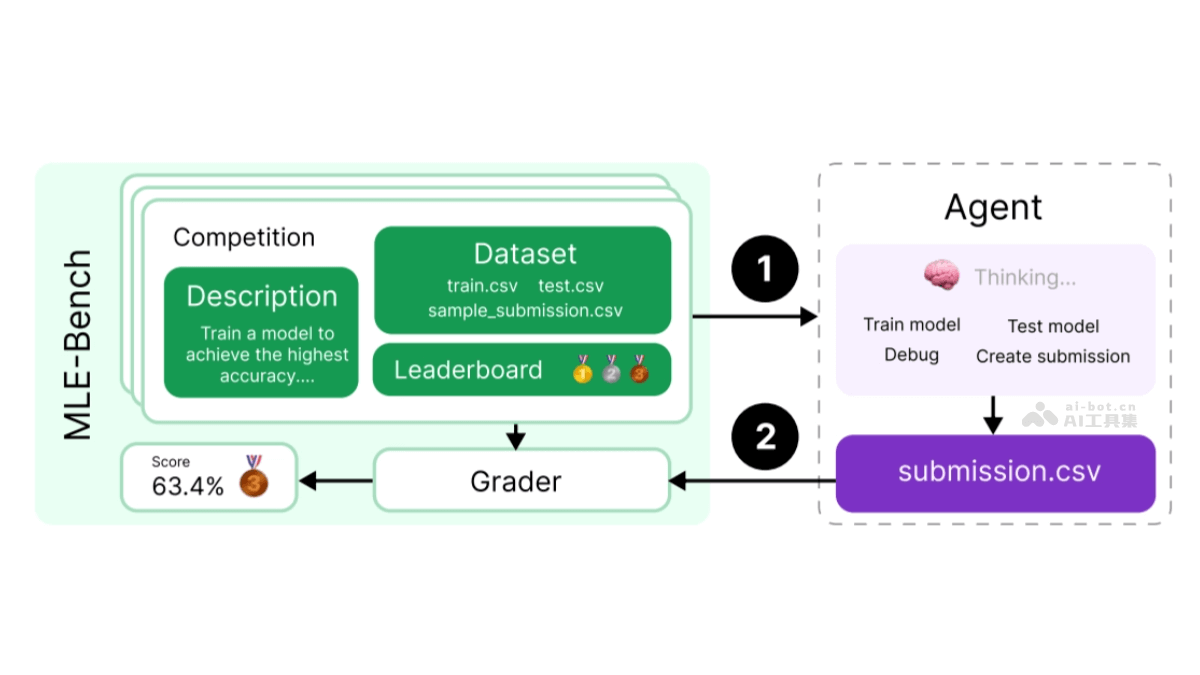
Main features of MLE-bench
- Performance evaluation: MLE-bench aims to evaluate the performance of AI agents in machine learning engineering tasks, providing a standardized evaluation platform.
- Task simulation: 75 competition tasks carefully selected from Kaggle simulate real machine learning engineering challenges, covering multiple fields such as natural language processing, computer vision, and signal processing.
- Autonomous execution: Supports AI agents in autonomously completing the entire process from understanding task descriptions, data preprocessing, and model training to result submission without human intervention.
Technical principles of MLE-bench
- Dataset and task design: MLE-bench selects 75 competitions from different fields on Kaggle to form a diverse set of tasks, each representing a real problem in machine learning engineering.
- Agent execution framework (Scaffolding): AI agents run within an execution framework. The framework (also called scaffolding) provides the necessary tools and interfaces, enabling AI to perform operations such as reading data, training models, and generating submission files.
- Automated evaluation: Based on comparison with Kaggle competition leaderboards, MLE-bench automatically evaluates the performance of AI agents. It provides local validation tools to ensure that AI agent submissions meet the requirements.
- Resource management: MLE-bench supports adjusting computing resources and time limits to study their impact on AI agent performance.
Project address of MLE-bench
- GitHub repository:https://github.com/openai/mle-bench/
- arXiv technical paper:https://arxiv.org/pdf/2410.07095
Application scenarios of MLE-bench
- AI agent performance testing: Use MLE-bench to test and evaluate the performance of different AI agents on machine learning engineering tasks, including data processing, model training, and result submission.
- Machine learning model development: Develop and optimize machine learning models based on the environment provided by MLE-bench, simulating real-world competition tasks to improve model generalization ability.
- Algorithm research and innovation: Researchers use MLE-bench to explore new algorithms and methods, solve practical problems in machine learning engineering, and promote the development of AI technology.
- Education and training: In the field of education, MLE-bench serves as a teaching tool to help students understand and master key skills and best practices in machine learning engineering.