
What is ML-Master
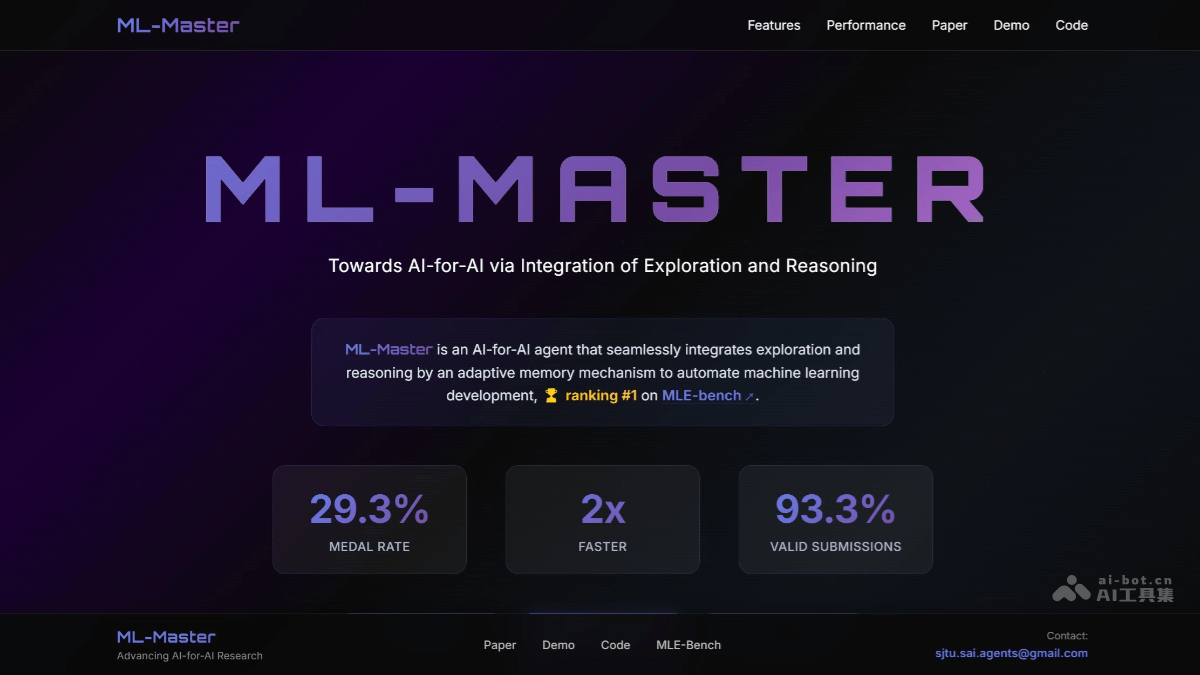
ML-Master is an AI expert agent launched by the Agents team at the School of Artificial Intelligence of Shanghai Jiao Tong University. It performs excellently in OpenAI's authoritative benchmark MLE-bench, ranking first with an average medal rate of 29.3%, surpassing competitors such as Microsoft's RD-Agent and OpenAI's AIDE. Through the innovative paradigm of "deep integration of exploration and reasoning," ML-Master simulates the cognitive strategies of human experts, integrates broad exploration with deep reasoning, and significantly improves AI performance in machine learning engineering. It adopts two major modules, balanced multi-trajectory exploration and steerable reasoning, and achieves efficient coordination between the two through an adaptive memory mechanism.
Main Features of ML-Master
-
Deep Integration of Exploration and Reasoning: Through the innovative paradigm of "deep integration of exploration and reasoning," ML-Master simulates the cognitive strategies of human experts, integrates broad exploration with deep reasoning, and significantly improves AI performance.
-
Outstanding Performance:
-
In OpenAI's MLE-bench benchmark, ML-Master ranks first with an average medal rate of 29.3%, far ahead of Microsoft's RD-Agent (22.4%) and OpenAI's AIDE (16.9%).
-
93.3% of tasks submitted valid solutions, and 44.9% of tasks surpassed more than half of the human participants, demonstrating strong generalization ability and stability.
-
Computational efficiency is extremely high, completing the test in only 12 hours, with computational cost only half that of baseline methods.
-
-
Strong Self-Evolution Capability: ML-Master continuously improves the quality of solutions during multiple rounds of task execution, with final performance improving by more than 120% compared with the initial version.
Technical Principles of ML-Master
- Balanced Multi-trajectory Exploration
-
MCTS-inspired Tree Search: Models the AI R&D process as a decision tree, where each node represents the state of an AI solution.
-
Parallel Exploration Strategy: Explores multiple solution branches simultaneously, breaking through the limitations of traditional serial exploration and greatly improving exploration efficiency.
-
Dynamic Priority Adjustment: Dynamically allocates computational resources according to the potential value of each branch, avoiding ineffective exploration.
-
- Steerable Reasoning
-
Adaptive Memory Mechanism: Accurately extracts key information, avoids information overload, and intelligently filters effective information from historical exploration to ensure that the reasoning process is based on more relevant knowledge.
-
Contextualized Decision-Making: Conducts well-grounded analysis by combining specific execution feedback and successful cases, avoiding arbitrary decision-making.
-
Closed-Loop Learning System: Exploration results feed back into the reasoning process in real time, forming a virtuous cycle of "exploration -> reasoning -> optimization -> re-exploration."
-
- Adaptive Memory
-
Intelligent Memory Construction: The exploration module automatically collects execution results, code snippets, and performance metrics, while selectively integrating key information from parent nodes and parallel sibling nodes.
-
Embedded Reasoning Decision-Making: Memory information is directly embedded into the decision-making part of the reasoning model, ensuring that each reasoning step is based on specific historical execution feedback and experience from diverse exploration.
-
Co-Evolution Mechanism: Reasoning results guide subsequent exploration directions, and exploration experience continuously enriches the reasoning process, achieving deep integration of exploration and reasoning.
-
ML-Master's project address
- Project official website:https://sjtu-sai-agents.github.io/ML-Master/
- Github repository:https://github.com/sjtu-sai-agents/ML-Master
- arXiv technical paper:https://arxiv.org/pdf/2506.16499
ML-Master's application scenarios
-
Machine learning task automation: Through its "deep integration of exploration and reasoning" technical framework, ML-Master can automatically complete the entire machine learning process from model training and data preparation to experiment execution. It performs excellently on OpenAI's MLE-bench benchmark, demonstrating its efficiency and accuracy in handling complex machine learning tasks.
-
AI development efficiency improvement: By balancing multi-trajectory exploration and controllable reasoning modules, ML-Master significantly improves the efficiency of AI development. It is suitable for AI projects that require rapid iteration and optimization.
-
AI self-evolution and optimization: ML-Master has strong self-evolution capabilities and can continuously improve the quality of solutions across multiple rounds of task execution. It is suitable for AI systems that require long-term optimization and self-improvement, such as adaptive learning and optimization tasks in complex environments.
-
Multi-domain task coverage: ML-Master can be extended to other fields that require autonomous AI optimization, such as materials science, medical diagnosis, financial trading, and more. For example, the technical framework can be used for material property prediction, new material discovery, and production process optimization.
-
Sentiment analysis and text processing: The technical principles of ML-Master can also be applied to the field of natural language processing, such as sentiment analysis and opinion mining. It can perform semantic representation of text, based on which sentiment classification and opinion extraction can be carried out, making it suitable for scenarios such as consumer decision-making and public opinion analysis.