
What is Mistral OCR 4
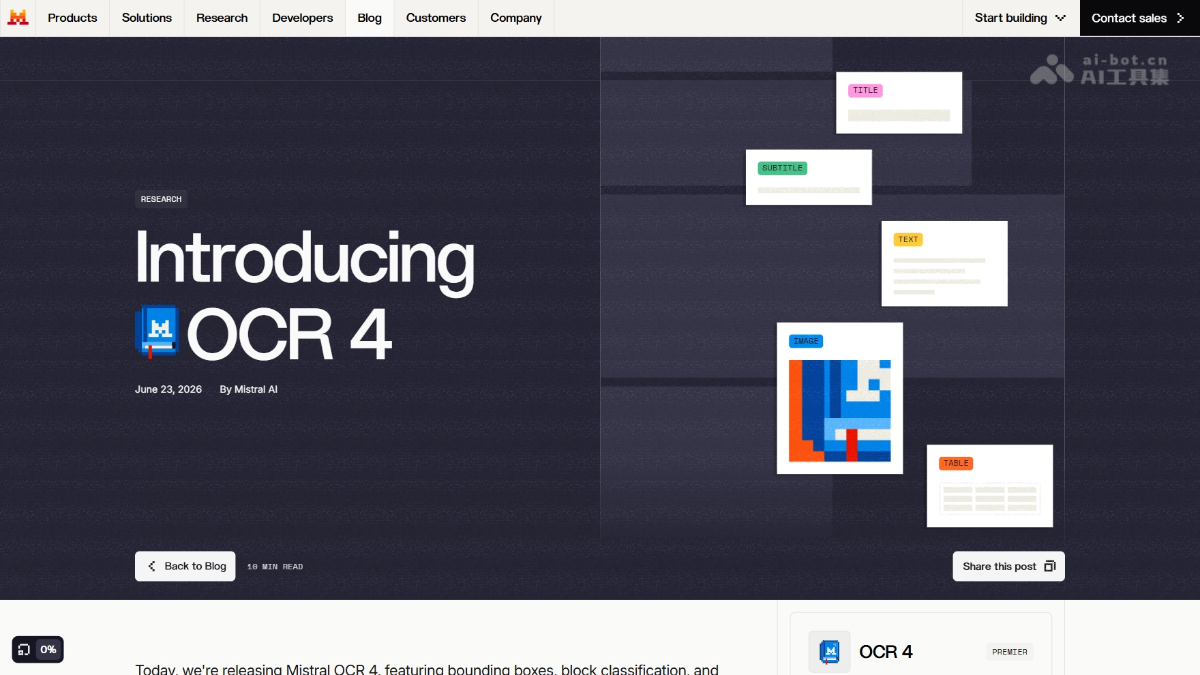
Mistral OCR 4 is the latest-generation document understanding model released by Mistral AI. The model supports extracting text from complex documents such as PDFs, images, and presentations, and can return structured output with bounding-box localization, region type classification, and confidence scores. It supports 170 languages and is designed for downstream scenarios such as RAG, agentic workflows, and enterprise search.
Main features of Mistral OCR 4
- High-precision document parsing: Supports common enterprise formats such as PDF, DOC, PPT, and OpenDocument, extracting rich elements including text, tables, formulas, images, and signatures.
- Structured output: Each content block comes with bounding-box coordinates, a type label such as heading, table, formula, or signature, and per-page/per-word confidence scores.
- Multilingual support: Covers 170 languages across 10 language families, with particularly strong performance on low-resource languages.
- Dual-mode output: The same endpoint supports a pure extraction mode, Markdown + structured metadata, and Document AI mode (structured JSON output according to a custom Schema).
- Ultra-high throughput: A single node can process up to 2,000 pages of documents per minute, making it suitable for large-scale batch processing scenarios.
Technical principles of Mistral OCR 4
- Visual text detection and classification: Based on CNN/Transformer architectures, it locates text regions in documents and performs semantic classification on each block, restoring the hierarchical structure of the original document.
- Sequence-to-sequence text recognition: Uses Seq2Seq or CTC models to convert detected character streams into editable text, improving recognition accuracy in combination with image preprocessing.
- Structured semantic chunking: Splits documents into semantic chunks with type labels and coordinates, providing downstream RAG systems with citation-ready units that can be used directly for retrieval and supporting structured operations by agents.
- Lightweight single-container deployment: The model is compact enough to be self-hosted and deployed within a single container, meeting data residency and compliance requirements.
How to use Mistral OCR 4
- Register to get an API Key: Visit Mistral AI's developer platform La Plateforme, register an account, then go to the "API Keys" page to create and save a key.
- Install the SDK: In a Python environment, run
pip install mistralaito install the official SDK. - Call the API to process documents Use the
client.ocr.process()method, pass in a document URL or local file, setmodel="mistral-ocr-latest", and enableinclude_blocks=Trueto get bounding boxes and type information. You can also useconfidence_scores_granularity="word"to get per-word confidence scores. - Parse the structured results: The API returns JSON containing a
pagesarray. Each page includes fields such asmarkdowntext,images、tables、hyperlinks、dimensions, andconfidence_scores, and can be directly integrated into RAG or agentic workflows. - Batch processing to reduce costs: For high-throughput scenarios, it is recommended to submit tasks through the Batch Inference API to enjoy a 50% price discount.
Core advantages of Mistral OCR 4
-
Leading in human preference: In independent human evaluations, OCR 4 achieved an average win rate of 72%, scoring 93.07 on OmniDocBench and 85.20 on OlmOCRBench, with output quality preferred by humans over frontier models such as GPT 5.5 Pro and Gemini 3.1 Pro Preview.
-
Extreme cost-effectiveness and speed: Only $4 per thousand pages ($2 for batch processing), and a single node processes 2,000 pages per minute; Rogo measured its cost at about 1/8 that of leading agentic parsers, with latency as low as 1/17.
-
Citation-ready fine-grained output: Triple annotation of bounding box + type + confidence enables RAG systems to provide traceable answers with clickable citations and to automatically route low-confidence regions to human review.
- Unified endpoint with dual modes: Without switching interfaces, the same endpoint satisfies both engineers' raw extraction needs and business users' Schema-based structured output needs.
Mistral OCR 4 project address
- Project official website:https://mistral.ai/news/ocr-4/
Comparison of Mistral OCR 4 with similar competitors
| Comparison dimension | Mistral OCR 4 | MOCR |
|---|---|---|
| Developer | Mistral AI, France | Huazhong University of Science and Technology + Xiaohongshu hi lab |
| Release date | June 2026 | March 2026 |
| Model scale | Undisclosed (small focused model) | 3B parameters(1.2B visual encoder + Qwen2.5-1.5B decoder) |
| Open source/closed source | Closed source(cloud API + single-container self-hosting) | Open source(Apache 2.0,HuggingFace / ModelScope / GitHub) |
| OmniDocBench | 93.07 | Specific score undisclosed (tested on version 1.5) |
| OlmOCR Bench | 85.20 | 83.9(SOTA among open-source models) |
| OCR Arena Elo | Undisclosed | Ranked second(second only to Gemini 3 Pro) |
| Human evaluation win rate | 72% on average(vs all competitors) | Independent human evaluation data undisclosed |
| Language coverage | 170 languages(10 language families) | Multilingual (exact number unspecified, but supports Chinese, Japanese, etc.) |
Application scenarios of Mistral OCR 4
-
Enterprise-grade RAG knowledge base: Convert scanned documents such as contracts, research reports, and manuals into structured retrieval units with citations, and connect to Mistral Search Toolkit for traceable question answering.
-
Agentic automated workflows: Provide structured fields with type labels and coordinates for agents handling invoice processing, form filling, etc., enabling automatic flow from documents to actions.
-
Confidence-tiered review pipeline: Based on word-by-word confidence scores, automatically ingest high-confidence content and route low-confidence regions to manual verification, balancing efficiency and accuracy.
-
Enterprise search and compliance auditing: As a data ingestion component, perform entity extraction and index construction on massive unstructured documents to meet compliance and auditing needs in industries such as finance, law, and government affairs.