
What is MiroFlow
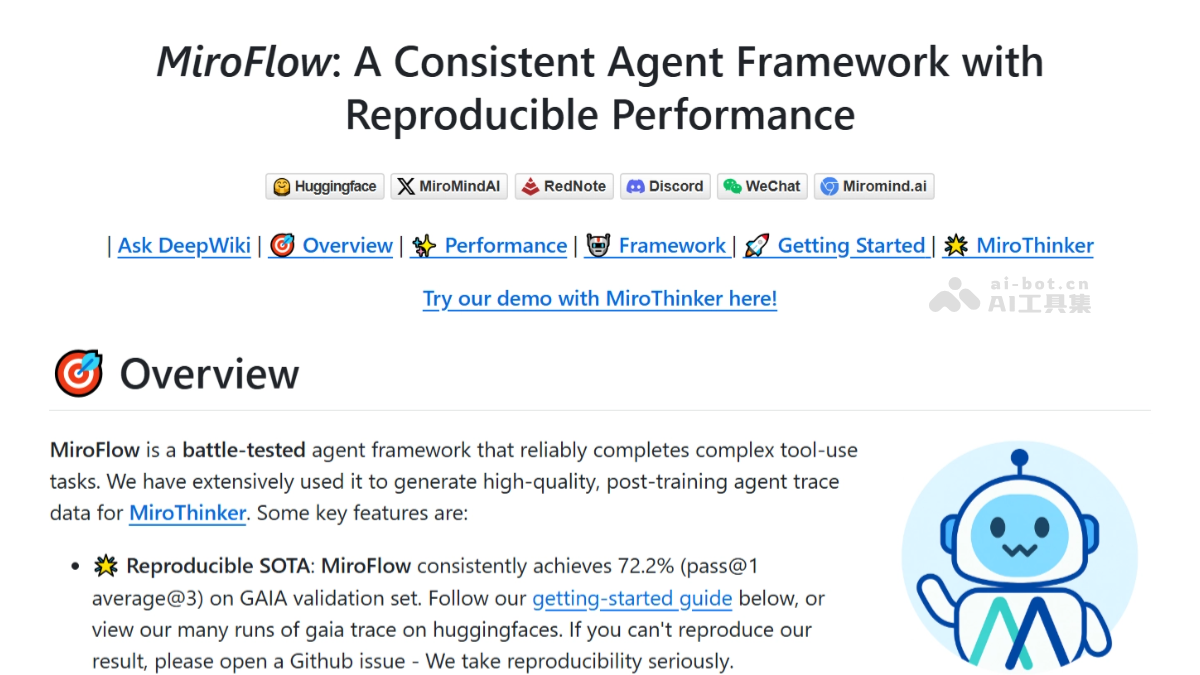
MiroFlow is a powerful multi-agent system development framework, specifically designed for building complex, high-performance AI agents, generating high-quality agent trajectory data for models such as MiroThinker. The framework delivers reproducible performance, consistently achieving a 72.2% pass rate on the GAIA validation set. The framework supports high concurrency and fault tolerance, with built-in observability and evaluation tools for easy debugging and optimization. MiroFlow uses a modular design, supports multi-turn conversations, rich tool integration, and a hierarchical sub-agent architecture, enabling flexible handling of complex tasks. MiroFlow provides a detailed configuration system, task logging, and output formatting features, making it easy for developers to get started and extend.
Main Features of MiroFlow
- Reproducible High Performance: MiroFlow consistently achieves a 72.2% pass rate on the GAIA validation set, providing complete scripts and configuration files to ensure reproducible results.
- High Concurrency and Fault Tolerance: Supports efficient concurrent processing, with a robust fault-tolerance mechanism to handle rate-limited APIs and unstable networks.
- Built-in Observability and Evaluation Tools: Equipped with benchmark testing scripts and a web interface for visualizing and debugging agent run trajectories, while also providing a comprehensive logging system.
- Modular Design: Based on multi-turn conversations, tool integration, and a hierarchical sub-agent architecture, supporting flexible handling of complex tasks.
- Flexible Tool Integration: Connects to various tools through MCP servers, supporting code execution, visual perception, web search, and other functions, compatible with multiple LLM providers.
- Configuration and Extensibility: Uses the Hydra configuration management system, supports structured YAML configuration files, and the output formatting system can adapt to different benchmark testing requirements.
Technical Principles of MiroFlow
- Multi-Stage Workflow: User input undergoes intent recognition and query enhancement through the LLM. The main agent formulates an execution plan based on the enhanced query and coordinates the entire workflow, including calling tools and delegating tasks to sub-agents. Sub-agents independently plan, execute tool calls, and return results to the main agent. The main agent aggregates the results and generates output that conforms to user instructions or benchmark testing formats.
- Modular Architecture: Core components include Pipeline (task execution coordinator), Orchestrator (conversation flow manager), and LLM Client (LLM interface). The Tool Manager is responsible for connecting to and managing MCP servers, supporting tool discovery, error handling, and tool blacklisting. Sub-Agents focus on specific domain tasks, such as web browsing, code execution, etc., and each sub-agent has its own toolset and customized prompts.
- LLM and Tool Integration: MiroFlow uses LLMs for task planning and conversation management, while using tools provided by MCP servers to execute specific tasks. MCP servers are built on FastMCP, supporting various tools such as code execution, visual perception, web search, etc.
- High Concurrency and Fault Tolerance: Achieves high-concurrency task processing based on asynchronous processing and queue management. The built-in fault-tolerance mechanism can handle issues such as API rate limiting and network instability, ensuring task continuity.
- Observability and Logging System: Provides a web interface for visualizing agent run trajectories. A comprehensive logging system records agent interactions, tool executions, performance metrics, and error information, facilitating debugging and optimization.
MiroFlow Project Address
- GitHub repository:https://github.com/MiroMindAI/Miroflow
MiroFlow application scenarios
- Complex task automation: MiroFlow can handle multi-step, multi-tool tasks, such as automated data processing and analysis, improving enterprise work efficiency.
- Intelligent customer service and support: Used to build intelligent customer service systems, automatically answer user questions, handle complex tasks such as order inquiries, and enhance customer experience.
- Education and learning assistance: Provide students with personalized learning paths and homework tutoring, offer targeted answers based on learning progress, and help make education intelligent.
- Code generation and debugging: Assist software development, automatically generate code snippets, debug code issues, improve development efficiency, and reduce manual intervention.
- Multimodal content creation: Combine multiple modalities such as text, images, and audio to generate content, enhancing the diversity and appeal of content creation.