
What is MiroFlow v0.2
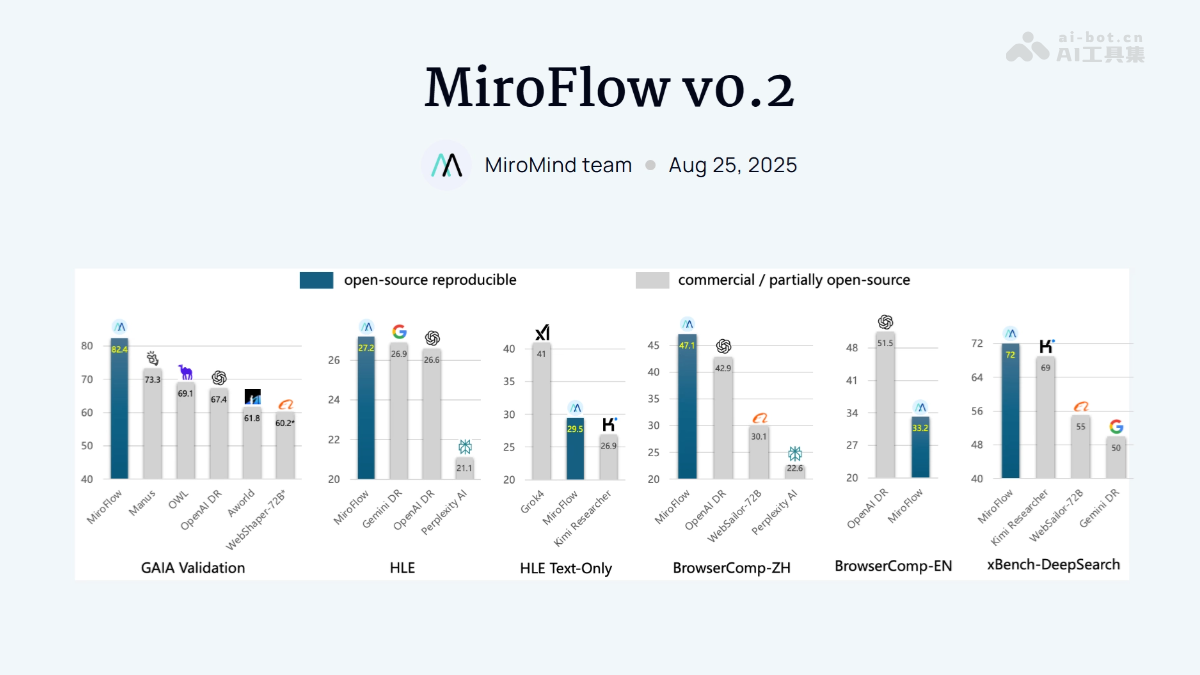
MiroFlow v0.2 isMiroMindan open-source research agent framework that can upgrade any large language model (LLM) to OpenAI deep research-level capabilities, focusing on reliably completing complex tool-use tasks. The framework offers advantages such as open-source reproducibility, high concurrency and high reliability, and low deployment cost, and has achieved top results in multiple benchmarks including GAIA, HLE, xBench-DeepSearch, and BrowserComp. MiroFlow v0.2 is based on a concise Gradio front-end interface and a powerful back-end multi-tool collaboration, efficiently handling user queries through stages such as query enhancement, task planning, sub-agent delegation, tool invocation, and result synthesis, providing strong support for AI research and applications.
Main features of MiroFlow v0.2
-
Task planning and execution: It can automatically plan and execute complex tasks, coordinating multiple tools and sub-agents to complete tasks.
-
Multi-tool collaboration: It supports collaboration among multiple tools (such as web browsers, Python tools, etc.) to complete multi-step web research and resource analysis.
-
High concurrency and high reliability: It has powerful concurrency management and fault-tolerant design, efficiently handling rate-limited APIs and unstable network environments.
-
Cost-effectiveness: It can run on a single RTX 4090 GPU, is based on free and open-source tools, and is easy to deploy and extend.
-
Open-source and reproducible: All performance metrics can be reproduced through publicly available code, ensuring the transparency and verifiability of the research.
Technical principles of MiroFlow v0.2
-
Query enhancement: It uses a large language model to analyze user input, clarify intent, and enrich query details, making it easier to understand requirements more precisely.
-
Task planning: The main agent formulates a detailed execution plan based on the enhanced query content and coordinates the entire workflow.
-
Sub-agent delegation: For complex or specialized tasks, the main agent delegates part of the work to sub-agents with relevant expertise, and the sub-agents can autonomously plan and execute tasks.
-
Tool invocation: Agents connect to MCP (Model Context Protocol) servers to obtain and use the required external tools.
-
Result synthesis: After the task is completed, the system integrates results from multiple information sources to ensure the output is high quality and meets user needs.
Project addresses of MiroFlow v0.2
- Project official website:https://miromind.ai/blog/miroflow
- HuggingFace model library:https://huggingface.co/collections/miromind-ai/mirothinker-v02-68af084a18035f57b17cd902
Application scenarios of MiroFlow v0.2
- Academic research: It helps researchers quickly collect and analyze large amounts of academic resources, automatically generate literature reviews or research proposals, and greatly improve the efficiency of academic research.
- Market analysis: Through multi-step web research and multi-tool collaboration, it quickly analyzes market trends and competitor information, providing data support for business decisions.
- News reporting: It automatically collects and organizes multifaceted information on news events, helping journalists quickly generate news reporting frameworks and improving the timeliness of news production.
- Educational tutoring: Based on students' questions, it quickly searches for and organizes educational resources, provides detailed answers and learning suggestions, and assists teaching activities.
- Technical development: Assist developers in quickly collecting technical documentation, code examples and other resources, help users better understand and apply new technologies, and improve development efficiency.