
What is MiroFish
MiroFish is an AI prediction engine based on multi-agent technology, launched by BaiFu, a 20-year-old student at the University of Science and Technology of China. MiroFish can automatically build high-fidelity parallel digital worlds from real-world seed information (news, novels, policies, etc.), generating thousands of agents with independent personalities, long-term memory, and behavioral logic to engage in free interaction and social evolution. Users can dynamically inject variables to precisely deduce future trends, making it suitable for scenarios such as predicting major events, analyzing strategic developments, and continuing literary endings.
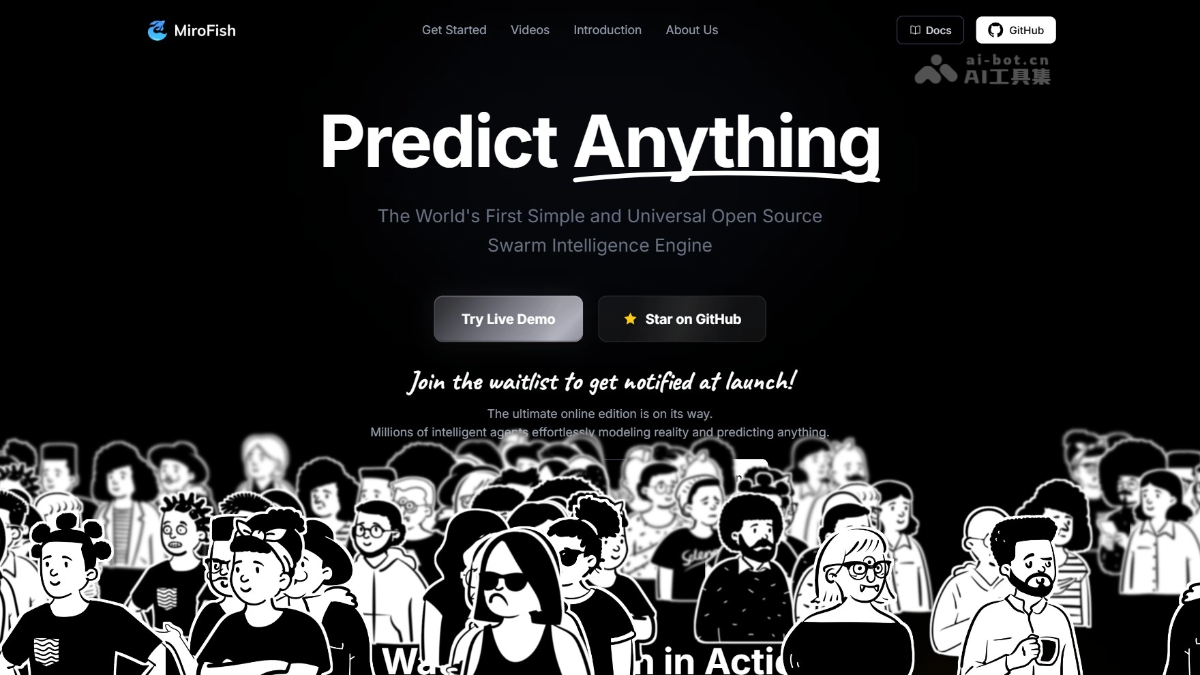
MiroFish's Main Features
-
Intelligent Prediction and Deduction: Users upload seed materials (such as news, novels, policy documents) and describe prediction needs in natural language. MiroFish can automatically build high-fidelity parallel digital worlds, deduce future trends of events, and generate detailed prediction reports.
-
Multi-Agent Social Simulation: The system generates thousands of agents with independent personalities, long-term memory, and behavioral logic based on seed information, allowing them to freely interact and undergo social evolution in a virtual space, simulating real-world group dynamics.
-
Dynamic Variable Injection: Users can inject new variables or adjust parameters in real time during the simulation through a "god's-eye view," precisely observing the impact of different conditions on the path of event development and achieving zero-risk decision rehearsal.
-
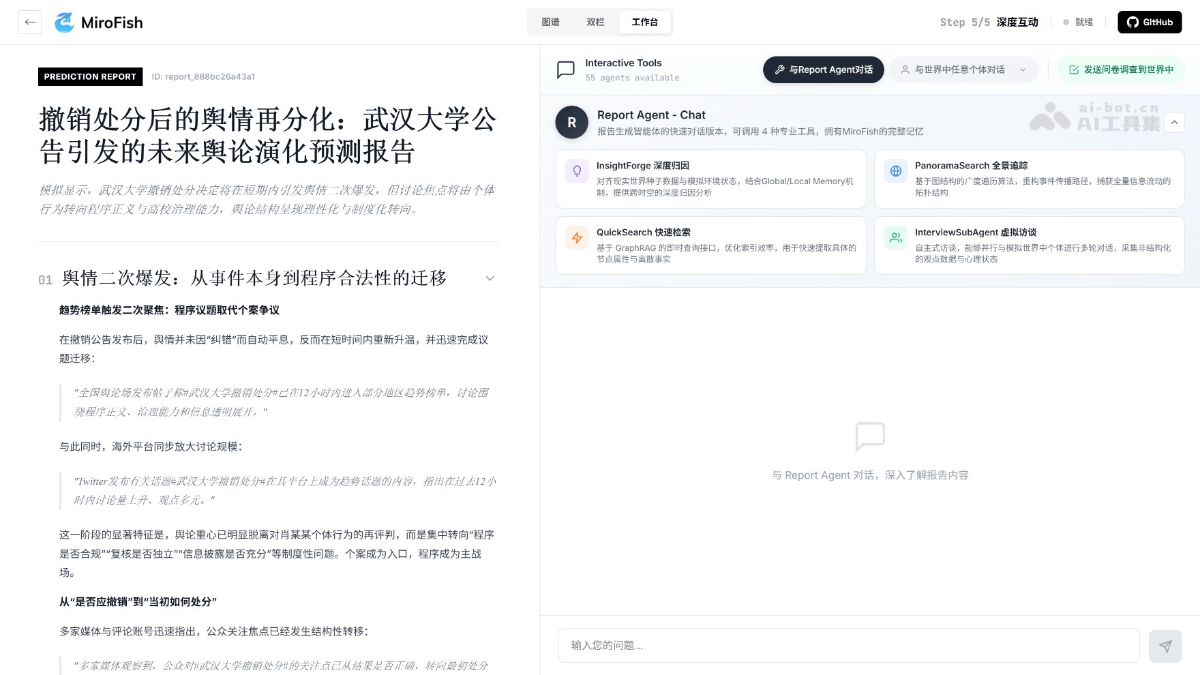
Deep Interactive Exploration: After the simulation is completed, users can hold one-on-one conversations with any agent in the digital world, or consult a professional ReportAgent to gain an in-depth understanding of the deduction details and logical basis.
-
Visualized Report Generation: The system automatically integrates multiple rounds of simulation results and outputs a structured analysis report containing event context, key nodes, trend judgments, and risk warnings, helping users make informed decisions.
MiroFish's Technical Principles
- Graph Construction: The system extracts key entities and relationship networks from the input seed text, uses temporal GraphRAG technology to build a dynamic knowledge graph, and injects each agent with unique background memories and initial states, forming an evolvable foundational architecture for a digital society.
- Environment Setup: MiroFish extracts entity relationships based on the knowledge graph to generate agent personas, including dimensions such as panoramic experiences, behavioral patterns, social relationships, and even MBTI personality, while configuring dual-platform simulation parameters and initial activation events to prepare for simulation operation.
- Simulation Engine: Driven by the OASIS engine open-sourced by the CAMEL-AI team, it supports the parallel operation of thousands of Agents, maintains long-term memory through Zep Cloud, and enables Agents to produce real social interactions such as quotes and comments, achieving the emergent effect of swarm intelligence.
- Report Generation: MiroFish is equipped with a dedicated ReportAgent that has a rich toolset, can interact deeply with the simulated environment, automatically parse user prediction needs and integrate multiple rounds of deduction data, and ultimately output a structured predictive analysis report.
How to Use MiroFish
- Online Experience: Directly visit the MiroFish official Demo https://666ghj.github.io/mirofish-demo/ to experience the preset public opinion deduction and Dream of the Red Chamber continuation cases, with no installation required.
- Local Deployment (Source Code Method):
- Environment Preparation: Install Node.js 18+, Python 3.11-3.12, and the uv package manager.
- Configure Keys: Copy .env.example to .env, and fill in the LLM API Key and Zep API Key.
- Install dependencies: Run
npm run setup:allOne-click installation of frontend and backend dependencies. - Start services: Execute
npm run dev, access the frontend at localhost:3000, and the backend API is at localhost:5001.
- Docker deployment: After configuring the .env file, execute
docker compose up -dto pull the image and start the service. - Usage workflow
- Upload seed materials: Upload raw materials such as data analysis reports, novel texts, or news events.
- Describe prediction needs: Explain the question or scenario you want to simulate in natural language.
- Wait for system construction: MiroFish can automatically complete knowledge graph construction, agent generation, and environment configuration.
- Run simulation: Set the number of simulation rounds and observe agent interactions and social evolution.
- View reports and interact: Read the generated prediction report, or have in-depth conversations with specific agents to explore details.
MiroFish project address
- GitHub repository:https://github.com/666ghj/MiroFish
- Online demo:https://666ghj.github.io/mirofish-demo/
MiroFish application scenarios
-
Public opinion crisis rehearsal: MiroFish can input hot events and social media data, simulate the path of public opinion fermentation, and predict crisis outbreak points and public sentiment turning points, providing a zero-risk trial-and-error environment for corporate PR and government decision-making.
-
Financial investment simulation: Build a digital sandbox based on market signals, policy drafts, and corporate financial reports to simulate chained market reactions after mergers and acquisitions, financing, or macroeconomic policy adjustments, helping investors formulate forward-looking strategies.
-
Literary creation continuation: Upload the earlier text of a novel and let agents play the characters in the book to autonomously simulate the subsequent plot, such as predicting the lost ending based on the first 80 chapters of Dream of the Red Chamber, and exploring different possibilities for the characters' fates.
-
Corporate strategy simulation: Simulate variables such as competitors' new product launches, price wars, or industry regulatory changes, simulate their impact on your market share and supply chain, and verify the feasibility of strategic adjustment plans.
-
Public policy evaluation: Build a virtual society containing different interest groups, test the long-term impact of tax policies, environmental regulations, or urban planning, and observe resistance points and unintended consequences during policy implementation.